
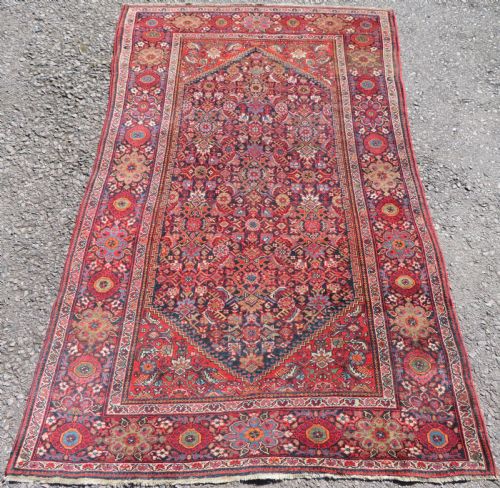


Antique Herati Carpet
An antique herati carpet brings Persian artistry into a room through repeated geometric floral motifs woven over centuries.
Antique Herati Carpet
When you search for an antique herati carpet, you encounter woven floor coverings originating from various Persian regions, including Farahan, Malayer, Bidjar, Senneh, and Tabriz. The selections span the nineteenth and early twentieth centuries, encompassing formats from small area rugs to long gallery carpets and kellehs.
You are most likely to meet traditional village and tribal pieces featuring all-over repetitive patterns. These works include rugs attributed to Kurdish weavers, Afshar tribes, and Qashqai makers, alongside city-woven examples from western Persia.
The characteristic pattern across these textiles involves a floral head enclosed by a split leaf, often accompanied by small rosettes and a diamond lattice framework. Regional variations alter the scale and framing of this motif, yet the core design remains constant.
Materials and construction methods
The listings record wool as the primary pile material, utilised for its resilience and capacity to hold rich dye colours over decades of use. Cotton foundation threads provide structural stability for the warp and weft, supporting dense pile knots in city-woven and village pieces alike.
Weavers tied symmetrical and asymmetrical knots by hand onto vertical looms, varying the density according to the regional workshop or tribal tradition. Natural dye sources supplied the underlying palette of deep blues, reds, and occasional lemon ground colours seen in Kurdish and Persian examples.
Evaluating craftsmanship and condition
Quality in these carpets rests upon the precision of the weave and the handling of the repetitive herati design across the field. Tightly packed knots and clear delineation of the floral lattice distinguish superior village and city work from simpler commercial output.
The integrity of the wool pile, evenness of wear, and survival of the original outer borders dictate the visual impact of each piece. Superior examples maintain crisp colour contrasts and structural soundness across the cotton foundation.
The Antique Herati Carpet Glossary
- Herati design
- A repeating pattern composed of a central rosette enclosed by a diamond lattice and flanked by curved leaves. It is sometimes known as the fish pattern.
- Kelleh
- A long, rectangular format of Persian carpet, typically narrower than a standard room-size carpet but broader than a runner. These rugs fit narrow hallways or large gallery spaces.
- Kilim
- A flat-woven carpet produced without a pile by tightly interweaving warp and weft strands. These pieces offer a lighter weight than knotted pile rugs.
- Warp
- The vertical foundation threads stretched lengthwise on the loom before knotting begins. Cotton supplies the standard base for these antique pieces.
- Weft
- The horizontal threads passed across the warp strands after each row of knots is secured. They hold the structure firm.
Antique Herati Carpet: Frequently Asked Questions
How do I style an antique carpet?
These carpets suit traditional and modern interiors alike, anchoring sitting rooms, studies, and hallways with rich colour and texture. Placing them over wooden flooring highlights their intricate border work and field patterns.
Choose a room size or runner format that allows the main field design to remain visible rather than hidden beneath heavy furniture. Proper underlay protects the cotton foundation and prevents slipping.
How are different regions told apart?
Regional attribution relies on knot density, colour choices, and structural variations in the wool and cotton. For instance, Bidjar rugs often display heavy construction and bold handling, while Senneh pieces show finer, lighter weaves.
Tribal examples like Afshar and Qashqai incorporate distinctive medallion arrangements alongside the repeat herati motif. Examining the border styles and secondary colours clarifies the origin.
Are these rugs durable for daily use?
Hand-spun wool pile on a sturdy cotton foundation provides natural resilience against foot traffic. Regular care helps these antique floor coverings endure in domestic settings.
Gentle vacuuming without a rotating brush roll preserves the wool fibres. Professional cleaning maintains the original dye saturation and structural integrity.