

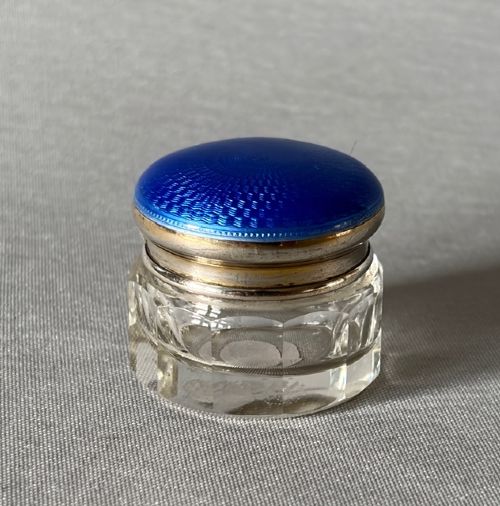




Antique Guilloche Jar
An antique guilloche jar brings precision enamelwork and heavy cut glass together on the dressing table, offering a glimpse of early twentieth-century elegance.
Antique Guilloche Jar
The antique guilloche jar combines a glass or cut glass body with a mechanically patterned enamel lid, designed to hold cosmetics or scents on a dressing table. Most examples belong to the Art Deco period, alongside Edwardian and George V pieces, reflecting the tastes of the early decades of the twentieth century.
These items take various forms, including vanity jars, dressing table jars, lidded bowls, perfume bottles, and scent bottles. They serve both a decorative and a practical function in domestic settings.
Collectors encounter pieces originating from English assay offices, showcasing the craftsmanship of silversmiths working in major centres like London and Birmingham.
Materials and construction
Silversmiths utilised sterling silver alongside clear cut glass and etched glass for the main bodies and fitted rims of the containers. The metal components bear hallmarks indicating the year of manufacture and the assay town.
Lids feature enamel or guilloche enamel applied over engine-turned metal bases, creating translucent coloured patterns that catch the light. Artisans cut geometric designs into the metal beneath the enamel to produce the characteristic radiating waves and lines.
Antique Guilloche Jar Retail Price Guide 2026
Typical asking prices for guilloche jar among the pieces listed under this phrase on Sellingantiques today, from the lower quarter to the upper quarter. They describe what is for sale here now, not the wider market.
Some dressing table jars arrived in pairs, surviving decades together on the same mirrored vanity tray without getting separated.
Judgements of quality
The sophistication of the engine-turned pattern beneath the enamel determines much of the visual depth and complexity of the lid. Crisper, finer mechanical engraving yields a more luminous finish through the coloured enamel layers.
The weight and clarity of the cut glass or etched glass body balance the substantial feel of the silver and enamel top. Matching pairs and pieces carrying identifiable silversmith marks command greater attention from collectors.
Henry Clifford Davis·Henry Perkins·Goldsmith's and Silversmith's Co.
The Antique Guilloche Jar Glossary
- Guilloche enamel
- A decorative technique where an intricate geometric pattern is mechanically engraved into metal before translucent enamel is applied over the top. This method allows the underlying design to show through the coloured glass layer.
- Sterling silver
- An alloy containing a high proportion of pure silver, used for the rims, collars, and lids of the jars. It provides durability and a bright finish.
- Cut glass
- Glass decorated by grinding and polishing facets or patterns into the surface. It adds weight and sparkle to the vessel.
- Assay mark
- A stamp indicating the purity of the precious metal and the office where it was tested. These marks help date the piece accurately.
- Dressing table jar
- A small container intended for holding powders, creams, or pins on a vanity or dressing table. These pieces often feature decorative tops designed to be displayed upright.
Antique Guilloche Jar: Frequently Asked Questions
What is an antique guilloche jar?
An antique guilloche jar is a vanity container featuring a glass body and a metal lid decorated with engraved enamel work. These items date primarily from the early twentieth century.
They were designed to hold powders, cosmetics, or perfumes on a dressing table.
How do I date these jars?
Dating relies on the silver hallmarks stamped on the metal mounts, which reveal the assay office and year of production. Stylistic elements such as Art Deco geometric forms also help narrow down the decade.
The inclusion of specific monarchical periods like George V provides further chronological context.
How were they used originally?
These jars sat on dressing tables as part of matching vanity sets used during daily grooming routines. They held perfumes, scented waters, or various cosmetic powders.
The airtight nature of the fitted silver lids kept contents fresh.
How do I care for my jar?
Care involves gentle cleaning of the silver and glass using appropriate non-abrasive cloths to preserve the polished surfaces. Enamel requires particular caution to avoid harsh chemical exposure.
Storing them away from direct sunlight protects the vibrant colours of the enamel.