

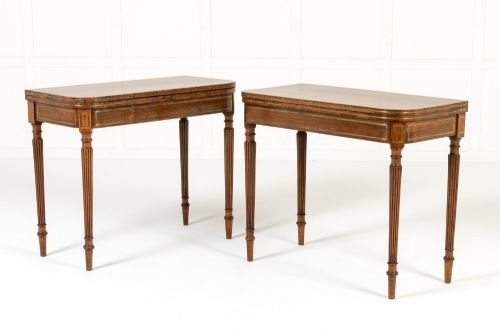
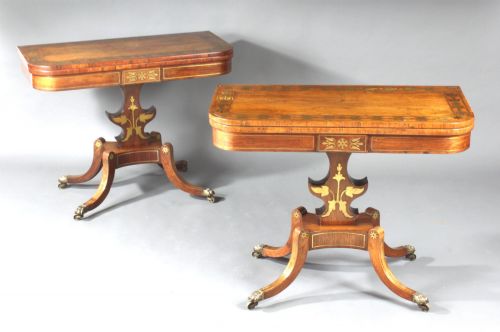
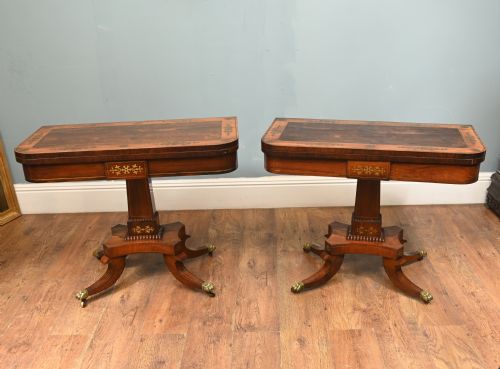
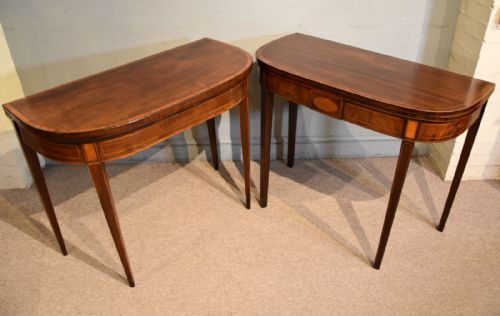

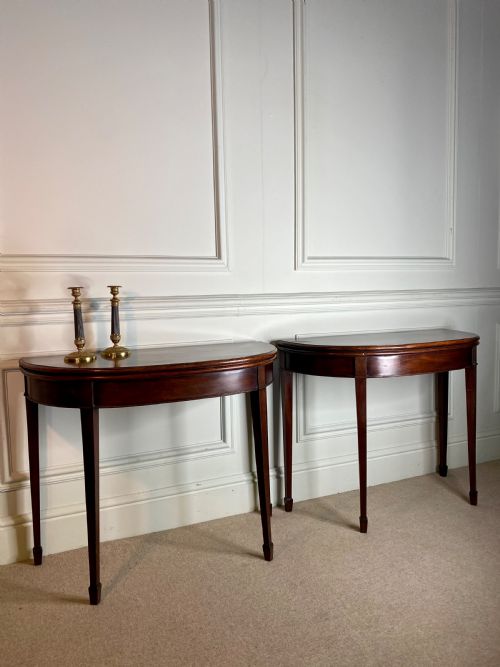


Antique Gaming Table Pair
An antique gaming table pair brings balanced symmetry to a drawing room, offering dual-surface design for cards and conversation.
Antique Gaming Table Pair
When searching for an antique gaming table pair, collectors encounter matched sets primarily formed of foldover card and tea tables spanning the eighteenth and nineteenth centuries. These pieces typically display hinged tops that rotate and open to reveal baize-lined playing surfaces, often doubling as console or side tables when closed. Regency and George III examples dominate the selection, frequently constructed in figured rosewood and rich mahogany.
Beyond traditional card tables, the selection incorporates occasional variations including tea and games combinations, demi-lune shapes, and occasional console adaptations. French Boulle work and inlaid satinwood appear alongside sturdy Victorian burr walnut and William IV designs. Finding a true matching pair from these earlier eras remains a notable discovery for period interiors.
Materials and construction methods
Cabinetmakers utilised dense hardwoods like mahogany and exotic veneers such as rosewood, satinwood, and amboyna over robust oak or pine carcases. The timber was carefully selected for figure and grain, often enhanced by contrasting stringing and geometric brass inlay.
Foldover mechanisms relied on precision knuckle joints, swing legs, or pivoting pivot tops to support the heavy opening leaf. Marquetry, boulle work involving tortoiseshell and brass, and hand-cut brass stringing required high levels of joinery expertise.
Some nineteenth-century makers concealed cunning swing-out candle trays on the corners so card players could see their hands after dusk.
Judging standard and execution
Quality rests in the matching of veneer grains across the foldover top when closed and the crispness of the brass inlay or boxwood stringing. Superior examples maintain stability in the pivoting mechanism and alignment of the concertina or swing leg frame without timber warp.
Finer pieces exhibit disciplined proportions, original interior baize or leather surfaces, and secondary timbers of consistent age. The depth of hand-finishing on the French polish and the integration of decorative elements like porcelain plaques determine the tier of the piece.
George Oakley
The Antique Gaming Table Pair Glossary
- Card table
- A small specialised table with a folding top designed for playing card games. These typically feature a baize-lined interior and a compartment for counters or cards beneath the surface.
- Demi-lune
- A half-moon shape popular in eighteenth-century furniture design. Such tables fit flush against a wall when closed and open into a full circle.
- Boulle
- A style of marquetry utilising brass and tortoiseshell inlaid into dark woods. Developed in seventeenth-century France, it reappeared on nineteenth-century show pieces.
- Concertina action
- An expanding table frame that opens like an accordion to support a folded top. This construction allows all four legs to move outward evenly.
- Stringing
- Thin lines of contrasting wood or light material inlaid into channels on a furniture surface. It defines borders and highlights geometric panel designs.
Antique Gaming Table Pair: Frequently Asked Questions
How were antique gaming tables used?
These tables served primarily for evening entertainment, hosting card games such as whist, quadrille, or chess when opened in the parlour. Between gatherings, the folded tops sat against the wall as decorative console or tea tables.
The dual functionality made them essential items for Georgian and Regency drawing rooms where space and versatility mattered. Owners stored decks, counters, and markers within the concealed spaces beneath the folding leaves.
How can I tell a Regency table from a Victorian one?
Regency tables tend to feature classical architectural lines, brass inlay, rosewood veneers, and sabre legs sometimes ending in brass paw castors. The aesthetic leans toward restrained elegance inspired by ancient Roman and Greek forms.
Victorian pieces generally appear heavier, utilising burr walnut or robust mahogany with more exuberant carving and bulbous turned pedestals. Proportions become thicker, reflecting nineteenth-century domestic tastes for substantial furniture.
Why are true pairs difficult to find?
Most gaming tables were made as single pieces or occasionally commissioned as matching pairs for symmetrical placement in large saloons. Over centuries, pairs frequently became separated through inheritance, house moves, or antique trade dispersal.
Finding two tables with identical timber grain, dimensions, and wear patterns indicates they survived together from the original commission.