


Antique Foliage Tapestry
These antique foliage tapestry pieces bring deep botanical texture to walls and chairs through centuries of Flemish and French craftsmanship.
Antique Foliage Tapestry
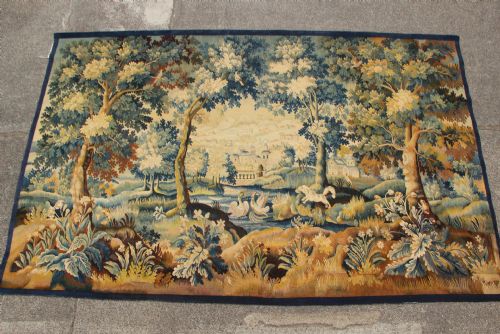
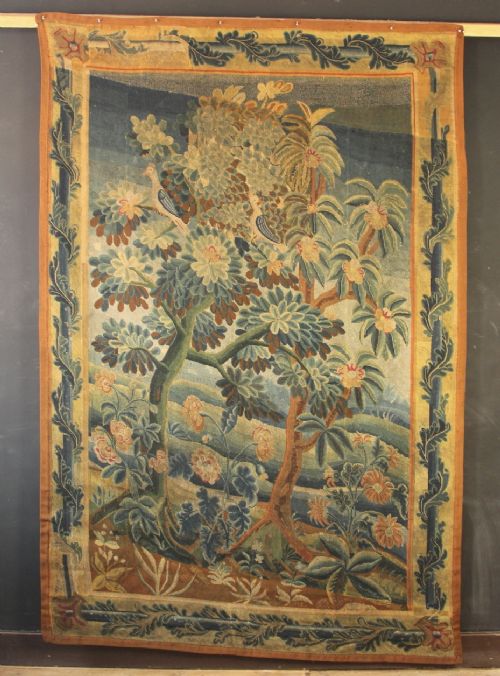
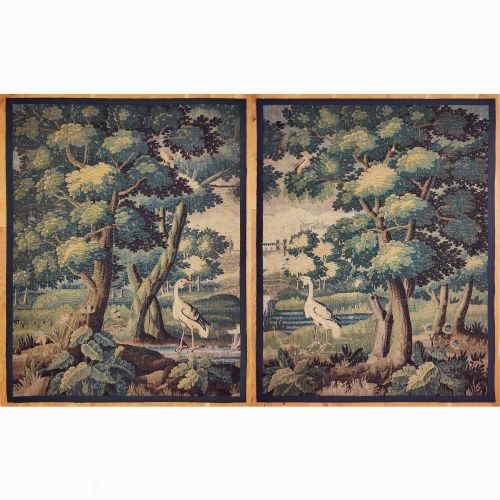
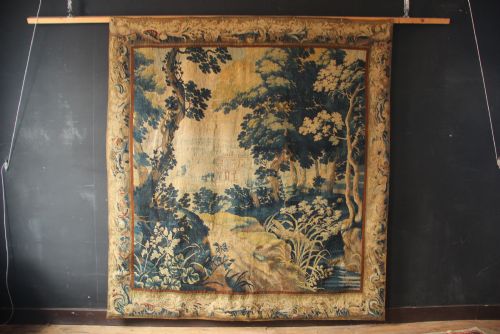
An antique foliage tapestry transports historic woodland scenes directly into a room, depicting dense leaves, trees, and distant landscapes in woven textile form. The examples found here span the seventeenth, eighteenth, and late nineteenth centuries, originating primarily from Flemish and French workshops including Aubusson and Audenarde. Most pieces take the form of large wall hangings known as verdure tapestries, alongside occasional needlepoint upholstery mounted on padouk wood chairs.
Buyers encounter substantial wall panels designed to dominate a room, as well as narrower vertical strips and pairs of matching panels. The seventeenth and eighteenth-century Flemish works focus heavily on lush, overgrown foliage using rich earthy tones. Later nineteenth-century French pieces from Aubusson continue this verdures tradition with lighter palettes and refined botanical detailing.
While the vast majority of pieces serve as decorative wall tapestries, the inclusion of needlework upholstery demonstrates how textile artists applied botanical motifs to functional seating. This variety allows collectors to choose between room-scale landscape panels and smaller seating accents sharing the same core foliage theme.
Materials and construction
Weavers constructed these textiles primarily using wool, silk, and linen fibres to build up the dense botanical imagery. Wool provided the durable structural base and heavy foliage textures, while finer silk threads added highlights to leaves and distant skies. Linen often served as a robust warp or backing material to support the heavy woven composition over centuries of hanging.
Needlepoint upholstery utilised similar wool and silk threads stitched onto canvas grounds to cover wooden furniture frames. Padouk wood provided a dense, dark tropical timber for chairs upholstered in these botanical needlework panels, contrasting with the woven wall hangings. Artisans dyed yarns with natural pigments derived from plants and insects, creating the muted greens, browns, and ochres characteristic of aged textiles.
Several centuries of European forest floor vegetation survive entirely intact, rendered in wool and silk without a single real leaf remaining.
Assessing quality and execution
The distinction between standard and exceptional pieces rests upon the complexity of the botanical drawing and the variety of dyed yarns utilised. Master weavers achieved remarkable depth by blending numerous subtle shades of green and brown to render multi-layered woodland foliage. Simpler panels rely on repetitive leaf patterns with minimal tonal gradation, whereas superior examples create convincing illusions of three-dimensional forests.
Survival of original materials and structural integrity heavily influence the standing of any given piece. Wall hangings that retain their original dimensions and unclipped borders demonstrate better preservation than heavily trimmed examples. The careful integration of silk threads for reflective highlights marks the distinction between ordinary workshop production and high-status weaving.
The Antique Foliage Tapestry Glossary
- Verdure tapestry
- A textile featuring landscape scenes dominated by trees, plants, and foliage rather than human figures. These pieces were immensely popular in European country houses for bringing the outdoors inside.
- Aubusson
- A town in central France famous for its carpet and tapestry weaving industry. Pieces from this centre often display lighter, more pastoral botanical compositions.
- Flemish Baroque
- An artistic style originating in Flanders during the seventeenth century characterised by lush, dramatic natural forms. Tapestries from this tradition emphasise heavy, shadowy woodlands.
- Needlepoint upholstery
- Canvaswork embroidery applied to furniture seats and backs using wool or silk yarn. This technique allowed chairs to match the rich botanical themes of wall hangings.
- Padouk wood
- A heavy, durable exotic timber utilised for furniture frames like carved chairs. Its deep reddish-brown tone complements dark botanical textiles.
Antique Foliage Tapestry: Frequently Asked Questions
How do I hang a large tapestry?
Heavy textile panels require even weight distribution across the top edge rather than single point suspension. Stitching a strong linen sleeve to the reverse allows a concealed wooden batten or metal rod to slide through for wall mounting.
Alternatively, some conservators recommend attaching Velcro strips where the soft side is hand-sewn to the back of the textile and the hook side is secured to a mounted wooden board.
Where were these tapestries made?
The pieces originate primarily from traditional weaving centres in Flanders and France. Seventeenth-century production centres around Flemish looms in regions such as Audenarde, while later works frequently hail from Aubusson.
French and Flemish workshops dominated European textile output during these periods, exporting verdure designs to aristocratic homes across the continent.
What is the difference between weaving and needlepoint?
Woven tapestries are created on a loom by interlacing horizontal woof threads through vertical warp threads to build the image simultaneously. This process requires specialised upright or horizontal frames and multiple artisans.
Needlepoint is an embroidery technique where yarn is stitched by hand through an already woven canvas mesh grid. Both methods produced rich foliage designs but involved entirely different artisan processes.
How should I clean an antique textile?
Antique tapestries and needlework require extremely gentle maintenance limited to very careful surface vacuuming through a protective mesh screen. Professional textile conservators should handle any major cleaning or structural stabilization.
Water washing or standard dry cleaning can permanently damage aged wool, silk, and linen fibres as well as historic natural dyes.