


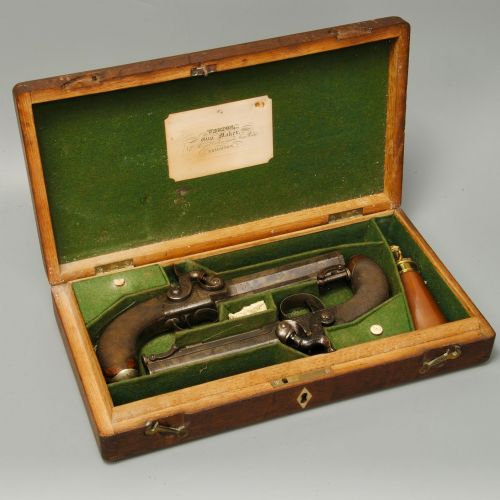


Antique Firearm Pair
An antique firearm pair brings matched engineering and period craftsmanship together, offering the collector a complete set of historical sidearms.
Antique Firearm Pair
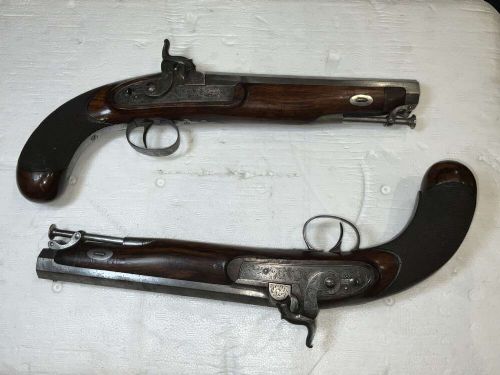
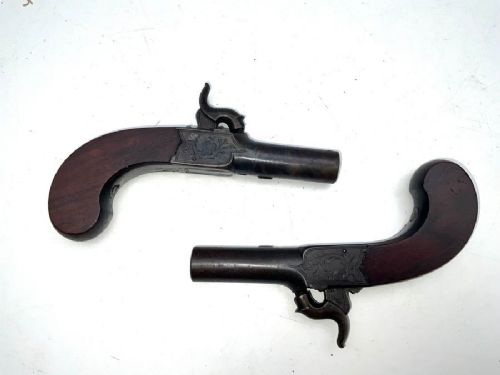
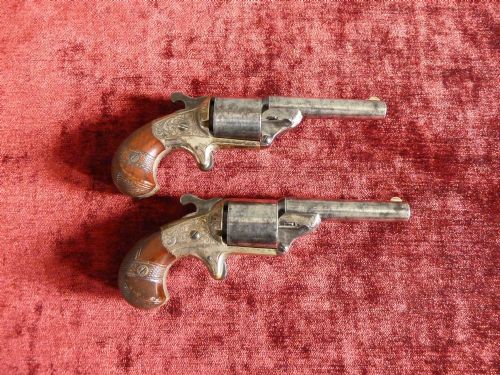
An antique firearm pair consists of two matching pistols designed and manufactured together, most frequently encountered from the eighteenth and nineteenth centuries. These matched sets span flintlock duelling pistols, boxlock pocket pistols, and percussion revolvers originating from English, Scottish, and American makers.
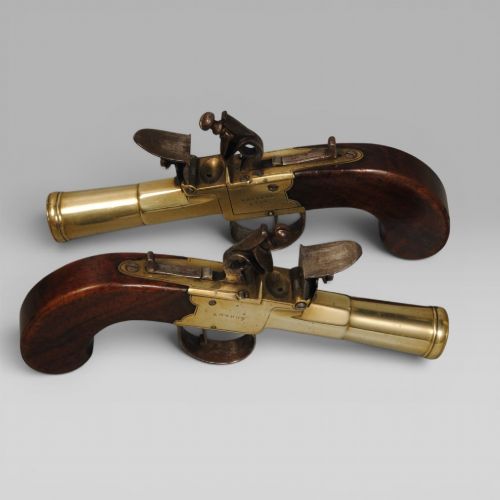
Buyers searching for an antique firearm pair frequently encounter Georgian, Regency, and Victorian iterations, including specialised variants like boxlock blunderbuss pistols with flick bayonets. Many of these matching sets survive within their original fitted cases lined with baize or velvet.
The objects serve as tangible records of historical armaments, reflecting the technological shifts from flintlock ignition systems to percussion mechanisms over successive eras.
Materials and construction methods
Makers constructed these sidearms using robust metals such as steel, iron, and brass for the barrels and lock mechanisms, paired with stocks shaped from dense timbers like walnut and mahogany. Silver mounts frequently appear on higher-status pieces.
Internal components required precise blacksmithing and gunsmithing techniques to ensure the matching actions operated in tandem, while wooden stocks were hand-carved and checked to fit the hand securely.
Antique Firearm Pair Retail Price Guide 2026
Typical asking prices for firearm pair among the pieces listed under this phrase on Sellingantiques today, from the lower quarter to the upper quarter. They describe what is for sale here now, not the wider market.
Listings for this phrase feature nineteenth-century and Georgian pieces utilising steel, iron, brass, walnut, and mahogany.
Factors of quality in matched sidearms
Quality in an antique firearm pair rests upon the symmetry of the set, the crispness of the engraved metalwork on the locks, and the precision with which the mechanical actions synchronize. Maker signatures from reputable gunsmiths elevate the standing of a matched pair significantly.
The integrity of the original wooden stocks, the presence of matching serial numbers or proof marks, and the survival of a fitted wooden case with its original interior lining distinguish superior examples from standard utility arms.
H.W. Mortimer & Son·John Rimes·Meyer & Mortimer
The Antique Firearm Pair Glossary
- Flintlock
- An ignition mechanism that uses a piece of flint striking a steel frizzen to create sparks that ignite the gunpowder charge. This system predates percussion caps.
- Percussion
- A later ignition system utilising a hammer striking a small priming cap containing fulminate of mercury. It replaced the flintlock mechanism during the nineteenth century.
- Boxlock
- A pistol design where the breech and action are forged as a single piece with the lock mechanism enclosed inside the frame. This layout provides a streamlined profile.
- Duelling pistol
- A precision-made sidearm engineered for accuracy and balance, typically produced in matched pairs for formal resolution of disputes.
- Turn-off barrel
- A barrel design that unscrews from the frame to allow loading from the breech end rather than the muzzle. This feature appears on pocket pistols.
Antique Firearm Pair: Frequently Asked Questions
What defines an antique firearm pair?
An antique firearm pair consists of two matched pistols manufactured by the same gunsmith to identical specifications, often sharing consecutive serial numbers or corresponding proof marks.
These sets were originally sold together for personal protection or duelling, housed within a single fitted wooden presentation case.
How do flintlock and percussion pistols differ?
Flintlock pistols rely on a piece of flint striking steel to generate a spark that ignites the gunpowder charge in the pan. This system was dominant through the eighteenth century.
Percussion pistols utilise a hammer that strikes a small detonating cap placed on a nipple, offering faster ignition times and greater reliability in damp weather.
Why were these pistols sold in pairs?
Pairs of pistols were standard for military officers, travellers, and gentlemen engaging in formal duels, providing a secondary weapon if the first misfired or required reloading.
Matched sets also demonstrated the wealth and social standing of the owner, as custom-ordered pairs represented a significant financial investment.
What is a pocket pistol?
A pocket pistol is a short-barrelled firearm designed for discreet personal concealment in a coat pocket or muff during the Georgian and Victorian eras.
Despite their compact size, many featured turn-off barrels or boxlock actions to maximise stopping power at close range.