
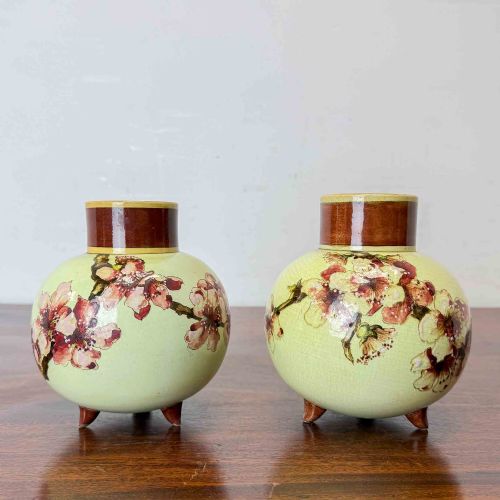


Antique Faience Vases Pair
These antique faience vases pair selections bring tin-glazed earthenware and ceramic forms spanning the nineteenth and early twentieth centuries straight to your table.
Antique Faience Vases Pair
When you search for an antique faience vases pair, you encounter matched sets of tin-glazed earthenware and ceramic vessels spanning the nineteenth and early twentieth centuries. These pieces encompass decorative vases, decorative urns, ceramic urns, and wall pockets.
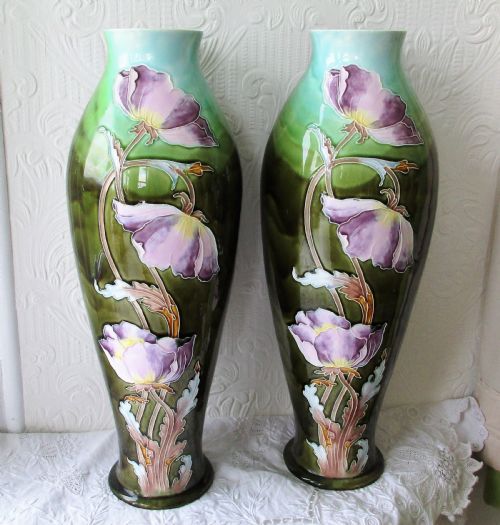
The selection on this page leans heavily toward French production, including French Rococo Revival, Art Nouveau, French Rococo, Aesthetic Movement, Victorian and Gothic, and French Orientalist styles. You will also find English contributions from Doulton Lambeth and Burmantofts.
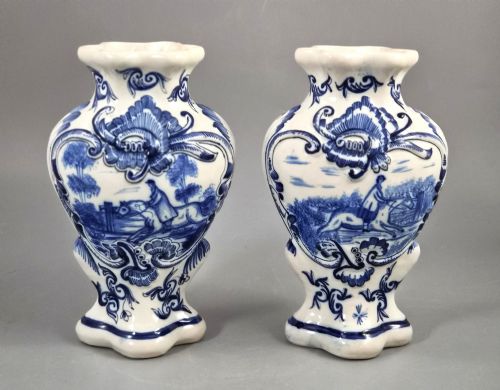
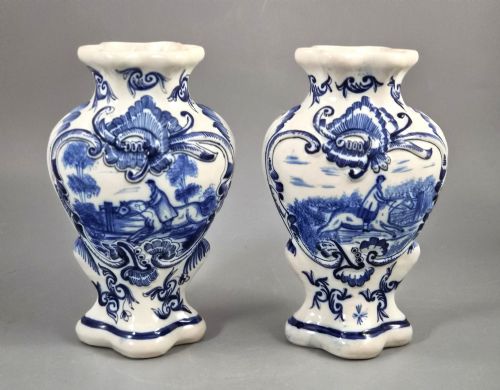
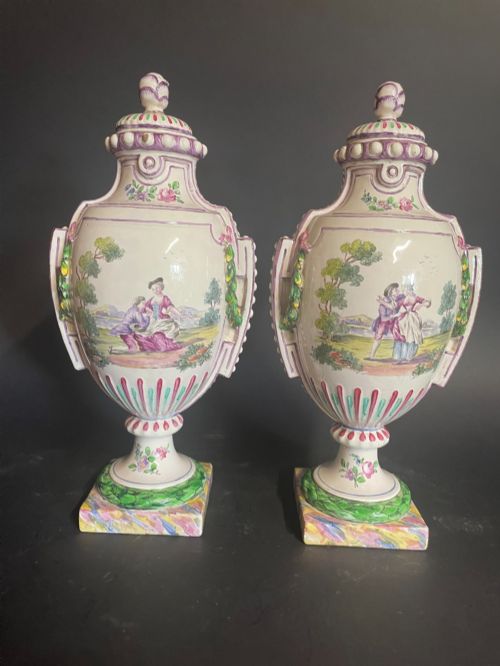
Forms range from lidded urns and bottle vases to posy vessels and wall pockets decorated with blue and white palettes, polychrome designs, parrot lids, and cherry blossom motifs. Most examples date from the 1850s through to the 1920s.
Materials and construction
Potters shaped these objects from clay and earthenware bodies before applying a tin-glaze or enamel surface. This opaque white or tinted glaze provided a smooth ground for hand-painted cobalt blue and polychrome pigments.
Kiln firing fixed the metallic oxides and tin-glazes to the ceramic body, yielding the distinctive glossy sheen seen across nineteenth-century European potteries. Certain makers integrated detailed relief work, moulded textures, and specialised glazing techniques.
Among the formal urns and bottle vases, a pair of pottery cat wall pockets waits to watch over the room.
Assessing quality in tin-glazed pairs
Quality rests in the precision of the hand-painted decoration, the crispness of the moulded details, and the uniformity of the tin-glaze. Superior examples display controlled brushwork, vibrant polychrome or blue and white pigments, and well-preserved surface enamels.
The degree of symmetry within the pair and the complexity of the ceramic form, such as lidded urns or intricate bottle shapes, influence the standing of the pieces. Maker attribution also plays a role, with established potteries demonstrating finer technical execution.
Fourmaintraux-Courquin·Sceaux·Doulton Lambeth·Burmantofts·Jules Vieillard
The Antique Faience Vases Pair Glossary
- Faience
- Tin-glazed earthenware produced in Europe, particularly associated with French and English traditions. The porous clay body is coated with an opaque white glaze that accepts painted decoration.
- Tin-Glaze
- A ceramic glaze made opaque by the addition of tin oxide. It creates a white surface that takes pigments directly before the final firing.
- Polychrome
- Decoration employing several colours rather than a single hue. In these ceramics, it describes multi-coloured painted motifs such as flowers and parrots.
- Posy Vase
- A small vessel designed to hold a short bunch of cut flowers. These diminutive pieces often appear in pairs from the early nineteenth century.
- Wall Pocket
- A flat-backed ceramic container meant to be hung on a wall for holding floral arrangements. Examples in this category include figural pottery designs.
Antique Faience Vases Pair: Frequently Asked Questions
What is faience pottery?
Faience is a form of tin-glazed earthenware developed across European potteries. Artisans coated a fired clay body with an opaque glaze to create a smooth surface for painting.
This technique allowed makers to produce intricate blue and white patterns as well as vibrant polychrome designs on decorative vessels.
Where were these pairs made?
The pieces originate primarily from French workshops and potteries, alongside notable English manufacturers. Regional centres developed distinct decorative vocabularies ranging from Rococo Revival to Art Nouveau.
Familiarity with specific factory styles helps distinguish French provincial production from large-scale English studio ceramics.
How do I care for antique ceramic pairs?
Keep these earthenware vessels away from direct sunlight and moisture to protect the tin-glaze and painted surfaces. Dust them gently with a dry, soft cloth rather than using liquid cleaners.
Display them on stable surfaces where they will not be knocked, as matched pairs rely on keeping both items intact.
How are different periods told apart?
Nineteenth-century pieces often reflect historical revival styles such as French Rococo or Gothic, utilising detailed hand-painted scenes and moulded forms. Early examples lean toward traditional blue and white palettes.
By the late nineteenth and early twentieth centuries, influences shifted toward Art Nouveau and Aesthetic Movement motifs, incorporating organic lines and stylized cherry blossom designs.