
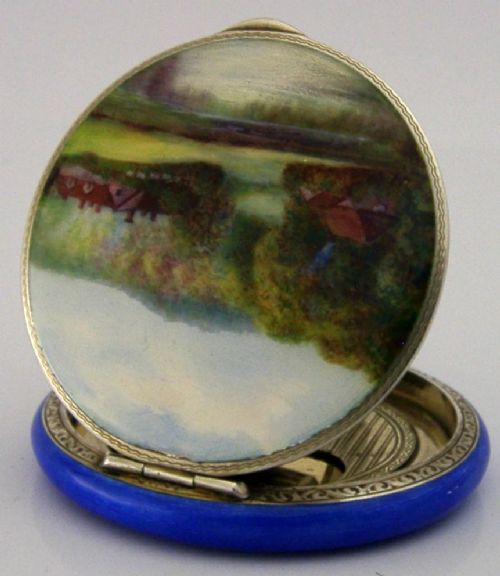


Antique Enamel Makeup Case
An antique enamel makeup case offers a pocket-sized slice of twentieth-century glamour, combining brightly coloured vitreous surfaces with clever folding mirrors and powder compartments.
Antique Enamel Makeup Case
An antique enamel makeup case is primarily found as a powder compact designed for a lady's handbag during the early and mid-twentieth century. These items were essential accessories for personal grooming at social events, combining storage for loose or pressed powder with a small fitted mirror.
The versions most commonly met here belong to the Art Deco era, particularly the 1930s, alongside pieces from the 1920s and the mid-century period. They frequently arrive in circular or rectangular formats, often housing internal mesh screens, suede linings, or combination compartments for cosmetics.
Makers such as Richard Hudnut and Giuliano Spinelli shaped this market, alongside larger production houses utilising chrome, brass, and silver foundations. The resulting objects range from simple geometric designs to hand-painted figurative scenes beneath a glossy vitreous layer.
Materials and Construction
These cases rely heavily on metal foundations such as chrome, brass, gilt metal, and sterling silver to provide a sturdy structure for daily use. Enamel was then applied to the exterior surfaces, fused to the metal through high-temperature firing to create smooth, durable panels of colour.
Interior fittings involved delicate engineering, including spring-loaded clasps, hinged lids, and woven mesh trays designed to hold cosmetic powder securely. Additional luxury touches included suede linings and fitted mirrors held within the upper lid.
Listings feature items spanning the 1920s, 1930s, and 1950s, highlighting a strong representation of Art Deco design alongside mid-century Italian craftsmanship.
Distinctions in Quality
Quality in these items often rests on the complexity of the enamel work and the choice of base metal, with sterling silver and 800 silver representing a higher tier than plated brass or chrome. Hand-painted decoration and named maker attributions elevate the distinction of a piece far above standard mass-produced items.
The preservation of the vitreous surface is central to the standing of any piece, as is the crispness of the mechanical hinges and the snug closure of the lid. Items that retain original internal fittings like suede linings and mesh retain a greater degree of their original character.
Richard Hudnut·Giuliano Spinelli·Evans
The Antique Enamel Makeup Case Glossary
- Enamel
- A glassy substance fused to a metal substrate through firing, providing a smooth and colourful decorative finish. This technique protects the underlying metal while offering a vibrant canvas for geometric patterns or hand-painted scenes.
- Mesh
- A flexible metallic web used inside compacts to hold cosmetic powder in place during transit. It prevents loose powder from spilling while allowing a puff to pick up the right amount.
- Sterling Silver
- A high-grade silver alloy consisting of significant pure silver content, frequently stamped on better-quality compact cases. It provides a durable and prestigious framework for decorative enamel panels.
- Art Deco
- A dominant design style of the 1920s and 1930s characterised by clean lines, geometric shapes, and stylised motifs. Many compacts from this period display this aesthetic through repeating patterns and bold colour contrasts.
- Combination Compact
- A multifunctional case designed to hold multiple cosmetic items such as powder, lipstick, and sometimes a watch or coin space. These pieces represent a more complex engineering feat than standard single-purpose compacts.
Antique Enamel Makeup Case: Frequently Asked Questions
What is an antique enamel makeup case used for?
These pieces served as portable cosmetic containers for women during the early twentieth century, housing powder, mirrors, and sometimes rouge or lip colour.
Today, collectors use them as decorative vanity display items or retain them as tactile examples of historical metalwork and design.
How do I date an Art Deco compact?
Dating relies heavily on stylistic markers such as geometric motifs, typography on internal mirrors, and material choices like chrome or early plastics.
Maker marks and silver hallmarks, where present, can also narrow down the year of production to the 1920s or 1930s.
Are these compacts made of solid silver?
Some pieces utilise sterling silver or continental silver grades like 800 silver for their primary construction.
Many other examples rely on base metals such as brass, chrome, or gilt metal covered with enamel and paint.
How should I clean an enamel makeup case?
Gentle dusting with a soft cloth is usually sufficient to maintain the glossy surface of the enamel and metal.
Harsh chemical dips and abrasive cleaners must be avoided to protect the fragile vitreous surface and historical linings.