


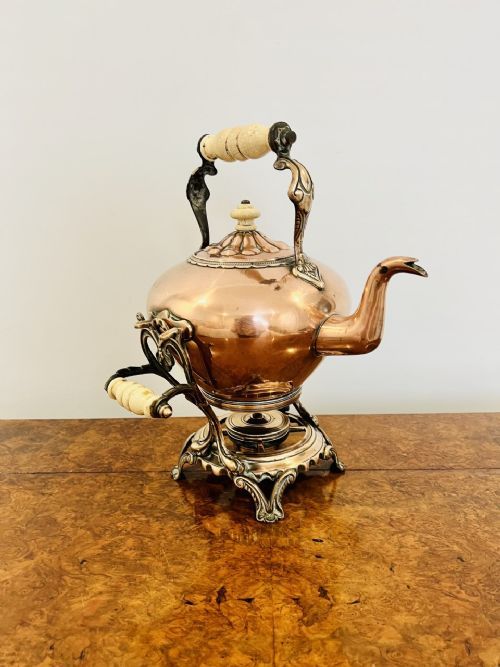


Antique Copper Table Urns
These antique copper table urns bring warmth and tactile weight to a room, offering both decorative presence and historic utility.
Antique Copper Table Urns
When you search for antique copper table urns, you encounter a specialised selection of metalware designed for heating water or serving table functions, spanning the Regency period through to the early twentieth century. The items grouped under this search comprise kettles, spirit kettles, samovars, and decorative vases shaped by diverse global influences.
Alongside British and continental pieces, the selection extends to East Asian aesthetics, notably Japanese Meiji mixed metal vases and Chinese nineteenth-century ceramics adapted for decorative use. This variety means that table urns and their accompanying kettles range from utilitarian heating vessels to purely ornamental display objects.
How they were made
The primary construction relies on hammered or spun copper sheeting, frequently combined with cast brass for handles, taps, and feet to provide structural contrast and durability. Artisans utilised chased and engraved decoration to render floral motifs and geometric borders across the metal surfaces.
Many spirit kettles and samovars incorporate auxiliary materials such as wood for insulating handles, bone for delicate spacers, and wrought iron or porcelain within stands and mountings. These varied components required specialised metalworking and assembly techniques appropriate to each period style.
Antique Copper Table Urns Retail Price Guide 2026
Typical asking prices for copper table urns among the pieces listed under this phrase on Sellingantiques today, from the lower quarter to the upper quarter. They describe what is for sale here now, not the wider market.
The selection includes British copper kettles alongside Japanese Meiji vases and French chateau urns.
What varies in quality
The distinction between standard domestic items and finer pieces rests on the weight of the metal, the crispness of chased detailing, and the integrity of structural joins. Superior examples demonstrate careful hand-finished execution in the brass mounts and well-balanced proportions across stands and burners.
Makers such as William Soutter and Sons applied consistent standards of finish to utilitarian brass and copper items, distinguishing workshop production from anonymous manufacturing. Quality also depends on the preservation of original patination and the survival of matching components like stands, burners, and lids.
William Soutter and Sons
The Antique Copper Table Urns Glossary
- Samovar
- A heated metal urn traditionally used to boil and heat water for tea, typically featuring an internal central tube.
- Spirit kettle
- A portable kettle mounted on a stand above a small spirit burner, designed for heating water at the table.
- Chased decoration
- Ornamentation applied by hammering tools directly into the metal surface to create raised designs without removing material.
- Meiji
- The Japanese historical period spanning from 1868 to 1912, known in metalwork for sophisticated mixed metal alloys and patination.
- Old Sheffield plated
- A method of fusing a thin layer of silver onto a copper base, creating layered metal items before electroplating was invented.
Antique Copper Table Urns: Frequently Asked Questions
What is a samovar?
A samovar is a large heated metal container traditionally used to boil water for tea service.
They often feature an internal vertical pipe and a spigot near the base for dispensing hot water.
How were spirit kettles used?
Spirit kettles were designed to sit on dedicated metal stands containing small fuel burners.
This allowed hot water to be maintained at the dining or tea table without returning to the kitchen.
How do I clean antique copper?
Antique copper is best maintained with gentle dusting and minimal intervention to preserve the aged surface.
Aggressive cleaning removes the historic patination that collectors value on nineteenth-century metalwork.
What is mixed metal?
Mixed metal describes decorative items combining copper, brass, bronze, and other alloys within a single design.
This technique was particularly favored by Japanese Meiji period artisans to create contrasting colour tones.
How do I date an antique kettle?
Dating relies on examining the construction methods, handle materials, and prevailing stylistic influences.
Regency and Victorian examples exhibit distinct mounting styles and manufacturing techniques compared to later pieces.