



Antique City Watercolour
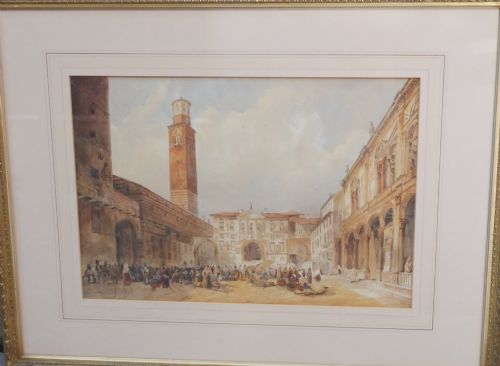
These antique city watercolour works capture the bustle and stone of urban life through pigment and wash.
Antique City Watercolour
An antique city watercolour captures urban streets, riversides and architectural landmarks using water-soluble pigments on paper. These paintings range from busy London and Paris thoroughfares to Italian scenes and quiet northern English townscapes.
The works appearing here span from the nineteenth century through the Edwardian era and into the early twentieth century. Buyers encounter both tightly detailed topographical views and looser British Impressionist or naive interpretations of cityscapes.
Framed paintings behind glass dominate the selection, preserving the delicate paper surfaces from atmospheric damage. Artists utilise ink alongside watercolour paint to define the sharp lines of buildings and monuments.
Materials and technique
Artists painted primarily on paper supports using watercolour pigment, often applying ink lines to establish the perspective of streets and buildings. The transparency of the wash allows the bright white of the paper to function as highlights on stone facades and wet pavements.
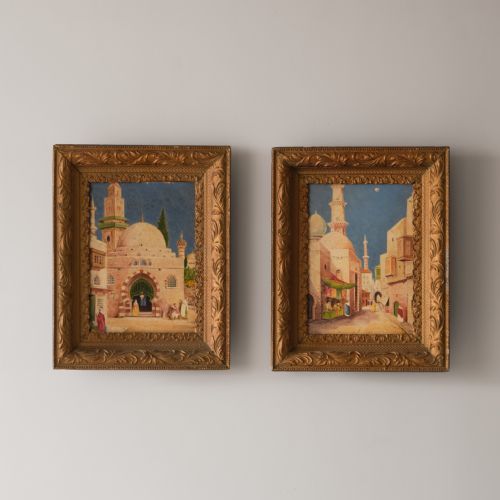
Works from this selection are housed in traditional frames made of wood, frequently finished with gilt decoration under protective glass. This combination of paper, pigment and timber ensures the survival of delicate urban details across decades.
Antique City Watercolour Retail Price Guide 2026
Typical asking prices for city watercolour among the pieces listed under this phrase on Sellingantiques today, from the lower quarter to the upper quarter. They describe what is for sale here now, not the wider market.
Several watercolours preserve the exact moment someone fed the birds outside London stone.
Quality and execution
Quality rests in the confidence of the brushwork and the artist's ability to convey the atmosphere of a specific street or square. Stronger examples capture the movement of crowds and light upon urban architecture with economy and precision.
The handling of perspective and spatial depth distinguishes finer townscapes from simpler naive works. Superior pieces integrate ink and wash harmoniously, giving weight to historic buildings without losing the translucent quality of the medium.
Albert Ludovici Jnr·William Manners·Charles James Lauder·Rowland Henry Hill·Noel Harry Leaver·Fred Lawson·Frances E Nesbitt·Tom Dudley·Matthew Hale·Walter Duncan
The Antique City Watercolour Glossary
- Watercolour paint
- A medium consisting of colour pigments suspended in a water-soluble vehicle. It produces translucent washes that allow the underlying paper to reflect light through the colour.
- Genre watercolour
- A painting depicting scenes of everyday life and ordinary people in public spaces. These works provide a record of contemporary urban dress and street activity.
- Townscape
- A painting or drawing that depicts an urban landscape or city street view. The focus rests primarily on architectural forms and civic spaces rather than natural scenery.
- Gilt wood
- Timber framing finished with a thin layer of gold leaf or metallic gilt gesso. It provides a traditional decorative border that complements the tones of the painting inside.
- British Impressionism
- A painting style characterised by visible brushstrokes and an emphasis on the accurate depiction of light in its changing qualities. Artists working in this manner moved away from rigid academic finishes.
Antique City Watercolour: Frequently Asked Questions
How should I hang my watercolour?
Keep watercolours away from direct sunlight to prevent the pigments from fading over time. Hang them on interior walls where temperature and humidity remain relatively stable.
Ensure the frame seals properly against dust and moisture while keeping the glass from touching the delicate paper surface directly.
What is the difference between a townscape and a topographical view?
A townscape focuses on the atmosphere, mood and visual rhythm of an urban street or square. The artistic interpretation of light and movement takes precedence over strict architectural accuracy.
Topographical views prioritise precise record-keeping of buildings and geography. They function more as historical documents of how a city appeared at a specific date.
Why are these paintings framed behind glass?
Paper and water-soluble pigments are highly sensitive to moisture, smoke and atmospheric pollution. Glass acts as a physical barrier protecting the fragile surface from environmental degradation.
Air trapped against the paper can cause deterioration, so professional framing maintains a small gap between the glass and the artwork using a mount.
How do I identify Edwardian city watercolours?
Edwardian works often display a brighter palette and a lighter touch compared to heavier Victorian compositions. They frequently capture the transition of urban transport, showing horse-drawn cabs alongside early motor vehicles.
Artists working in this period frequently signed and dated their watercolours clearly on the front, providing direct evidence of their creation around the turn of the twentieth century.