



Antique Chessmen
These antique chessmen are tactile survivors of past parlours and libraries, offering the serious player both historical weight and exquisite desk presence.
Antique Chessmen
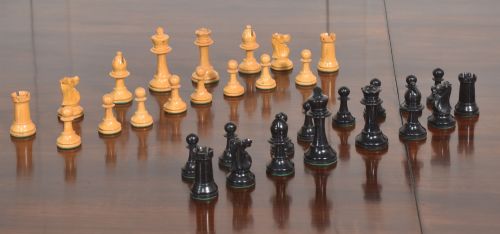
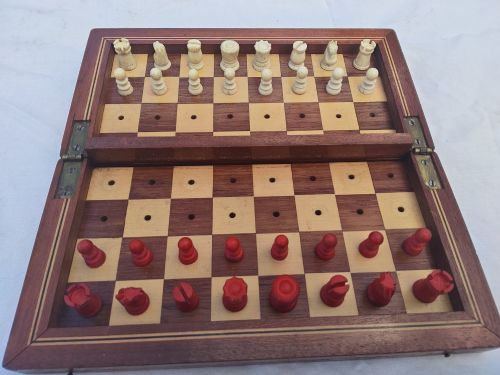
When searching for antique chessmen, collectors encounter complete sets housed in games boxes or accompanied by folding boards designed for travel and home play alike. The examples recorded here span the Victorian and Edwardian eras, bringing late-nineteenth-century and early-twentieth-century craftsmanship straight to the board.
Most pieces met on this page follow the definitive Staunton pattern, alongside alternative historical designs such as the Whittington, St George and Calvert patterns. These sets range from miniature portable travel companions to four-inch weighted library heavyweights.
Originating predominantly from English workshops, these chessmen capture the shift from traditional regional forms to the standardised tournament design that dominated the late nineteenth century and remains the global standard today.
How they were made
Turned from dense hardwoods such as boxwood, ebony, rosewood and ebonised wood, these pieces rely on precise lathe work for their symmetry and balance. Contrasting dark and light timbers create the traditional visual division on the board without need for complex surface decoration.
Bone serves as a lighter alternative material for travel sets, carved with delicate detail and paired with mahogany boxes or folding boards. Many library and club sets incorporate internal weighting to improve stability during rapid play.
Green felt bases are frequently applied to the underside of weighted pieces to protect the board and ensure a smooth glide across the playing surface during a match.
Antique Chessmen Retail Price Guide 2026
Typical asking prices for chessmen among the pieces listed under this phrase on Sellingantiques today, from the lower quarter to the upper quarter. They describe what is for sale here now, not the wider market.
The documented examples span unweighted travel sets up to four-inch weighted library sets produced by notable English makers.
What varies in quality
Quality in antique chessmen rests upon the precision of the turning and the crispness of the carved details, particularly on the knight and king. Master carvers imparted individual character to each knight head, whereas mass-produced sets display flatter, more mechanical repetition.
The integrity of the timber and the retention of original weighted bases distinguish superior sets from lesser examples. Sets bearing maker attributions or stamps retain greater distinction among collectors who value documented workshop origins.
Condition and completeness matter immensely, as missing pieces or replacement components disrupt the harmony of a set and alter its historical continuity.
Jaques·British Chess Company·F. H. Ayres·Calvert
The Antique Chessmen Glossary
- Staunton pattern
- The standard design for chess pieces introduced in the mid-nineteenth century, featuring architectural forms for the major pieces and distinct finials for the bishops. It quickly became the mandatory pattern for tournament play.
- Whittington pattern
- A distinct nineteenth-century regional chess set design that predates the absolute standardisation of the Staunton style. These pieces exhibit unique stylistic quirks in the carving of the crown and mitre.
- Calvert pattern
- A nineteenth-century style of chess pieces often characterised by sturdy proportions and distinctive turning, named after the prominent maker of the period. They remain sought after by specialists in early English sets.
- Ebonised wood
- Fruitwood or boxwood treated with a chemical stain or dye to imitate the deep black appearance of genuine ebony. This technique provided an economical alternative for dark pieces while maintaining uniform playing weight.
- Weighted set
- Chess pieces containing lead or metal ballast within the base to lower the centre of gravity. This addition prevents the pieces from tipping easily during energetic club or tournament play.
Antique Chessmen: Frequently Asked Questions
How do I date antique chess sets?
Dating relies primarily on the style of the pieces, turning techniques, and the materials utilised. The introduction of the Staunton pattern around the mid-nineteenth century provides a firm benchmark for pieces following that design.
Secondary clues include the presence of original wooden boxes, stamps, brass markers, and the type of felt used on the bases. Comparing the turning profile of the rooks and pawns against documented examples helps narrow the decade of production.
What is a weighted chess set?
A weighted chess set contains lead or metal weights inserted into the base of each piece during manufacture. This modification lowers the centre of gravity to prevent accidental toppling during intense games.
Weighted sets were particularly favoured for library and club use where rapid movement across the board was common. The added heft gives the pieces a satisfying feel in the hand compared to hollow or unweighted alternatives.
Are bone chess sets durable?
Bone chess sets are strong but require careful handling compared to dense tropical hardwoods. Bone can become brittle over time and is susceptible to damage if dropped onto hard surfaces.
Most bone sets were created as travel companions, housed within compact mahogany folding boxes. Their lighter weight made them ideal for carriage, but they demand gentle storage away from extreme humidity and direct sunlight.
How do I spot a Jaques set?
Jaques sets often feature distinctive carving on the knight pieces, which were hand-carved with notable expression and detail. Some sets include stamped marks or original labels on the box lid or the underside of the king.
The proportions of the pieces, the quality of the boxwood and ebony selection, and the characteristic form of the coronets on the queen provide further confirmation of the maker's hand.