
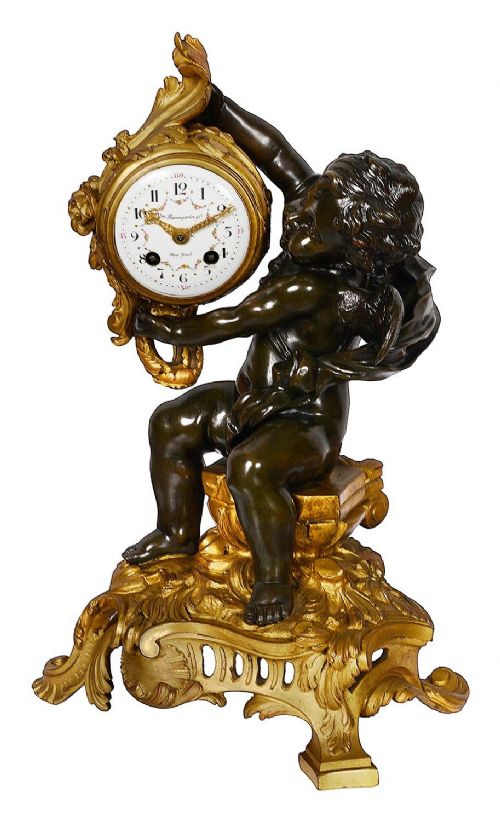


Antique Cherub Mantle Clock
An antique cherub mantle clock brings nineteenth-century French bronze and marble into a room, combining sculptural putti with mechanical timekeeping.
Antique Cherub Mantle Clock
The antique cherub mantle clock stands as a prominent form within nineteenth-century decorative metalwork, bringing figurative sculpture and timekeeping together on a shelf or sideboard. Buyers encounter these pieces largely through nineteenth-century French production, spanning the Victorian era and embracing revival aesthetics from Louis XV to Second Empire styles.
The visual focus rests upon cast figures of cherubs, putti, or cupids integrated with dials, columns, and plinths. Many examples appear alongside matching candelabras or side urns as part of complete clock garnitures.
Makers housed these movements within architectural or pastoral housings, pairing figures with gilt bronze, ormolu, marble, and porcelain dials. The selection reflects diverse interpretations of classical and rococo revival tastes popular across the decades from eighteen-fifty to nineteen-hundred.
Materials and construction methods
Foundries cast these bodies in bronze, brass, and gilt metal, applying mercury gilding or ormolu finishes to achieve a bright, durable surface. Ormolu components provide the characteristic golden lustre seen across French classical and rococo revival designs.
Craftsmen incorporated panels of painted porcelain, such as Sevres-style plaques and enamel dials, alongside bases carved from white or pink marble and variegated stone. Movements relied on brass gear trains, often featuring silk suspension systems in earlier models and upgraded pendulum mechanisms in later Victorian pieces.
Several cherubs share shelf space with carved dragonflies, reminding buyers that nineteenth-century bronze casters loved a sudden insect intrusion.
Assessing quality and execution
Finely chased detailing in the bronze or ormolu figures sets superior pieces apart, where feather tips, facial expressions, and drapery remain crisp rather than soft or cast flat. The depth and weight of the marble plinths, alongside the integration of hand-painted porcelain plaques, indicate the workshop standards behind the assembly.
The complexity of the clock movement and the presence of a matching garniture set elevate a piece's standing. Complete sets featuring paired candelabras display a unified decorative ambition missing in solitary timepieces.
Japy Freres·Phillipe H. Mourey·P.H. Mourey
The Antique Cherub Mantle Clock Glossary
- Ormolu
- Gilt bronze produced by applying a mercury and gold amalgam to a bronze base and firing it. This historic technique creates a rich, matte golden finish.
- Garniture
- A set of matching decorative objects designed to be displayed together on a mantelpiece, typically comprising a central clock flanked by two candelabras or urns.
- Champleve
- An enamelling technique where troughs are dug into a metal surface and filled with vitreous enamel before firing. It decorates clock dials and bezels with coloured patterns.
- Putto
- A plump, naked male child figure frequently depicted in classical art and found cast in metal upon these clocks. They often appear with wings, representing cupids or cherubs.
- Silk suspension
- A method of hanging the pendulum from a small loop of woven silk thread inside the movement. This early mechanism appears in mid-nineteenth-century examples.
Antique Cherub Mantle Clock: Frequently Asked Questions
How do I wind a nineteenth-century clock?
Most pieces use a double-ended key to tighten the springs behind the dial, turning each arbour slowly until resistance meets the hand. Care prevents overwinding the brass gear train.
Striking mechanisms require patience to let the chime sequence finish before advancing hands or adjusting the time. Setting the minute hand gently avoids strain on the escapement.
What is a clock garniture set?
A garniture groups a central timekeeper with matching side ornaments like candelabras or urns, styled in matching brass, marble, or porcelain. Makers designed these symmetrical arrangements for grand mantelpieces.
The matching pieces share the same motifs, such as gilt cherubs or floral enamel panels, creating a unified display across a room.
How do I identify the period of a clock?
Stylistic cues point to specific decades, with Rococo Revival pieces showing asymmetrical scrolling and Second Empire models favouring heavier classical proportions. Materials like pink marble and Sevres-style porcelain often align with specific Victorian manufacturing decades.
Movement types also help date the housing, as silk suspension appears earlier in the nineteenth century while later Victorian pieces adopt more robust pendulum setups.
Can these clocks keep accurate time daily?
These mechanical movements can keep reliable time when properly serviced, cleaned, and adjusted on a level surface. Small regulation levers inside the case allow fine-tuning for daily gains or losses.
Environmental changes like room temperature and humidity can affect the metal components, requiring minor seasonal adjustments to the pendulum.