




Antique Ceramic Table Ornament
These antique ceramic table ornaments bring figurative elegance and decorative detail to a room, ranging from Georgian groups to Victorian porcelain figures.
Antique Ceramic Table Ornament
An antique ceramic table ornament encompasses a diverse array of decorative objects designed to adorn surfaces within the home. When searching for this category, collectors encounter everything from Georgian porcelain stags and figural groups to 19th-century centrepieces, ewers, and candlesticks.
The selection leans heavily toward Continental and English porcelain, with German factories and French makers well represented alongside Dutch delftware and Royal Worcester. Figurines, animals, and mythological or pastoral scenes dominate the forms available on the page.
Varying across periods from the 18th century through to the early 20th century, these items reflect changing domestic tastes in interior decoration. Buyers often find matched pairs of figures, ewers, or vases intended for symmetrical placement on mantelpieces or side tables.
Materials and construction
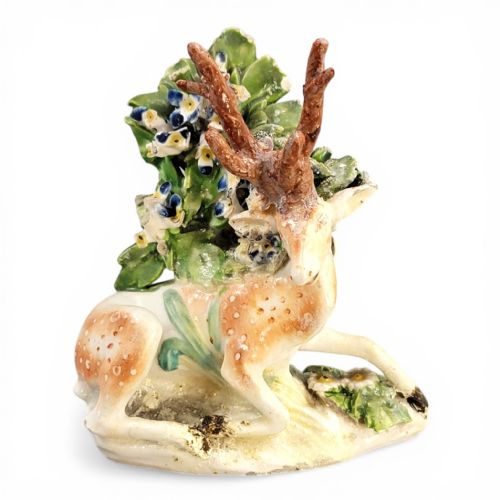
The pieces rely on ceramic bodies such as soft-paste porcelain, biscuit porcelain, earthenware, and pearlware, shaped by hand or moulded in sections. Many items incorporate intricate details like applied porcelain foliage, known as bocage, which requires immense skill to fire without cracking.
Surface decoration involves hand-painting underglaze and overglaze colours, complemented by gilding and gold leaf accents. Glazes provide the protective and glossy finishes seen across the various figures, animals, and miniature furniture pieces.
Listings feature pieces spanning the Georgian, Victorian, and Edwardian eras, utilising porcelain, earthenware, and brass across figural and functional forms.
Assessing the workmanship
Quality rests primarily on the crispness of the modelling and the precision of the hand-painted details. Finer examples display delicate facial expressions, subtle colour shading, and well-preserved gilt highlights that have survived centuries of handling.
The complexity of the form also dictates the standard of manufacture, particularly in multi-figure groups or pieces featuring fragile elements like floral encrustations. Superior works maintain structural integrity despite intricate appendages, whereas lesser items show coarser moulding and simpler painted washes.
Ralph Wood·Vion and Baury·Kister Scheibe Alsbach·Chantilly·Volkstedt·Royal Worcester·Meissen·Sitzendorf·Carl Thieme Dresden
The Antique Ceramic Table Ornament Glossary
- Bocage
- Applied porcelain foliage or tree branches forming a decorative background behind a figurine. This delicate technique appears frequently on 18th-century animal and human figures.
- Biscuit porcelain
- Unglazed porcelain fired once to produce a matte, tactile finish resembling marble. French factories utilised this method extensively for sculptural groups.
- Ewer
- A large jug with a wide spout and handle, often produced purely for display rather than utility. These decorative vessels appear in ceramic and paired formats.
- Pearlware
- A refined earthenware developed in the late 18th century featuring a bluish glaze that pooled in recesses to mimic Chinese porcelain. It was championed by potters such as Ralph Wood.
Antique Ceramic Table Ornament: Frequently Asked Questions
What defines an antique ceramic table ornament?
These pieces are decorative objects modelled from porcelain, earthenware, or ceramic, created to adorn furniture surfaces rather than serve a functional purpose. They include figural groups, animals, candlesticks, and centrepieces.
Originating from various European kilns, they span periods from the Georgian era through the 19th century into the early 20th century.
How were these ornaments displayed?
Historically, owners placed them on mantelpieces, sideboards, and centre tables to demonstrate taste and wealth. Many items were manufactured in pairs to allow for symmetrical arrangement in formal rooms.
Larger centrepieces and ewers served as focal points for dining tables or entrance halls during the Georgian and Victorian periods.
How do I care for antique porcelain figures?
Dusting them gently with a soft, dry brush prevents the accumulation of dirt in intricate crevices and painted areas. Avoid using liquid cleaners or submersing pieces in water, particularly those with overglaze enamel or gold leaf.
Keep them away from direct sunlight and areas subject to sudden temperature fluctuations to protect the ceramic body and glazes.
How can I tell 18th-century pieces from 19th-century ones?
Earlier pieces from the Georgian period often exhibit softer paste compositions and hand-modelled details that vary slightly from piece to piece. They frequently display the characteristic stylistic traits of early Rococo or soft-paste manufacturing.
Nineteenth-century examples tend to show crisper factory marks, brighter enamel palettes, and occasionally harder porcelain bodies influenced by industrial advancements.