
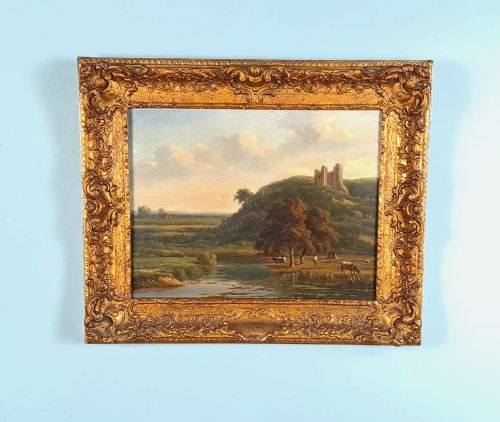


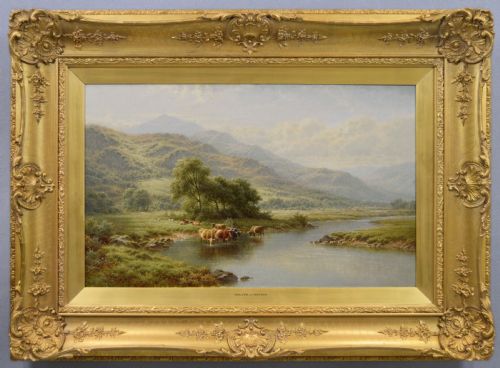

Antique Cattle River Painting
When searching for an antique cattle river painting, you are looking at nineteenth- and early-twentieth-century pastoral art capturing livestock at water.
Antique Cattle River Painting
An antique cattle river painting typically portrays herds of cows, calves or drovers resting by waterways, riversides, and pastoral landscapes. These works capture the nineteenth-century and early-twentieth-century fascination with rural life and agricultural scenes across Britain and Ireland.
You will frequently find these compositions rendered in either oil on canvas, oil on board, or watercolour on paper. They span styles from Victorian pastoral and naturalism to English school landscapes produced between the mid-nineteenth century and the 1920s.
The subjects range from tranquil lowland riverbanks in Kent and Nottinghamshire to dramatic mountainous river settings in Wales and Scotland. Herds are often shown wading, watering, or grazing near bridges and banks under changing daylight.
Materials and technique
Painters of these rural scenes utilised oil paints applied to stretched canvas, wooden panels, or prepared boards, often building rich textures with multiple layers of pigment. Watercolours were similarly worked onto paper, sometimes enhanced with bodycolour to capture light sparkling on the water.
Finished works were frequently housed in period wooden gilt frames, often embellished with gesso mouldings that complemented the warm tones of the pastoral landscape within.
Calves and ducks frequently share the riverbank with the cattle, adding a touch of bustling farmyard charm to the scenery.
Assessing the work
The distinction between standard works and exceptional examples lies in the naturalist handling of light, anatomical precision of the cattle, and atmospheric depth in the surrounding river valley. Superior artists capture subtle weather conditions, reflections on the water, and the natural posture of resting animals rather than stiffly rendered figures.
Provenance and documentation also elevate certain pieces, particularly when a stretcher bears an inscribed title, a specific geographic location such as the River Dart or River Leam, or a known signature from an established regional school painter.
Thomas Sidney Cooper·William Sidney Cooper·Sidney Richard Percy·Alfred de Breanski·Henry John Kinnaird
The Antique Cattle River Painting Glossary
- Pastoral
- Relating to the countryside and rural life, frequently depicting herds, shepherds, and agricultural workers in peaceful natural settings.
- Stretcher
- The wooden framework upon which canvas is stretched tight before painting and framing takes place.
- Gesso
- A plaster-like mixture applied to wooden picture frames as a base before gilding with gold leaf or metallic paint.
- Giltwood
- Wood that has been coated or gilded with gold leaf or a gold-coloured finish, standard for nineteenth-century frame moulding.
- Watercolour
- A painting method where fine pigment is suspended in a water-based solution, producing translucent washes on paper.
Antique Cattle River Painting: Frequently Asked Questions
What periods do these paintings come from?
These works date primarily from the nineteenth century through to the early twentieth century, spanning the Victorian and Edwardian eras.
They reflect a sustained artistic interest in idealized rural landscapes and agricultural daily life.
Where were these river scenes set?
Artists painted specific named locations across the British Isles, including rivers in Wales, Scotland, Kent, and Devon.
Many compositions also depict generic pastoral riverbanks infused with characteristic regional foliage and topography.
How do I care for an antique canvas?
Keep paintings away from direct sunlight, high humidity, and rapid temperature fluctuations to protect both the canvas and the gilt frame.
Dust gently with a soft dry brush and avoid using liquid cleaners on the painted surface.
How do I distinguish watercolours from oils?
Watercolours are painted on paper under glass and show translucent washes of pigment with visible paper texture beneath.
Oils are executed on canvas, board or panel, possessing a heavier paint layer and a more textured, opaque surface.