




Antique Cased Telescope
An antique cased telescope is a precision optical instrument housed in a fitted wooden or leather box, prized by collectors for its fine mechanics and tangible connection to maritime and scientific history.
Antique Cased Telescope
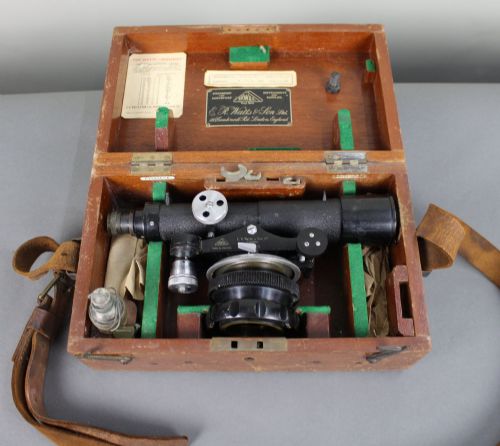
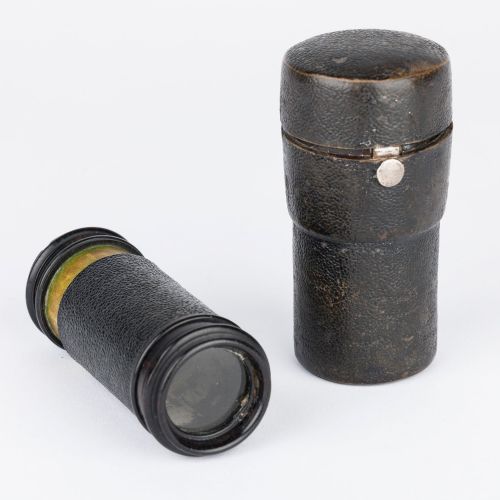
An antique cased telescope represents a diverse range of optical and surveying equipment designed for observation, navigation, and measurement. Buyers searching for an antique cased telescope will encounter portable spyglasses, heavy library telescopes on stands, and complex brass levels from the eighteenth, nineteenth, and early twentieth centuries.
The versions most frequently met on this page are brass and leather draw telescopes alongside mahogany-cased scientific instruments such as levels and theodolites. These pieces originate from British and European workshops, spanning Georgian simplicity through to robust Victorian scientific production and mid-twentieth-century utility designs.
How they were made
Maker workshops constructed these instruments primarily from polished brass for the optical tubes and mounting hardware, paired with glass lenses ground for magnification. Protective outer bodies frequently utilised stitched leather coverings or wooden barrels made from dense timbers like mahogany.
Fitted cases were custom-built to house each instrument and its delicate accessories securely, often incorporating brass hinges, hooks, and velvet or cloth linings. Secondary materials such as steel, card, and gunmetal appear in specific mechanical components and internal mountings.
Antique Cased Telescope Retail Price Guide 2026
Typical asking prices for cased telescope among the pieces listed under this phrase on Sellingantiques today, from the lower quarter to the upper quarter. They describe what is for sale here now, not the wider market.
Some nineteenth-century surveyors had to carry heavy mahogany cases containing complex brass levels across rough fields just to draw straight lines.
What varies in quality
Quality in these instruments is dictated by the precision of the optical glass and the smoothness of the draw tubes or adjustment gears. Superior examples maintain clear, sharp focus across multiple extending draws and show rigorous mechanical alignment in their mountings.
E.R. Watts & Son Ltd·L Casella & Co·Newton & Co·Alexander Adie of Edinburgh·Chadburn Brothers of Sheffield·Matthew Berge London·WF STANLEY
The Antique Cased Telescope Glossary
- Draw
- A sliding tubular section of a telescope that extends to adjust the focal length. Multiple draws allow a long instrument to collapse into a compact size.
- Theodolite
- A precision instrument used for measuring horizontal and vertical angles in surveying and civil engineering. It typically mounts on a tripod and incorporates spirit levels.
- Altazimuth
- A mounting that allows an instrument to rotate freely in both altitude and azimuth directions. This setup simplifies tracking terrestrial or celestial targets.
- Achromatic
- A lens design corrected to bring two different wavelengths of light into focus in the same plane. This engineering reduces chromatic aberration and sharpens the observed image.
- Spyglass
- A small, portable refracting telescope used historically for quick terrestrial viewing. They are typically handheld and feature a modest number of extending draws.
Antique Cased Telescope: Frequently Asked Questions
What is the difference between a spyglass and a telescope?
A spyglass denotes a compact, handheld refracting instrument designed for portability and rapid deployment in maritime or military contexts. Telescopes on this page also encompass larger library instruments mounted on stands and complex surveying levels.
Larger stationary models required stable tabletops or tripods for support. Handheld spyglasses prioritized lightweight mobility over high-magnification stability.
How do I date an antique cased telescope?
Examine the materials, typography of the maker signature, and the mechanical construction of the brass draws. Georgian and early nineteenth-century pieces often display simpler unsigned tubes or fine signature engraving on the eyepiece rim.
Victorian and later instruments frequently feature stamped maker details, standardised screw threads, and more complex mechanical assemblies. The wood and lining style of the accompanying case also provide strong chronological clues.
Why are some instruments housed in wooden cases?
Fitted wooden cases protected delicate optical alignments and precision glass lenses during transport across land or sea. Mahogany and other sturdy timbers absorbed impacts and kept moisture away from the metal components.
These boxes often contain specialised internal blocks and velvet recesses designed specifically for that single instrument. Complete original cases significantly enhance the historical integrity of the scientific apparatus.