

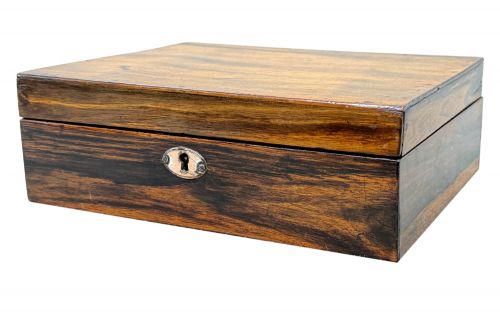


Antique Calamander Box
An antique calamander box brings deep, figured timber and dense, heavy construction to a desk or dressing table.
Antique Calamander Box
An antique calamander box is a small lidded container built from exotic tropical hardwoods, frequently configured as writing slopes, tea caddies, or dressing boxes. These pieces emerge predominantly from the nineteenth century, spanning the Regency and Victorian eras.
The versions most commonly encountered on this page take the form of coromandel writing slopes or fitted vanity boxes, often enhanced with brass mounts and mother-of-pearl inlay. They represent the height of nineteenth-century desk furniture craftsmanship.
Makers adapted these dense timbers to create stationary cabinets, work boxes, and scent bottle boxes designed for the affluent Victorian home or colonial traveller. The timber itself provides a distinctive striped grain that marks each box out immediately from ordinary walnut or mahogany.
Materials and construction methods
Cabinet makers utilised calamander and closely related coromandel wood as veneered surfaces over sturdy secondary timbers, taking advantage of the rich grain patterns. These wooden carcasses were frequently reinforced with brass banding and corner plates to withstand heavy travel and daily use.
Interiors combined secondary woods like satinwood with fitted velvet, leather, and silk compartments designed to hold stationery, jewellery, or glass bottles. Complex locking mechanisms and hidden secret drawers were routinely integrated into the joinery.
Antique Calamander Box Retail Price Guide 2026
Typical asking prices for calamander box among the pieces listed under this phrase on Sellingantiques today, from the lower quarter to the upper quarter. They describe what is for sale here now, not the wider market.
Materials appearing across these boxes include calamander, coromandel, satinwood, brass, and mother-of-pearl.
Assessing quality in the range
Quality reveals itself in the tightness of the timber's grain and the precision with which the brass mounts and stringing are inlaid into the wood. Finer examples display meticulous internal fittings, such as matched glass inkwells and functioning locks stamped by renowned makers.
Simpler boxes rely solely on the visual impact of the polished wood, whereas superior pieces incorporate elaborate mother-of-pearl cartouches, secretaire drawers, and heavy brass carrying handles that demonstrate a higher level of workshop skill.
Houghton and Gunn·Mechi and Bazin
The Antique Calamander Box Glossary
- Calamander
- A dense, heavy tropical hardwood featuring dark brown and fawn stripes. It is closely related to coromandel and was highly prized for luxury nineteenth-century boxes.
- Writing slope
- A portable desk with a hinged, slanted writing surface that folds flat when closed. Inside, it provides storage for paper, pens, and inkwells.
- Tea caddy
- A small lidded container designed specifically to store dry tea leaves securely. They often featured internal compartments and small mixing bowls.
- Stationery cabinet
- An upright desk accessory with doors or a drop front, built to organise letters and writing paper. These frequently date to the later Victorian period.
- Stringing
- A narrow inlay of contrasting wood or light-coloured timber used to outline panels on a box. It defines the geometric edges of the piece.
Antique Calamander Box: Frequently Asked Questions
What is an antique calamander box used for?
These boxes served practical domestic or travel functions, holding writing materials, correspondence, loose tea, or precious jewellery. Their fitted interiors kept small, valuable items organised and secure.
Today, collectors use them on desks or dressing tables to store modern stationery, watches, or small personal keepsakes while displaying the decorative timber grain.
How do I tell calamander from coromandel?
Calamander and coromandel are terms historically used interchangeably for closely related Asiatic Diospyros hardwoods. Both exhibit striking dark brown and light fawn striping.
Exact botanical distinction can be difficult without laboratory testing, as nineteenth-century cabinet makers used both names for similar imported woods from India and Sri Lanka.
How do I date a Victorian writing box?
Dating relies on examining the construction methods, secondary woods, and hardware styles. Regency and early nineteenth-century pieces often feature simpler brass inlay, while later Victorian examples display more elaborate mounts and fitted stationery compartments.
Maker stamps on locks or hinges, where present, can also narrow down the production year significantly.
Are these boxes suitable for travel now?
While originally designed as portable campaign or vanity luggage, surviving nineteenth-century boxes are now treated as delicate decorative antiques. The aged wood, traditional adhesives, and delicate veneer are vulnerable to modern temperature fluctuations and rough handling.
It is best to place them in a stable environment away from direct sunlight and excessive humidity.