


Antique Bronze Gong
An antique bronze gong brings a resonant acoustic presence and striking sculptural form to a room, drawing on diverse global styles from the nineteenth century onward.
Antique Bronze Gong
An antique bronze gong is a striking percussion instrument typically suspended within a supportive wooden, iron, or bamboo frame for domestic or ceremonial use. When you search for an antique bronze gong, you encounter objects ranging from small table gongs to large floorstanding and wall-mounted dinner gongs used to summon households.
The pieces appearing on this page span the nineteenth and early twentieth centuries, encompassing Victorian, Edwardian, and Art Deco eras alongside distinct global aesthetics. You find English country house dinner gongs alongside imported Chinese, Japanese, Burmese, and Anglo-Indian designs.
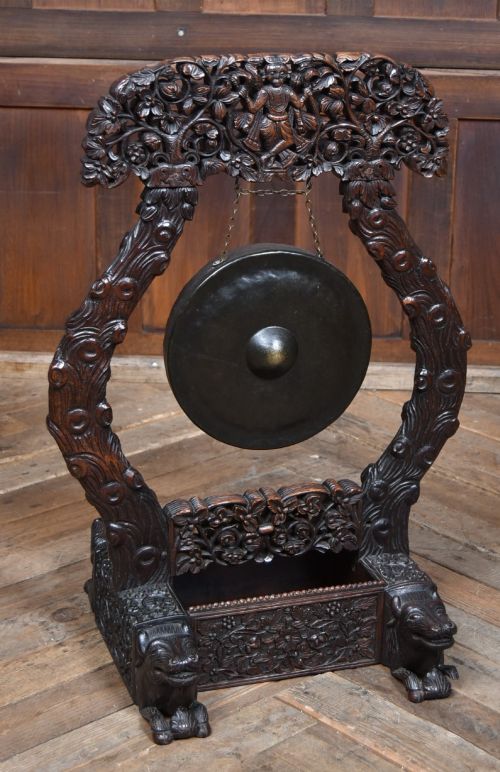
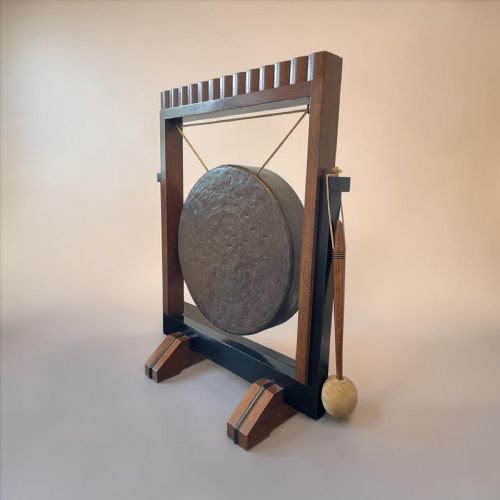
Forms vary from simple circular discs and bells to elaborate hanging arrangements featuring carved dragons, elephants, or bamboo structures. The most common varieties combine a cast bronze chime with structural woodwork like oak, teak, or carved hardwood.
Materials and construction
The primary metal components consist of cast bronze or brass, shaped to produce a sustained musical tone when struck. These metal discs and bells are paired with structural frames forged from wrought iron, cast iron, or carved hardwoods such as oak and teak.
Hanging mechanisms rely on sturdy cord or leather strapping to suspend the heavy metal securely while allowing free vibration. Frames often incorporate detailed hand-carved motifs or metalwork consistent with Arts and Crafts, Art Nouveau, or East Asian artistic traditions.
Elephants and carved dragons occasionally share guard duty at the base of the frame, ready to rumble at dinner time.
Evaluating craftsmanship and build
Quality in these pieces rests upon the metallurgical composition of the bronze and the depth of resonance achieved when the instrument is struck. Superior examples maintain a clear, sustained tone without unwanted rattling or distortion from the suspension mount.
The joinery and carving of the supporting frame separate standard items from exceptional ones. Finely executed woodwork featuring hand-carved dragons, elephants, or structural bamboo adds substantial architectural presence compared to plain utilitarian iron stands.
William Tonks
The Antique Bronze Gong Glossary
- Dinner gong
- A domestic percussion instrument traditionally placed in a hallway or dining room to announce meals. These gongs are frequently mounted in substantial oak, bamboo, or wrought iron frames.
- Lithophone
- A musical instrument consisting of pieces of stone or metal that emit resonant tones when struck. Certain East Asian cast bronze types function on similar acoustic principles.
- Japonisme
- A late nineteenth-century European artistic movement influenced by Japanese art and design. Pieces in this style often incorporate Eastern motifs into Western domestic furnishings.
- Anglo-Indian
- A descriptive term for objects created in India during the British colonial period, combining British furniture forms with traditional Indian carving techniques and materials.
Antique Bronze Gong: Frequently Asked Questions
How were antique gongs used in homes?
These instruments served primarily as domestic signals in large Victorian and Edwardian country houses. Servants struck the metal chime with a mallet to announce the arrival of dinner or gather residents.
Over time, they transitioned from functional timekeeping tools into decorative furnishings valued for their striking visual silhouette and resonant acoustic qualities.
What materials make up these frames?
Frames are constructed from a variety of durable materials depending on the period and stylistic influence. Oak, teak, and carved hardwoods appear frequently alongside wrought iron, cast iron, and bamboo.
The metal gong itself is typically suspended from the upper crossbeam using sturdy cord, leather, or specialised metal hooks designed to bear the weight.
How do I date an antique gong?
Dating relies on stylistic clues found in the mounting frame and the manufacturing techniques of the metalwork. Victorian and Edwardian examples often feature heavy oak frames with Gothic or medieval revival styling.
Art Deco and Arts and Crafts pieces introduced streamlined geometric woodwork or exposed ironwork dating from the early twentieth century, around nineteen-thirty.
Are these gongs still musically functional?
Most antique gongs retain their acoustic properties and produce a deep, resonant tone when struck properly with an appropriate mallet. The sound quality depends on the alloy composition and the freedom of the suspension cord.
Care should be taken when sounding older pieces to ensure the historical metal and suspension lines remain stable and undamaged.