



Antique Brass Level
These antique brass level pieces are precision surveying tools that bring industrial history and handsome metalwork into a modern study.
Antique Brass Level
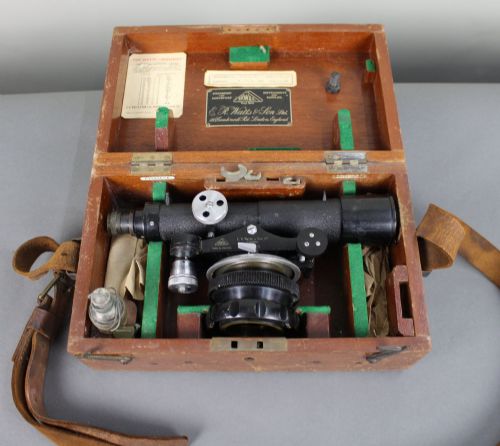
When you search for an antique brass level, you encounter scientific instruments and surveying tools built from the nineteenth century through the mid twentieth century. These instruments include drainage levels, precision levels with clinometers, radial theodolites, and transit instruments housed in fitted wooden cases.
The versions most commonly met on this page date from the Victorian and Edwardian eras, bearing the signatures of prominent scientific instrument makers. They combine polished metal components with glass vials, silvered metal dials, and occasionally wooden elements or leather straps.
Alongside the primary surveying instruments, the selection occasionally encompasses related scientific apparatus, water pressure gauges, and related case furniture from overlapping periods.
Materials and construction methods
Makers fashioned the primary bodies and fittings of an antique brass level from cast and turned brass, polished to a bright finish or left with a warm, aged patina. Silvered metal is frequently utilised for the graduated compass circles and vernier scales, allowing sharp, legible engravings.
Delicate spirit levels depend on blown and sealed glass vials filled with spirit to house the floating bubble. These instruments are frequently accompanied by fitted mahogany or teak transit cases, sometimes lined with velvet and fitted with brass carrying hooks.
Antique Brass Level Retail Price Guide 2026
Typical asking prices for brass level among the pieces listed under this phrase on Sellingantiques today, from the lower quarter to the upper quarter. They describe what is for sale here now, not the wider market.
Early surveyors trusted their spirit levels so completely that a cracked glass vial meant an immediate trip back to the maker for repairs.
Assessing quality in scientific instruments
The distinction between standard utility instruments and superior examples lies in the crispness of the engraved maker signatures, the complexity of the internal optics, and the survival of the original fitted wooden housing. Signed pieces by notable London and regional makers demonstrate finer tolerances in their vernier scales and leveling screws.
Completeness dictates desirability among collectors, specifically the retention of original screw-in lenses, sunshades, silvered dials, and undamaged glass vials. Instruments that retain their original leather straps or mahogany transport boxes hold greater documentary interest.
E.R. Watts & Son Ltd·W&S Jones·L Casella & Co·Cooke Troughton & Simms·Negretti & Zambra·Elliott Bros. of London·Alexander Adie of Edinburgh·W. H. Harling·WF Stanley
The Antique Brass Level Glossary
- Clinometer
- A tool used for measuring angles of slope, elevation, or depression of an object with respect to gravity. It typically incorporates a graduated arc and a swinging index or spirit level.
- Vernier
- A secondary sliding scale attached to a primary scale that permits readings to a fraction of the smallest division. This device ensures high precision in scientific measurements.
- Transit instrument
- A telescope mounted on an axis perpendicular to its optical axis, used for observing celestial bodies as they pass the meridian. These portable devices were essential for precise mapping.
Antique Brass Level: Frequently Asked Questions
What is an antique brass level?
An antique brass level is a vintage surveying or scientific instrument constructed primarily from polished brass, utilised in construction, cartography, and land measurement during the nineteenth and early twentieth centuries.
These instruments rely on spirit-filled glass vials and precision optics to establish horizontal planes, often accompanied by original fitted wooden storage cases.
How do you date an antique brass level?
Dating relies on engraved signatures, patent dates, and the evolution of manufacturing techniques visible across the nineteenth and twentieth centuries. Maker directories and address changes stamped onto the metal provide precise operational windows.
Stylistic shifts in the wooden transport cases and typography on silvered dials also offer reliable chronological markers for these scientific objects.
Were these levels used outdoors?
Surveyors and engineers deployed these precision instruments in the field for railway construction, architectural mapping, and civil engineering projects. Their robust brass construction and fitted wooden cases protected delicate glass vials during transport across rough terrain.
Despite their rugged field use, many survived in exceptional condition due to careful handling and protective housing by their original operators.
How do you display an antique brass level?
These instruments suit placement on desks, bookshelves, or dedicated display tables where their polished metal surfaces and complex mechanical components remain visible. Many collectors exhibit the instrument alongside its original mahogany case to highlight the complete surveying kit.
Occasional dusting with a soft cloth preserves the brass finish without disturbing the natural aged patina accumulated over decades.