
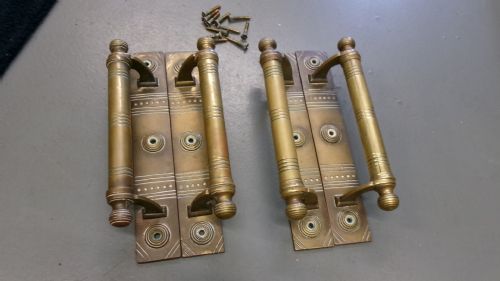


Antique Brass Door Pull
An antique brass door pull brings tactile weight and period character to an entrance, turning a simple threshold into a distinct architectural feature.
Antique Brass Door Pull
An antique brass door pull encompasses heavy hardware items designed for domestic and commercial entryways, spanning Victorian, Georgian, Regency, Edwardian, and Art Deco periods. Buyers looking for an antique brass door pull will encounter paired handles, single centre door knobs, bell ringers, and combined letter boxes with pull handles. The selections here originate from various eras, showing how functional ironmongery evolved alongside architectural design.
Victorian and Georgian examples dominate the available forms, often presenting as heavy brass or bronze castings shaped into octagonal profiles, bee hive patterns, or ovular configurations. Alongside standard brass, the inventory includes pieces incorporating materials such as crystal glass, amber glass, blue glass, china, horn, and ebony wood. These variations reflect the diverse aesthetic demands of different decades, from plain Regency restraint to ornate French Chateau detailing.
Assessing quality in period hardware
Quality rests in the weight of the metal casting and the crispness of any turned or moulded detail. Substantial brass and bronze components with deep relief work and tight joints represent higher standards of production.
The integration of secondary materials dictates the character of the piece, where smoothly bevelled crystal glass, unblemished ceramic china, and secure mountings distinguish superior examples from standard utility hardware.
Visitors could once announce their arrival using a brass bell ringer incorporating genuine animal horn.
The Antique Brass Door Pull Glossary
- Brass
- An alloy of copper and zinc used extensively for its durability and warm metallic tone. It forms the primary structural material for the majority of these door fittings.
- Centre door knob
- A large, prominent handle mounted centrally on a door leaf rather than near the edge. These were often fixed in place as pulling points rather than operating a latch.
- Bell pull
- A mechanical lever or handle mounted on a door surround, connected by wire to an internal bell. These fixtures enabled visitors to summon household staff before the widespread adoption of electric buzzers.
- Bronze
- A heavier metal alloy composed primarily of copper and tin. It appears in several Victorian and Edwardian items for its strength and dark patination.
- Bee hive
- A distinctive decorative turning style featuring concentric stepped ridges resembling a traditional beehive. This profile is common on Victorian brass door knobs.
Antique Brass Door Pull: Frequently Asked Questions
How do I install an antique door pull?
Most period pieces rely on traditional spindle mechanisms or surface-mounted fixing plates. You should check the backplate dimensions and spindle thickness against your existing door preparation before fitting.
Professional joiners can often adapt older fixings to fit modern standard door thicknesses while preserving the original exterior components.
Are these pulls suitable for exterior use?
Brass and bronze naturally withstand weathering by developing a protective patina over time. Many of these items served as exterior entrance hardware originally and remain robust enough for modern outdoor placement.
Protected porches extend the longevity of pieces that combine metal with delicate materials like glass or china.
How do I date a brass door pull?
Dating relies on stylistic clues, manufacturing techniques, and material combinations associated with specific periods. Georgian designs tend towards restrained geometric forms, whereas Victorian pieces often feature ornate cast decoration or multi-material assemblies.
Comparing the casting weight and fastener types against known period examples provides further chronological context.
What is the difference between a pull and a knob?
A door pull is typically a fixed handle designed solely for drawing a door open or closed without operating a latch mechanism. Centre door knobs often serve this same stationary pulling function on heavy entrance doors.
In contrast, operating handles generally rotate to turn an internal spindle and retract a latch bolt.