


Antique Blue Glass Urn
An antique blue glass urn brings deep colour and striking form to a room, catching the light through cobalt, opalescent, and sapphire tones.
Antique Blue Glass Urn
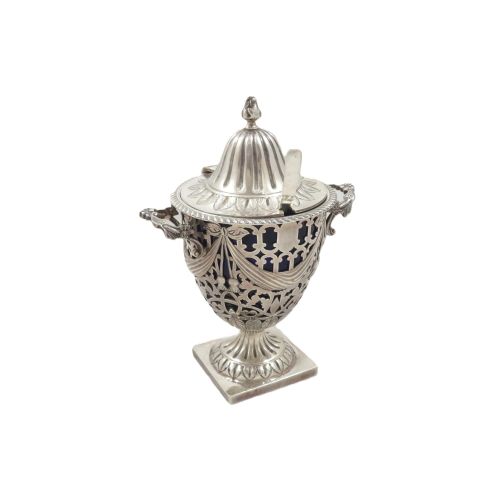
The antique blue glass urn and its close relatives encompass decorative vases, ornamental ewer lamps, and lidded sugar baskets from the Victorian, Edwardian, and Art Deco periods. These pieces serve primarily as decorative focal points, drawing the eye with rich shades of cobalt, sapphire, and blue satin glass.
Buyers frequently encounter Victorian and late nineteenth-century examples alongside later twentieth-century designs influenced by Art Nouveau and French Empire styles. Forms range from classical Grecian silhouettes to pressed glass vessels and pieces embellished with metal mounts.
Origins span English, French, and Scottish workshops, reflecting diverse regional techniques in coloured glass production. Whether configured as lidded vessels or table lamps, these objects combine utility with strong ornamental presence.
Materials and construction
Makers shaped these vessels using blown, pressed, and cut glass techniques, frequently employing cobalt or opalescent glass to achieve intense colour saturation. Cut-to-clear methods reveal contrasting layers by removing surface colour to expose clear glass beneath.
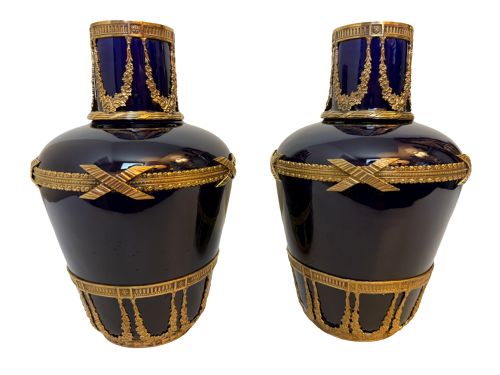
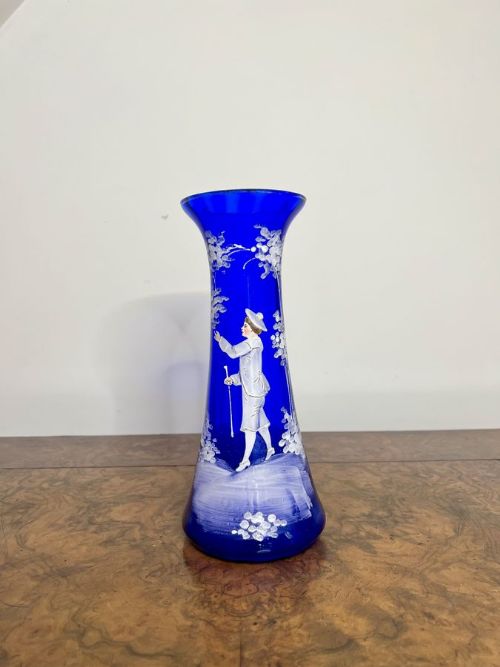
Metal components such as ormolu, bronze, sterling silver, and pewter provide structural mounts, handles, and overlays. Enamel painting and surface gilding frequently add decorative detail directly onto the glass body.
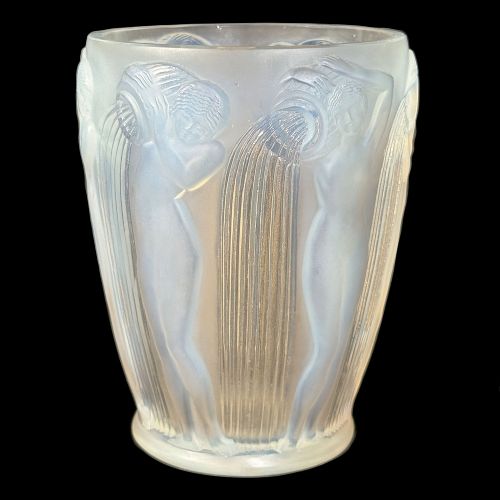
Water carriers and mythical nymphs occasionally make unexpected appearances frozen in opalescent glass.
Assessing quality
Quality rests upon the depth of the glass colour and the precision of any cut or enamelled decoration applied to the surface. Heavier glass bodies and well-defined cutting indicate careful craftsmanship during shaping.
The integration of metal mounts, whether ormolu trim or sterling silver lids, distinguishes standard production from finer ornamental pieces. Makers who achieved harmonious proportions between the glass vessel and its metal fittings command greater attention.
R Lalique·René Lalique·Monart
The Antique Blue Glass Urn Glossary
- Cobalt glass
- Glass coloured deep blue by the addition of cobalt oxide during the melting process. This intense hue remains stable and characteristic of nineteenth-century decorative wares.
- Ormolu
- Gilded bronze or brass mounts applied to decorative objects. It provides a bright metallic contrast against dark blue glass.
- Opalescent glass
- Glass that exhibits a milky, milky-blue translucency with iridescent highlights. It scatters light differently depending on the viewing angle.
- Cut-to-clear
- A technique where a coloured outer layer of glass is cut away to expose clear glass beneath, creating a patterned design. This requires skilled hand-cutting.
- Satin glass
- Glass treated with an acid bath to produce a velvety, matte finish rather than a high gloss. It softens the appearance of the underlying colour.
Antique Blue Glass Urn: Frequently Asked Questions
What periods do these pieces date from?
The pieces span from the late nineteenth century through the Art Deco era of the 1930s. Victorian and Edwardian examples predominate alongside French and Scottish works.
Specific dates are often identified through stylistic markers and mounting techniques typical of each decade.
How were these blue glass urns used?
Most functioned as ornamental display pieces on mantelpieces, side tables, or cabinets. Some were adapted as table lamps or utilised as lidded sugar vessels.
Their primary purpose was visual enrichment rather than everyday domestic utility.
How do I care for antique glass?
Dust gently with a soft, dry cloth to prevent accumulation on textured or enamelled surfaces. Avoid harsh chemical cleaners that might damage painted details or metal mounts.
Keep pieces away from direct, intense sunlight to protect the integrity of the coloured glass.
How do I identify French Empire style?
French Empire pieces typically incorporate classical architectural motifs and ornate ormolu metalwork. The forms lean towards formal symmetry and Greco-Roman inspiration.
Mounts are usually heavy and cast with careful attention to decorative detail.
What is cut to clear glass?
Cut-to-clear glass involves a vessel made with a thin outer layer of coloured glass over a clear body. Artisans grind away portions of the outer layer to form geometric or floral patterns.
The resulting contrast highlights the skill of the glass cutter.