
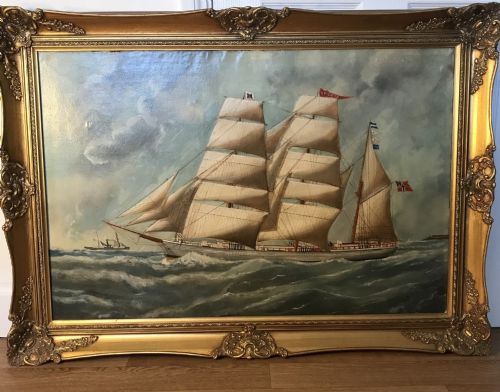


Antique Barque Sailing Ship
An antique barque sailing ship captures the romance of deep-water commerce in oil, watercolour, and diorama form.
Antique Barque Sailing Ship
When you search for an antique barque sailing ship, you encounter maritime artworks and decorative objects dedicated to three-masted and four-masted merchant vessels. The pieces available span the nineteenth century, the Victorian era, the Edwardian period, and the nineteen-thirties.
The most common formats on this page are oil paintings and watercolours depicting named vessels at anchor or under full sail. Alongside flat art, you find maritime dioramas and decorative bookends capturing the silhouette of these square-rigged working ships.
Materials and construction methods
Makers recorded these subjects using traditional fine art materials such as oil on canvas, watercolour on paper, and ink, housed within giltwood frames. Maritime dioramas incorporate sculpted wooden models and painted glass backgrounds to create three-dimensional depth.
Decorative objects utilise brass and wood to form structural items like bookends depicting tall ships. Artists rendered hulls, rigging, and coastal waters with precise brushwork informed by first-hand observation of nineteenth-century ports.
Materials represented include oil on canvas, watercolour, paper, wood, glass, and giltwood.
Assessing quality and execution
Quality rests upon the artist's command of maritime architecture, spatial perspective, and atmospheric conditions such as choppy waters or coastal light. Finer works accurately delineate rigging, hull forms, and the specific characteristics of named vessels like the Limbe or the Sindia.
The sophistication of the medium also distinguishes the selection, moving from decorative bookends and models to detailed Victorian and Edwardian watercolours and historical oil paintings by listed artists.
Charles William Adderton·Marie-Edouard Adam·Samuel John Milton Brown
The Antique Barque Sailing Ship Glossary
- Barque
- A sailing vessel with three or more masts, having the foremast and mainmast square-rigged and the mizzenmast fore-and-aft rigged. This rig allowed efficient ocean passages with smaller crews.
- Diorama
- A three-dimensional scene depicting ships, often set within a glazed wooden case featuring a painted backdrop and modelled water. These items combine model-making with maritime painting.
- Giltwood
- Wood carved and covered with a thin layer of gold leaf or gold paint. Frames of this finish frequently enclose nineteenth-century marine paintings.
- Watercolour
- A painting method in which the paints are made of pigments suspended in a water-based solution. Many maritime works from the Victorian and Edwardian periods utilise this medium on paper.
Antique Barque Sailing Ship: Frequently Asked Questions
What is an antique barque?
A barque is a sailing ship with at least three masts possessing square sails on the forward masts and gaff sails on the rearmost mast. These vessels formed the backbone of nineteenth-century deep-water trade.
Antiques depicting them record the era of commercial sail through paintings, watercolours, and dioramas created by contemporary marine artists.
How do I date a maritime painting?
Dating relies on stylistic clues, framing materials, artist signatures, and the specific rig or design of the depicted vessels. Victorian and Edwardian works often bear signatures or period framing conventions.
Paintings from the nineteenth century typically emphasise detailed rigging and named merchant vessels documented in shipping records.
Where were these marine artworks displayed?
Original owners included shipowners, master mariners, and merchants who decorated their homes and offices with portraits of specific vessels. These pieces celebrated family ties to maritime commerce and distant ports.
Today, they suit studies, living rooms, and libraries where maritime heritage forms part of the interior style.
What is a maritime diorama?
A maritime diorama is a shadow box or glazed case containing a half-hull or full-hull model set against a painted canvas background. The foreground often uses sculpted plaster or glass to simulate waves.
Victorian sailors and specialist craftsmen constructed these pieces to portray ships in realistic coastal or open-sea settings.