




Antique Barn Painting
These antique barn painting works capture rustic farmyards, sheltering livestock and rural life in oil on canvas.
Antique Barn Painting
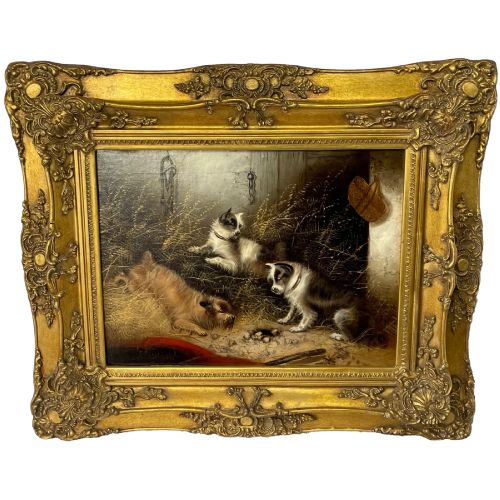
An antique barn painting depicts rural scenes centred on farm buildings, stables, and agricultural yards, often populated by livestock, working horses, or farm dogs. The works recorded here span from the eighteenth century through the Victorian era into the early twentieth century, capturing changing approaches to pastoral life.
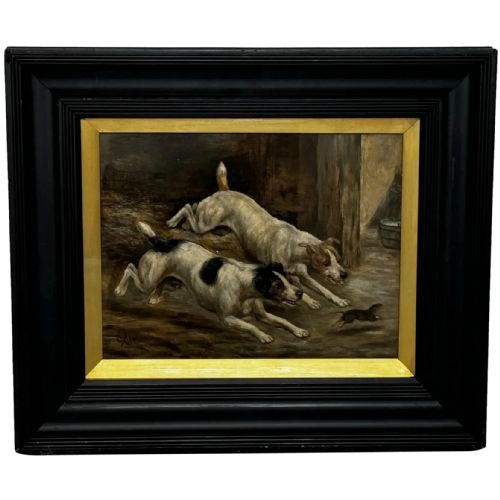
The most common examples on this page are oil paintings on canvas or wood panel, alongside occasional watercolours. They range from detailed Victorian genre scenes of terriers ratting in barns to broader impressionistic Yorkshire landscapes and French provincial views.
Materials and methods
Artists painted primarily with oil paint upon stretched canvas or wooden panels, sometimes applying gesso preparations to create a smooth ground. Many works are housed in period giltwood frames, occasionally enriched with gold leaf detail.
Support materials vary from canvas board to traditional wood panels, while framing often reflects the aesthetic tastes of the Victorian period or the early twentieth century.
Evaluating quality
Quality rests in the handling of light within the shadowy interior of a barn and the anatomical accuracy of the animals depicted, whether working horses, sheep, or terrier dogs. Stronger compositions demonstrate confident brushwork and a cohesive sense of atmosphere rather than stiff mechanical rendering.
The distinction between a standard topographical record and a superior piece lies in the artist's ability to convey texture, from weathered timber and straw to the coats of livestock.
Julius Caesar Ibbetson·Thomas Sidney Cooper·Ernest Higgins Rigg·Herbert Royle·Owen Bowen·Anthonij Anton Mauve·Frank Moss Bennett·Thomas Blinks·Paul Henry Schouten·John Falconer Slater
The Antique Barn Painting Glossary
- Oil on Canvas
- Pigment mixed with drying oil applied to a woven fabric stretched across a wooden frame. This method became the dominant medium for fine art painting across the nineteenth century.
- Gesso
- A paint mixture consisting of a neutral binder mixed with chalk, gypsum, or pigment used to prepare a substrate such as wood or canvas for painting. It provides a smooth, stable surface for oil application.
- Giltwood
- Wood carved and treated with a thin layer of gold leaf or metallic powder to resemble solid gold. It was widely utilised for decorative antique picture frames.
- Genre Painting
- The pictorial representation of scenes from everyday life, typically involving ordinary people at work or leisure. In this context, it describes farmyard scenes, animal studies, and rural labour.
Antique Barn Painting: Frequently Asked Questions
What subjects appear in these paintings?
These works focus primarily on rural agricultural subjects, including farmyards, stables, and barns sheltering livestock like sheep, cattle, and horses. Many also feature working farm dogs, poultry, and figures engaged in daily agricultural labour.
The perspective frequently shifts between the dim interior of a timber barn and the sunlit yard outside, capturing the quiet rhythm of nineteenth and early twentieth-century country life.
How do I date a barn painting?
Dating relies on stylistic clues, framing, and the specific material support used by the artist. Victorian pieces often display detailed narrative realism, while works from the early twentieth century lean towards impressionistic brushwork.
Signatures, artist records, and the construction of the wooden stretcher or panel offer further chronological markers to narrow down the period.
Are these works always signed by the artist?
Many pieces feature a visible signature or monogram, while others remain attributed to a specific school or follower of a known master. Unsigned works are evaluated through technique, palette, and subject matter to determine their likely origin.
Documentation or historical labels on the reverse of the canvas often provide additional context regarding the creator.
How should I display an oil painting?
Display the artwork away from direct sunlight and significant fluctuations in temperature or humidity to protect the oil paint and canvas. Maintaining a stable environment prevents cracking in the paint layer and warping in the wooden stretcher.
Ensure the painting hangs securely using appropriate hardware suited to the weight of the giltwood frame and the wall surface.