
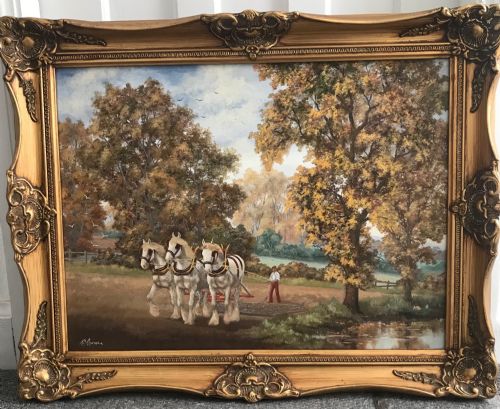

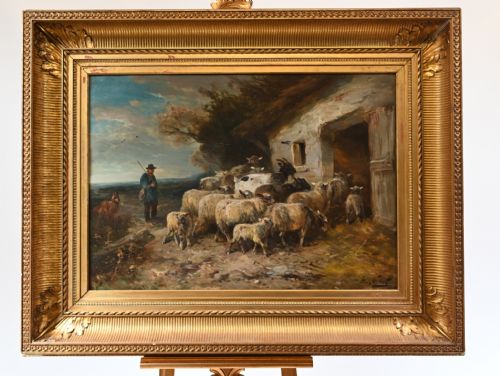
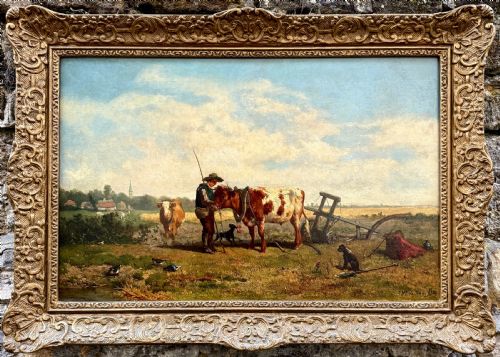


Antique Agricultural Wall Art
Antique agricultural wall art brings rural labour, livestock and harvest scenes from past centuries directly into modern interiors.
Antique Agricultural Wall Art
Antique agricultural wall art encompasses framed paintings, watercolours and prints depicting rural life, farm workers, and working animals. These works capture historic farming practices through the eyes of Victorian and early twentieth-century artists.
The pieces on this page are predominantly oil paintings and watercolours on canvas or paper, originating from the nineteenth and early twentieth centuries. Subjects range from heavy horses and cattle in stables to expansive haymaking and harvest landscapes.
Buyers encounter traditional realism, British Impressionism and French Provincial styles alongside functional wooden items like drying racks and threshing boards adapted for display. These objects reflect a vanished agrarian economy preserved through visual art and country craftsmanship.
Materials and construction
Painters of these rural scenes worked primarily with oil paint or watercolour applied to canvas, wood panels, or heavy paper. Canvases are typically stretched over wooden frames, while watercolours rely on paper supports protected beneath glass.
Framed pieces often utilise moulded timber, sometimes accented with gesso details to complement the painting within. Structural items like threshing boards and shoulder yokes employ solid native woods such as elm and beech, shaped by hand for agricultural use.
Listings feature works spanning the nineteenth and early twentieth centuries, capturing the transition from manual farming to early mechanisation.
Determinants of quality
The fidelity of anatomical drawing in animals and the convincing depiction of human labour separate accomplished works from naive or formulaic compositions. Master painters manage natural light and atmospheric perspective to give depth to harvest fields and stable interiors.
The integrity of the original support, stability of the paint surface, and preservation of the historic frame influence the overall standard of a piece. Works retaining their initial framing materials offer a more complete historical context.
Henry Schouten·Johannes de Haas·Raimond Louis Lecourt·Henry Bailey·Percival Glenfern·James William Booth·George Soper·Arthur Winter Shaw·Thomas Sidney Cooper·Arthur Charles Dodd·Vernon Stokes·Herbert Royle·Rowland Henry Hill·W.A. Clark·Joseph Paulman·John Percy Cooke·Walter Duncan·George Cole·William Huggins·William Sidney Cooper·George Graham·Charles James Adams·George Wright
The Antique Agricultural Wall Art Glossary
- Oil painting
- A work executed with pigments bound in a drying oil, usually linseed, applied to canvas or wood. This medium allowed artists to build rich textures and deep tones suitable for rural landscapes.
- Watercolour
- A painting method where fine pigment powders are suspended in a water-soluble binder, traditionally painted on paper. It produces translucent washes ideal for capturing soft morning light over farm fields.
- Gesso
- A plaster mixture applied to wooden frames as a base for moulding decorative details. It provides a smooth surface for subsequent gilding or painting.
- Threshing board
- A heavy wooden agricultural implement studded with flints or metal teeth, used historically to separate grain from straw. Surviving examples are often mounted on walls as primitive wooden sculpture.
- Shoulder yoke
- A curved wooden device carved to fit across the shoulders for carrying buckets or milk pails. Beech and elm examples display traditional rural craftsmanship.
Antique Agricultural Wall Art: Frequently Asked Questions
What subjects appear in antique agricultural wall art?
These works focus primarily on rural labour, farmyard animals, and seasonal harvests. Common motifs include shire horses ploughing fields, cattle resting in stables, and farmhands gathering hay.
Artists documented the realities of country life before mechanisation transformed agriculture. The imagery emphasises the interdependence of humans, animals, and the land.
How do I date an antique painting?
Dating relies on stylistic clues, artist signatures, framing methods, and the physical condition of the canvas or paper. Mid-nineteenth-century works often feature tighter academic realism, while later Edwardian pieces show looser brushwork influenced by impressionism.
Backboards, stretcher frames, and handwritten inscriptions on the reverse frequently provide additional chronological evidence. Comparing the technique to known dated works by the same artist helps narrow the timeline.
Where should I hang these heavy wooden pieces?
Structural items like threshing boards and shoulder yokes require secure wall fixings anchored directly into masonry or studs. Their substantial weight demands sturdy hardware rather than standard picture hooks.
Keep them away from direct heat sources such as radiators to prevent the dry wood from splitting. Positioning them at eye level allows the hand-worked textures to be appreciated fully.
Are watercolours as durable as oil paintings?
Watercolours on paper are more sensitive to light and moisture than oil paintings on canvas. They require protective framing behind glass and should be kept out of direct sunlight to prevent fading.
Oil paint forms a resilient film that withstands normal indoor environments more robustly. Both mediums benefit from stable room temperatures and moderate humidity levels.