

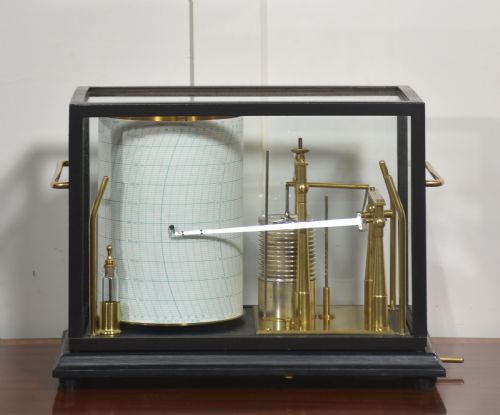
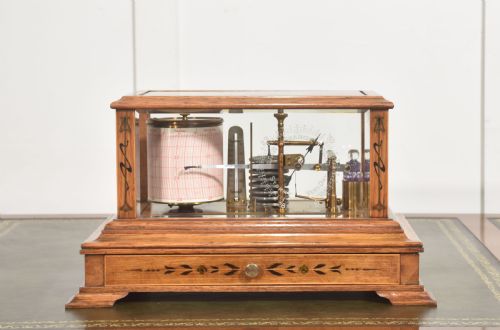


Aneroid Barograph Case
An aneroid barograph case houses a delicate mechanical weather-recording instrument that tracks atmospheric pressure over time.
Aneroid Barograph Case
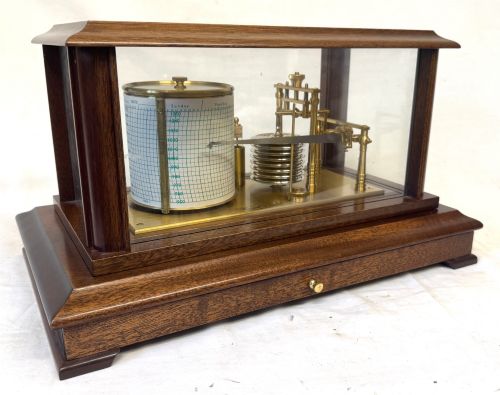
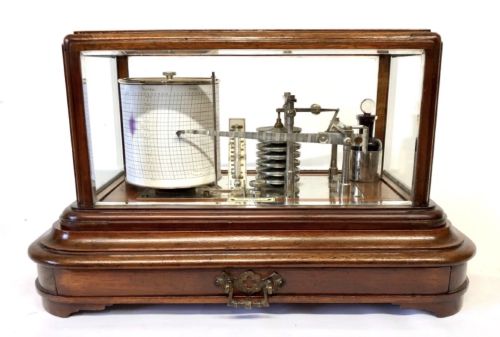
When you search for an aneroid barograph case, you are looking at enclosures built to protect and display self-recording meteorological instruments. These timber and glass housings preserve the barometer mechanism while allowing an uninterrupted view of the revolving drum and pen arm. The version you are most likely to meet on this page is the traditional table model featuring panelled wood and bevelled glass panes.
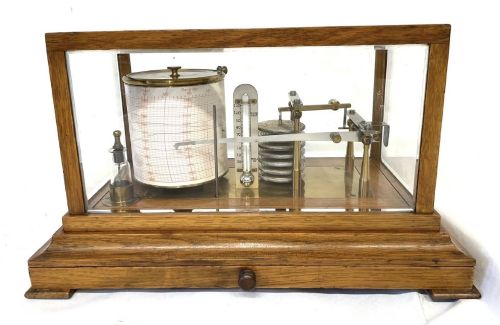
The objects span from the Victorian and Edwardian eras through to the mid-twentieth century, capturing shifts in scientific instrument housing. Oak and mahogany dominate the offerings, frequently incorporating small drawers beneath the main chamber for spare paper charts and ink bottles. Makers ranged from provincial British retailers to notable London scientific instrument firms.
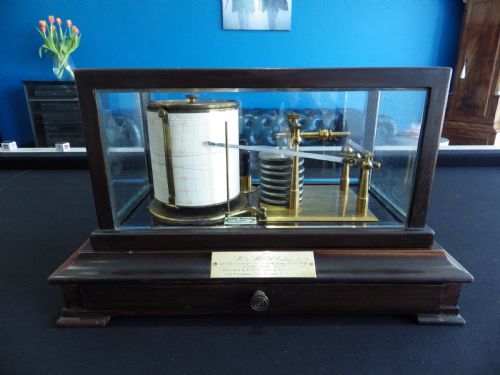
Many examples integrate additional weather indicators such as thermometers mounted on the wooden bed or supplementary barometer dials set into the front fascia. Some pieces bear retailer plaques or maker signatures on the metal bedplate or paper scale, linking the scientific apparatus to specific shops across Britain and the wider empire. The primary purpose remains the visual display of changing air pressure housed within a domestic cabinet.
What varies in quality
Quality in these housings rests on the choice of timber, the weight and clarity of the glass, and the crispness of any inlaid decorative details. Superior examples utilise dense, well-figured mahogany or quarter-sawn oak with heavy bevelled glass panes that fit flush into tight mitred frames. Lesser pieces rely on simpler butt joints, thinner timber boards, and plain flat glass.
The integration of auxiliary instruments distinguishes finer workshop output from standard commercial production. Models featuring supplementary thermometers, secondary aneroid dials, or fitted chart drawers demonstrate a higher grade of manufacture. Maker attribution also alters the character of the piece, with signed brass beds by established scientific houses marking out superior specimens.
Aneroid Barograph Case Retail Price Guide 2026
Typical asking prices for aneroid barograph case among the pieces listed under this phrase on Sellingantiques today, from the lower quarter to the upper quarter. They describe what is for sale here now, not the wider market.
Many chart drawers still retain unused vintage recording papers from decades past.
Short and Mason·Negretti and Zambra·Richard Freres·Gaupp and Co·Robson of Newcastle·R Fuess
The Aneroid Barograph Case Glossary
- Aneroid barograph
- A self-recording barometer that measures atmospheric pressure using expanding metal bellows without liquid mercury.
- Five-glass case
- A traditional housing style featuring a flat top and four vertical glass sides set in a wooden frame.
- Bevelled glass
- Glass panes with angled, polished edges that catch the light and fit neatly into the cabinet woodwork.
- Chart drawer
- A small shallow compartment built into the wooden base of the case to hold spare recording papers.
- Chapter ring
- The circular metal dial face engraved with pressure graduations and weather descriptions.
Aneroid Barograph Case: Frequently Asked Questions
What is an aneroid barograph?
An aneroid barograph is a mechanical instrument that records continuous atmospheric pressure onto a revolving paper chart without using liquid.
Inside the brass mechanism, stacked vacuum chambers expand and contract with air pressure changes, moving a pen arm across a clockwork drum.
How do you change the chart paper?
You lift the glass and wood cover straight up off the wooden base to expose the rotating brass drum.
The paper chart clips around the cylinder, and you gently lift the pen arm before replacing the sheet each week.
Where were these instruments placed?
Owners kept them in studies, hallways, and libraries where guests could observe daily weather patterns and atmospheric trends.
They sat flat on tabletops or sideboards away from direct sunlight and heavy heat sources to ensure accurate pressure readings.
How do you date an oak or mahogany case?
Stylistic clues such as Art Nouveau inlay, Edwardian proportions, and Victorian mouldings help establish the manufacturing period.
Maker signatures, retailer plaques, and serial numbers on the metal bedplate also provide chronological reference points.