

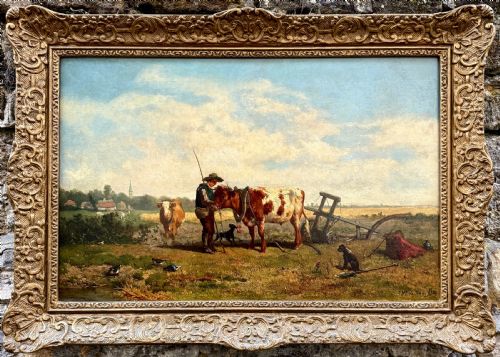


Agricultural Landscape Oil Painting
An agricultural landscape oil painting brings rural working life and working animals directly onto the wall.
Agricultural Landscape Oil Painting
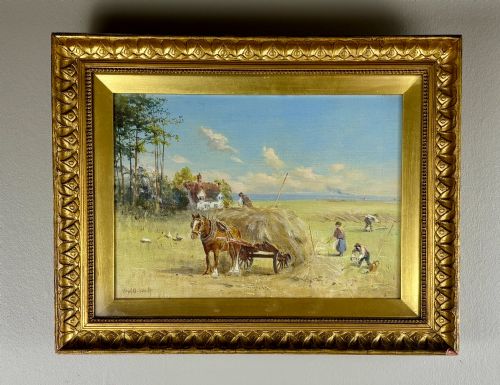
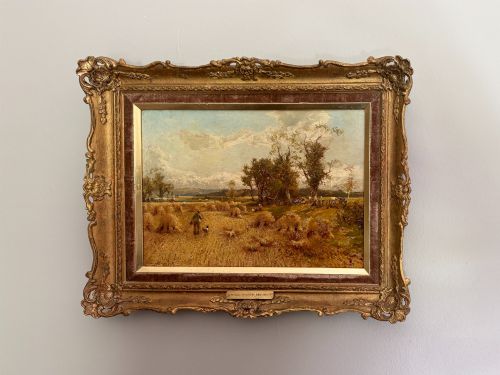
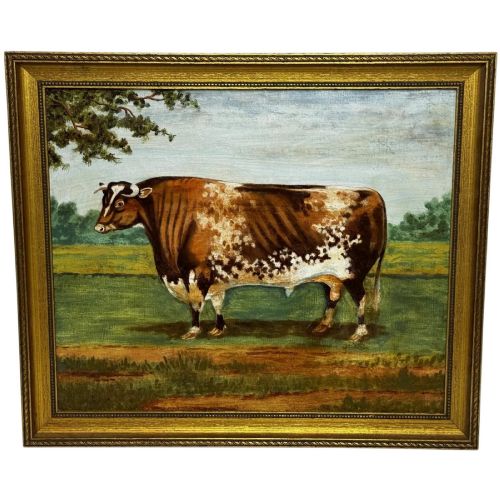
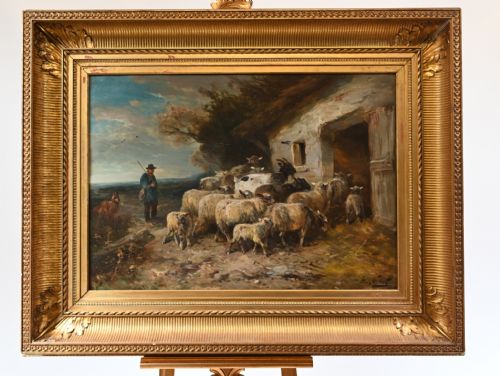
An agricultural landscape oil painting captures farming scenes, harvest times, and rural animal portraits across the nineteenth and twentieth centuries. These works record ploughing teams, shire horses, hay carts, and cattle within traditional country settings.
The pieces on this page span Victorian Realism, British Impressionism, and traditional country styles. Works range from intimate depictions of farmyards to large canvases depicting heavy horses at work.
Subjects frequently combine working animals with human labourers, depicting sheep flocks, dairy cattle, and farmworkers engaged in seasonal harvests. Dating stretches from the mid-nineteenth century through the Edwardian period up to the mid-twentieth century.
How they were made
Artists painted primarily using oil paint applied to canvas or wood panels. Canvases were stretched and secured within period frames, often complemented by gesso mouldings or ebonised and gilt finishes.
Brushes and palette knives built up layered pigments to render natural light, atmospheric conditions, and the textured coats of working horses and cattle. Signatures and dates were frequently inscribed directly into the lower margins of the composition.
The documented periods span from mid-nineteenth century Victorian works through to mid-twentieth century naive school interpretations.
What varies in quality
Quality rests upon the artist's handling of anatomical proportion in animals and the perspective within the wider landscape. Masterful works convey the heavy musculature of shire horses and the natural play of daylight across harvest fields with convincing depth.
The strength of the composition and the preservation of the original canvas and frame set apart finer examples. Brushwork execution ranges from tight academic realism to looser impressionistic strokes.
Henry Schouten·Johannes de Haas·A M Gauci·Raimond Louis Lecourt·Herbert Royle·Percival Glenfern·J.C. Grey·James William Booth·Arthur Winter Shaw·Arthur Charles Dodd·Vernon Stokes·W.A. Clark·Joseph Paulman·J L VAN Leemputten·Frederick William Jackson·JOHN PERCY COOKE·W E Millner·Ernest Higgins Rigg·George Cole·William Greaves·Owen Bowen·William Huggins·William Sidney Cooper·William Kay Blacklock·Frederick J Haycock
The Agricultural Landscape Oil Painting Glossary
- British Impressionism
- A painting style influenced by the French movement, focusing on natural light, outdoor settings, and looser brushwork. Artists working in this manner often captured rural scenes en plein air.
- Gesso
- A plaster-like mixture applied to wooden frames as a base for gilding or paint. It provides a smooth surface for decorative mouldings.
- Genre painting
- The pictorial representation of scenes from everyday life, including agricultural workers and farmyard activities. These works document social history alongside natural scenery.
- Canvas
- A heavy woven fabric used as a surface for oil painting. It is typically stretched tightly over a wooden frame before application.
- Realism
- An artistic movement dedicated to representing subject matter truthfully without artificiality. In rural contexts, this involves accurate depictions of farm animals, labourers, and implements.
Agricultural Landscape Oil Painting: Frequently Asked Questions
What periods do these paintings come from?
The works span from the mid-nineteenth century through the Victorian and Edwardian eras, extending into the mid-twentieth century. Styles shift from academic Victorian Realism toward British Impressionist landscape approaches.
Dates are often recorded directly on the canvas or within artist signatures, reflecting changing rural traditions across generations.
How were these agricultural scenes used?
These paintings served primarily as decorative fine art for domestic interiors, celebrating the economic and cultural importance of farming life. Wealthy patrons and agrarian enthusiasts commissioned or purchased them to display rural prosperity.
They functioned as both portraits of prized livestock and records of changing seasonal labour on the land.
How do I live with an oil painting?
Oil paintings on canvas benefit from placement away from direct sunlight and excessive humidity fluctuations. Stable indoor environments help preserve the integrity of the canvas and underlying gesso frames.
Routine dusting with a soft, dry cloth keeps the surface clear without risking moisture damage to the pigment.
How do I tell different artistic styles apart?
Victorian Realism relies on precise detail, careful anatomy, and finished brushwork to document farm animals and machinery accurately. Impressionist and later works utilise looser strokes and looser colour blending to capture transient atmospheric effects.
Examining the treatment of light and shadow helps distinguish academic studio compositions from outdoor field studies.