

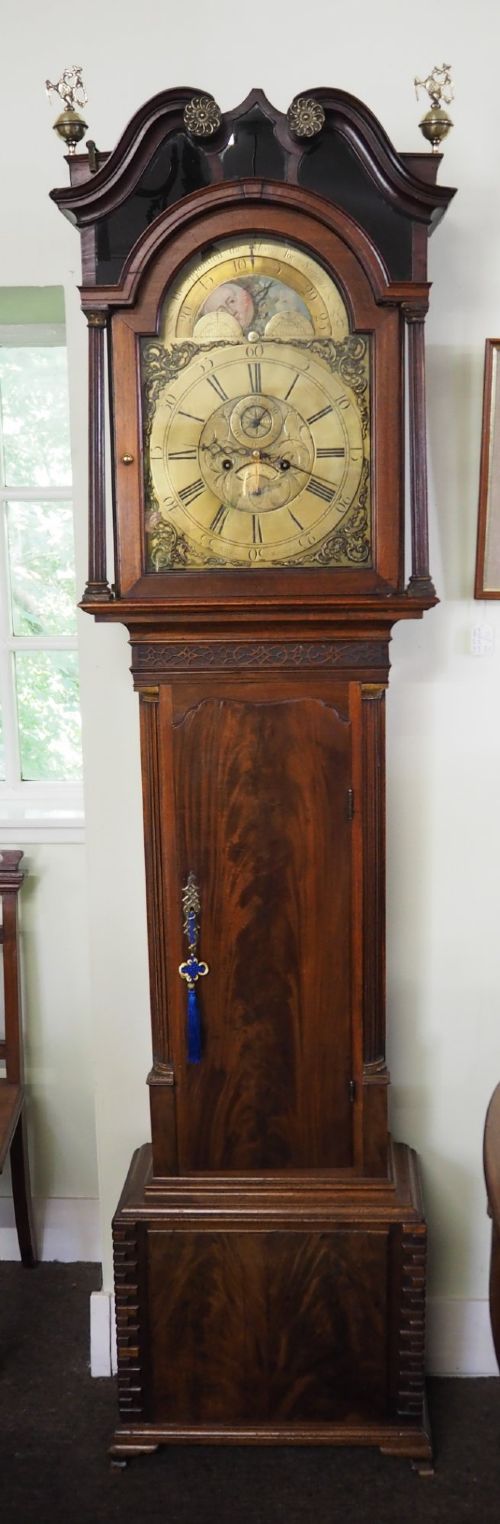


8 Day Weight Driven Clock
An 8 day weight driven clock is a dependable timepiece requiring weekly winding, bringing traditional mechanics and rich cabinetwork into the home.
8 Day Weight Driven Clock
An 8 day weight driven clock runs for slightly over a week on a single descent of its weights, appearing in forms such as tall longcase clocks, wall clocks, and miniature grandmother clocks. When searching for an 8 day weight driven clock, buyers encounter towering floor-standing cabinets as well as more compact wall-hanging formats.
The periods represented stretch across the Georgian and Victorian eras, alongside specific dates from the eighteenth and nineteenth centuries up to the early twentieth century. Common formats include longcase clocks, drum head longcase clocks, and wall clocks, reflecting domestic horology from various British and regional origins.
Makers recorded on these pieces include Lee of Great Marlow, Francis Perigal of Bond Street, Wm Stanford of Great Yarmouth, Rob Parry Pwllheli, and JJ Elliot. These range from provincial workshops to notable London horologists, alongside French provincial examples and lacquered or Chinoiserie decorative treatments.
Distinctions in quality
Quality rests in the precision of the brass movement and the sophistication of the cabinet timber, distinguishing simple regional items from signed London masterwork pieces. Finer examples display crisp dial engraving, substantial architectural proportions, and cabinetwork executed in well-figured mahogany or walnut.
Decorative treatments also separate standard production from high-end commissions, seen in specialised elements like strike-silent mechanisms, lacquered green Chinoiserie finishes, or miniature Westminster chime systems. The integration of movement and case reflects the original maker's ambition and workshop standards.
8 Day Weight Driven Clock Retail Price Guide 2026
Typical asking prices for 8 day weight driven clock among the pieces listed under this phrase on Sellingantiques today, from the lower quarter to the upper quarter. They describe what is for sale here now, not the wider market.
Listings feature woods including mahogany, oak, walnut, and ebonised wood alongside brass and glass components across Georgian and Victorian periods.
Lee of Great Marlow·Francis Perigal of Bond Street·Wm Stanford·Rob Parry Pwllheli·JJ Elliot
The 8 Day Weight Driven Clock Glossary
- Longcase clock
- A tall pendulum clock enclosed in a wooden case with a weighted movement, commonly known as a grandfather clock. These standing timepieces protect the delicate cords, weights, and pendulum from dust and disturbance.
- Drum head longcase clock
- A tall clock featuring a circular dial housing resembling a drum mounted atop a narrow trunk. This distinctive Victorian format combines the height of a floor-standing case with a compact dial profile.
- Grandmother clock
- A scaled-down version of the traditional longcase clock, typically produced during the early twentieth century. They offer the mechanical complexity of weight-driven movements within a reduced overall height.
- Strike-silent
- A mechanism allowing the striking train of the clock to be manually silenced while the timekeeping continues uninterrupted. This function prevented the hourly chimes from disturbing household occupants during the night.
- Arch dial
- A clock face featuring a curved semi-circular section at the top, often displaying subsidiary dials, maker signatures, or moon phases. This upper section provides space for mechanical additions and artistic embellishment.
8 Day Weight Driven Clock: Frequently Asked Questions
How do weight driven clocks work?
These movements rely on gravity pulling heavy metal weights downward, which are suspended by cords or chains wrapped around internal drums. As the weights descend over an eight-day period, they turn the gear train that powers the hands and escapement.
To keep the clock running, the weights must be manually pulled back up to the top using a winding key inserted through the dial face. This simple mechanical cycle repeats every week without requiring electricity or mainsprings.
Where should I place a longcase clock?
Tall timepieces require a stable, level floor and a secure attachment to the wall behind the upper trunk to prevent accidental tipping. Keeping the cabinet away from direct sunlight and strong temperature fluctuations protects the wooden veneer and internal mechanics.
Choose a quiet room where the steady ticking and hourly chime can be appreciated without causing disruption. Adequate clearance above the case is also necessary for easy access during the weekly weight winding process.
How do I tell Georgian and Victorian clocks apart?
Georgian examples, dating from the eighteenth and early nineteenth centuries, frequently display simpler architectural lines, brass dial plates, and casework in figured mahogany, walnut, or oak. Provincial pieces from this period often show charming regional variations in dial painting and cabinet proportions.
Victorian pieces tend to feature heavier, more imposing proportions, often incorporating ebonised wood, arch dials, or specialised chime movements. Drum head cases and miniature grandmother clocks also emerge more prominently in the later nineteenth and early twentieth century periods.
What maintenance do these clocks need?
Routine upkeep involves regular winding every eight days and ensuring the pendulum remains properly set to keep accurate time. Environmental stability is crucial, as drastic humidity changes can cause the wooden cases to swell and affect door alignment.
Periodically, the mechanical movement requires professional cleaning and oiling to remove accumulated dust and prevent wear on the brass pivots and gears. Leaving complex internal repairs to a qualified horologist ensures the survival of original components.