
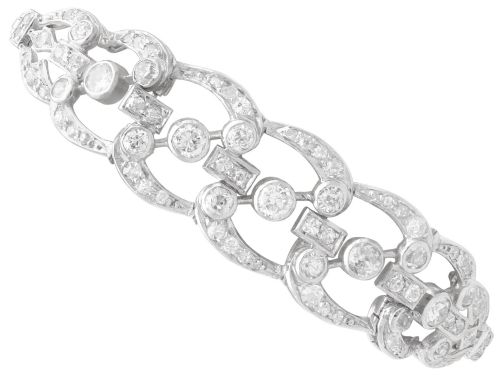
3 Carat Diamond Bracelet
A 3 carat diamond bracelet brings together old-cut stones and precious metal in a wrist ornament designed to catch the light with every movement.
3 Carat Diamond Bracelet
When you search for a 3 carat diamond bracelet, you are looking at wrist jewellery set with multiple diamonds totalling approximately three carats in weight. These pieces span several eras, from the Victorian and Edwardian periods through to Art Deco and mid-century modern designs.
The most common forms you will meet on this page include flexible line bracelets and hinged bangles, alongside cocktail watches set with diamonds. Materials range from traditional yellow and rose gold to platinum and white gold, sometimes accented with sapphires, rubies, turquoises, or opals.
How they were made
Goldsmiths and jewellers constructed these bracelets using precious metals such as platinum, 15ct gold, and 18ct white or yellow gold to securely hold the gemstones. Metalwork techniques varied by period, employing delicate millegrain edges and pierced galleries in Edwardian and Art Deco pieces, and solid channel or prong settings for line bracelets.
Diamonds were hand-cut, featuring old mine cuts, old European cuts, and rose cuts depending on the decade of production. These stones were then meticulously set into rigid bangles with secure clasps or flexible links designed to drape smoothly around the wrist.
What varies in quality
Quality in these bracelets rests upon the integration of the stones with the metalwork, where superior examples exhibit precise stone matching and secure, flush settings. The calibre of the metal fabrication, whether a finely articulated platinum link or a robust gold hinge, dictates the durability and movement of the piece.
The selection and cutting of the diamonds themselves define the upper tier of the range, with well-matched old cuts displaying superior light return. Furthermore, the presence of original safety chains and unaltered hallmarks indicates a higher degree of preservation.
The 3 Carat Diamond Bracelet Glossary
- Old mine cut
- An early diamond cut characterised by a near-square girdle, high crown, and large culet. This cut was prevalent in the eighteenth and nineteenth centuries.
- Millegrain
- A decorative jewellery technique featuring a line of tiny beads along the edges of metal settings. It is frequently seen on Edwardian and Art Deco platinum work.
- Line bracelet
- A flexible bracelet featuring a continuous line of gemstones, typically diamonds, linked together in a symmetrical arrangement. This form became particularly popular in the twentieth century.
- Rose cut
- A vintage diamond cut featuring a flat base and a domed top faceted with triangles. This style produces a soft, translucent lustre rather than modern brilliant sparkle.
- Bangle
- A rigid bracelet that slips over the hand or opens on a hinge with a clasp. These often feature chased decoration or flush-set gemstones across the top surface.
3 Carat Diamond Bracelet: Frequently Asked Questions
How do I care for an antique diamond bracelet?
Wear the piece with care, avoiding contact with hard surfaces, chemicals, and cosmetics that might weaken older settings or discolour the gold and platinum.
Store the bracelet flat in a lined box to prevent tangling of flexible links or stress on antique hinges.
Are these bracelets suitable for daily wear?
Many sturdy platinum and gold designs handle regular wear well, provided the stone settings remain secure and checked periodically by a professional.
Delicate Edwardian filigree or Victorian gemstone bangles benefit from being reserved for occasional evening use to preserve their fragile components.
How can I tell the period of a bracelet?
Examine the metal choices, gemstone cuts, and manufacturing techniques, such as platinum use pointing towards the Edwardian and Art Deco eras. Rose or yellow gold combined with old mine or rose cut stones typically signals Victorian or early twentieth-century origin.
Look for hallmarks stamped on the clasp or inner band, which often provide clues to the city of assay and the year of manufacture.
What is the difference between a tennis bracelet and a line bracelet?
The terms are frequently used interchangeably to describe a symmetrical, flexible line of diamonds set around the entire wrist.
Historically, line bracelets encompass various metal mountings from the early twentieth century onwards, while the modern term tennis bracelet gained traction later.