

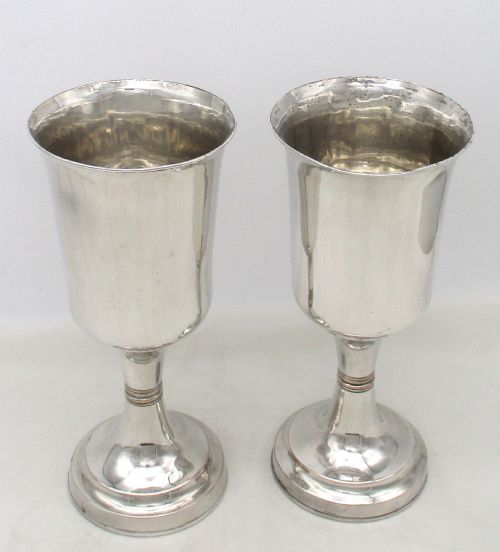


19th Century Silver Chalice
A 19th century silver chalice brings ecclesiastical gravity and grand dining ritual to the table, forged in sterling silver, Sheffield plate and export workshops.
19th Century Silver Chalice
A 19th century silver chalice encompasses heavy ecclesiastical communion vessels, monumental loving cups, and trophy cups produced across Victorian Britain, China, and India. The form ranges from austere church vessels to secular goblets decorated with parcel gilding and intricate repoussé work.
Buyers frequently encounter large Old Sheffield plate communion chalices alongside Victorian sterling silver goblets bearing hallmarks for makers such as George Unite. Styles span from Victorian and Gothic revival to Chinese export silver and Anglo-Indian Kutch designs.
Object types on this page vary from tall pairs of church chalices to singular loving cups and trophy cups. The 19th century output reflects both domestic liturgical needs and the bustling trade of nineteenth century export silver workshops.
How they were made
Many items utilise solid sterling silver or Old Sheffield plate, where a thin layer of silver is fused to a copper core. This foundational method provides durability while maintaining the lustre of precious metal across large communion vessels and loving cups.
Makers applied gold gilt and parcel gilding to the interior bowls and detailed accents of chalices, creating a striking contrast with polished exterior silver. Skilled artisans also employed deep repoussé chasing, seen in Chinese export pieces featuring koi carp and regional Indian Kutch motifs.
19th Century Silver Chalice Retail Price Guide 2026
Typical asking prices for 19th century silver chalice among the pieces listed under this phrase on Sellingantiques today, from the lower quarter to the upper quarter. They describe what is for sale here now, not the wider market.
Geographic origins range from Victorian Britain to Chinese export workshops in Hong Kong and Indian Kutch silversmiths.
What varies in quality
Quality rests upon the crispness of the chasing and the integrity of the underlying metal, distinguishing master workshops from standard production. Sterling silver examples with clear hallmarks command attention for their documentary value, whereas plated pieces depend entirely on the preservation of the silver layer over copper.
The artistic ambition of the form dictates distinction, separating simple utilitarian church vessels from elaborate Chinese export or Kutch trophy cups. Balance in the stem, weight in the foot, and the precision of parcel gilt interiors mark the higher tiers of nineteenth century metalwork.
George Unite·Wang Hing And Co Hong Kong·Zee Wo
The 19th Century Silver Chalice Glossary
- Old Sheffield Plate
- An early composite material made by fusing a sheet of silver to a thicker copper ingot under heat and pressure. This technique predates modern electroplating and leaves a characteristic subtle copper seam visible at edges.
- Parcel Gilt
- A decorative treatment where specific areas of an object, usually the interior bowl of a chalice, receive a thin coating of gold. It protects the silver from acidic contents and heightens the visual contrast.
- Repoussé
- A metalworking technique where the artisan hammers the design from the reverse side to form a raised relief on the front. It requires immense skill to control the metal thickness and achieve fine detail.
- Communion Chalice
- A sacred vessel utilised during the Christian Eucharist for sacramental wine. These pieces often possess deep bowls, knopped stems, and broad bases for stability during liturgical services.
- Chinese Export Silver
- Luxury silverware manufactured in China by local silversmiths for Western markets during the nineteenth century. These objects typically combine traditional Asian motifs like koi carp with European vessel forms.
19th Century Silver Chalice: Frequently Asked Questions
Were these chalices only used in church?
While many examples served solemn ecclesiastical roles for communion, a significant portion functioned as secular loving cups and athletic trophy cups. Dinners, banquets, and sporting clubs frequently commissioned large silver goblets to mark important occasions.
Secular pieces often display richer decorative chasing, such as marine life or regional foliage, compared to the austere sobriety required for church liturgy.
How can I tell Sheffield plate from solid silver?
Old Sheffield plate items lack standard town and maker hallmarks, often displaying subtle wear where the underlying copper peeks through high points or rims. A magnifying glass helps locate the faint seam line characteristic of fused plate.
Solid sterling silver pieces carry official assay marks including a lion passant, date letters, and maker initials. These hallmarks provide a precise anchor for dating the object.
How do I display a nineteenth century chalice?
Displaying these vessels benefits from secure shelving enclosed in glass cabinets to limit atmospheric tarnish and accidental knocks. Placing them away from direct sunlight protects any internal parcel gilding.
Pairing a tall pair of church chalices on a sideboard creates a strong focal point, while single trophy cups suit desk or bookcase placement.