




19th Century Medicine Box
A 19th century medicine box holds the bottled remedies and glass phials of the past within a fitted wooden case.
19th Century Medicine Box
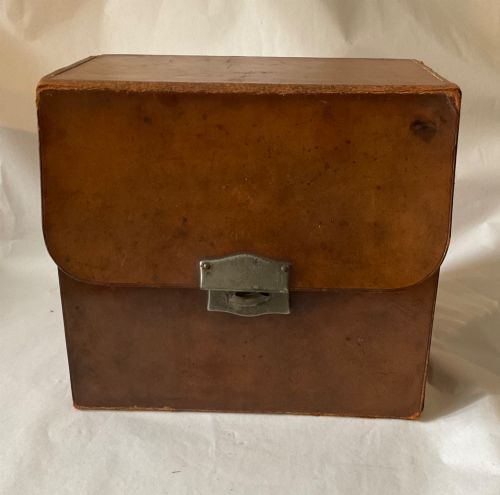
A 19th century medicine box serves as a portable dispensary or a tabletop cabinet designed to secure glass bottles, flasks, and apothecary equipment. These pieces take the form of compact travelling cases, fitted chests, and small wall cupboards originating across various European and Scandinavian regions.
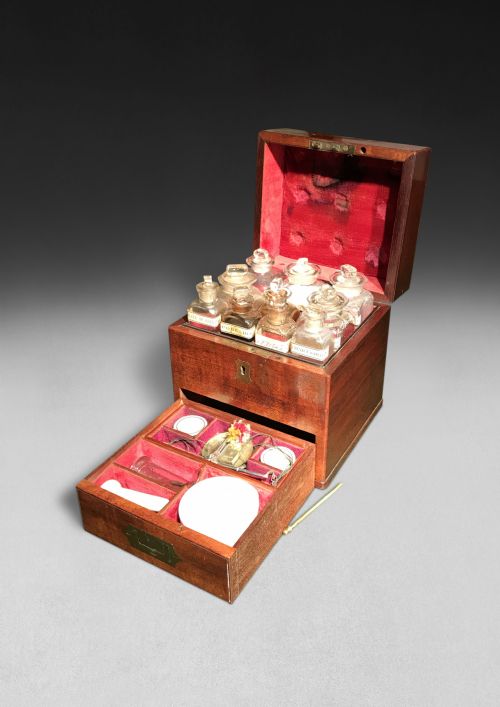
The selection on this page centres heavily on mahogany travelling cases and fitted boxes from the Regency and Victorian periods, often containing their original glass bottles and drawers. Alongside these traditional apothecary chests, one finds French silver and glass flask sets, spice cabinets, and polished wood display boxes.
Domestic medicine chests allowed households to manage their own treatments before modern pharmacies became widespread, while travelling versions accompanied doctors on journeys. The examples recorded here reflect this dual domestic and professional heritage through their diverse internal arrangements and locking mechanisms.
How they were made
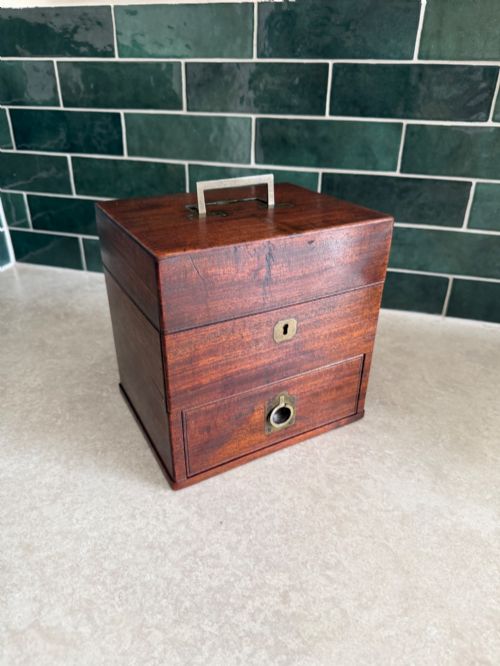
Timber selection dictated the construction of these boxes, with dense hardwoods like mahogany and burr walnut providing the structural integrity needed to protect fragile internal glass. Carpenters joined these woods using tight corner joints, frequently incorporating brass carrying handles, escutcheons, and locking mechanisms to withstand frequent travel.
Interiors were meticulously organised with fitted wooden partitions, velvet or leather linings, and dedicated slots to secure medicine bottles and pill boxes without movement. Glass phials and silver flasks were custom-blown and fitted precisely to the individual compartments of each chest.
Listings feature materials such as mahogany, brass, glass, velvet, leather, and paint across 19th century forms.
What varies in quality
The distinction between standard examples and superior pieces rests largely on the completeness of the original contents and the complexity of the internal fittings. Boxes that retain their original glass bottles, stoppers, and secondary drawers demonstrate a higher degree of preservation than those altered or emptied over time.
Cabinetwork quality appears in the precision of the timber matching, the integration of brass hardware, and the subtlety of inlay work such as stringing or contrasting wood panels. Finer pieces show careful attention to concealed compartments and robust locking mechanisms that remain fully operational.
The 19th Century Medicine Box Glossary
- Apothecary box
- A fitted wooden chest designed to hold medical bottles, scales, and ingredients for mixing remedies. These boxes feature internal partitions and secure locking lids.
- Regency
- An English design period spanning the early decades of the 19th century, known for classical restraint and clean mahogany surfaces. Pieces from this era often display refined brass inlay and minimalist hardware.
- Victorian
- The period covering the reign of Queen Victoria, characterised by robust construction and diverse domestic furniture styles. Medicine boxes from this era frequently employ burr walnut and heavier brass mounts.
- Escutcheon
- A protective brass plate surrounding a keyhole on the front of a box or cabinet. This hardware guards the surrounding wood from wear and secures the lock mechanism.
19th Century Medicine Box: Frequently Asked Questions
What did they keep inside?
These boxes held glass bottles of liquid remedies, powders, scales for measuring doses, and pill boxes for administering treatment.
They also contained small mixing jars and specialised equipment suited for domestic health maintenance or professional medical practice.
Were they used for travel?
Many examples were specifically constructed as travelling cases equipped with brass carrying handles and robust locks for transit.
Physicians and wealthy travellers relied on these compact wooden chests to transport necessary medicines safely on journeys.
How do I date a box?
Dating relies on observing the timber types, construction methods, and brass hardware styles characteristic of periods like the Regency or Victorian eras.
Internal paper labels, maker stamps, and the specific shape of the glass bottles also offer chronological clues.
Are the bottles usually original?
Survival rates vary, with some boxes retaining their complete set of original glass bottles while others have assembled contents or empty compartments.
Fitted wooden dividers often match the exact contours of the original glassware when it remains intact.