


19th Century Glass Urn
These 19th century glass urn pieces provide striking focal points through traditional craftsmanship and distinctive Victorian period forms.
19th Century Glass Urn
When you search for a 19th century glass urn, you encounter various decorative vessels shaped by Victorian and continental tastes. These objects function primarily as decorative ornaments, often appearing as lidded jars, garniture components or standalone display pieces.
The selections on this page span the broader Victorian era alongside specific decades, featuring forms shaped by Neoclassical revival and Bohemian glassmaking traditions. Vases, ewers, and sweetmeat jars dominate the available inventory, reflecting the diverse domestic display habits of the period.
Materials and methods
Makers utilised coloured, opaline, and satin glass as the primary substrate, applying techniques such as cutting, etching, and double-wall construction. Enamel painting, gold leaf, and polychromatic enamelling frequently adorn the exterior surfaces of these vessels.
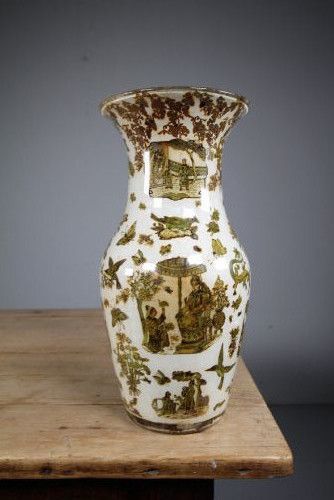
Many items incorporate overlaid glass or applied portraits, while others display intricate decalcomania transfers protected beneath glass layers. Workshops across England, Bohemia, and France employed distinct regional methods to achieve layered colour effects and structural depth.
Listings feature items from the 1850s through 1910, incorporating materials such as ormolu, giltwood, and satin glass alongside traditional blown vessels.
Assessing craftsmanship
The distinction between standard production and top-tier examples lies in the precision of the glass cutting and the hand-painted execution of motifs. Finely handled enamel work and crisply etched panels demonstrate superior workshop competency.
The depth of colour within the glass matrix and the integration of decorative elements reveal the maker's skill level. Superior pieces maintain harmonious proportions and careful finishing on secondary details such as lids and rims.
Gillows Of Lancaster·Varnish England·Moser·Richardson Vitrified·Harrach
The 19th Century Glass Urn Glossary
- Garniture set
- A coordinated group of ornamental vases or jars designed for symmetrical placement on a mantelpiece. These sets typically comprise a central tall vessel flanked by two matching smaller pieces.
- Opaline glass
- An opaque or translucent pale glass developed in France during the nineteenth century. It imitates porcelain while retaining the tactile qualities of blown glass.
- Decalcomania
- A technique where printed paper designs are transferred onto the interior of glass vessels and sealed. This method creates the illusion of hand-painting from the exterior perspective.
- Sweetmeat jar
- A covered glass vessel originally intended for holding sweetmeats or preserves. They often feature pedestal bases and finely cut lids.
- Cut to clear
- A method where a layer of coloured glass is overlaid on a clear glass body and partially cut away. This process exposes the contrasting clear layer underneath to form geometric or pictorial patterns.
19th Century Glass Urn: Frequently Asked Questions
How were glass urns used?
Nineteenth-century glass urns served primarily as decorative ornaments on mantelpieces, consoles, and side tables. They frequently formed part of garniture sets paired with clocks or candelabra.
Some lidded versions, such as sweetmeat jars, held confectionery or potpourri. Their placement in formal reception rooms demonstrated household taste and affluence.
How do I identify a Victorian glass piece?
Examine the weight, colour saturation, and surface decoration of the vessel. Victorian glass often employs rich cobalt blues, deep greens, or opaque opaline tones.
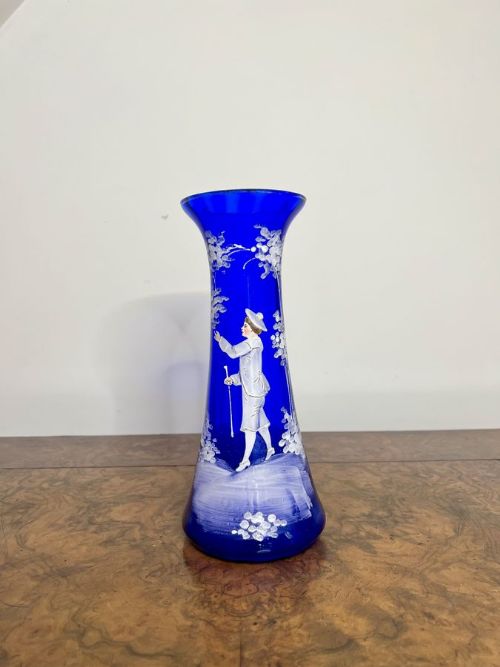
Signature techniques like Mary Gregory white enamel painting, cameo cutting, or acid etching help confirm the nineteenth-century production period.
What is Bohemian glass?
Bohemian glass originates from the historic region of Bohemia, now part of the Czech Republic. Makers there excelled in heavy cut crystal, flashed colours, and detailed enamelling.
Pieces from this tradition often display elaborate floral motifs or overlaid portraits reflecting Central European decorative styles.
Are these urns fragile?
These decorative objects consist of nineteenth-century glass and require careful handling during placement and cleaning. Sudden temperature changes can stress historical glass structures.
Display them on stable surfaces away from high-traffic areas to prevent accidental knocks or tipping.