



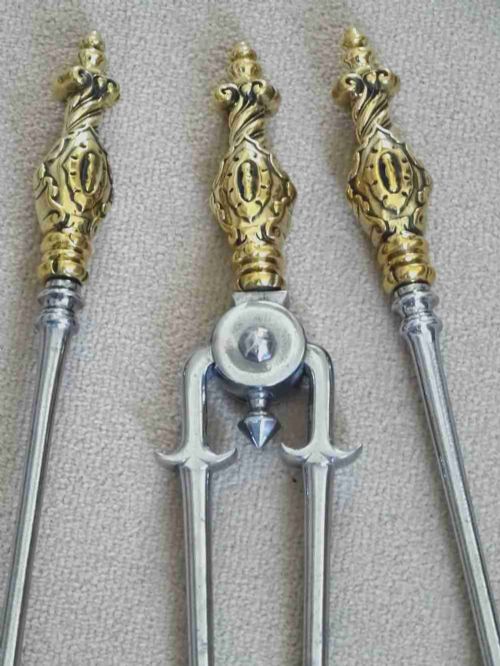

19th Century Fire Tools
These 19th century fire tools bring utility and period character to an active hearth, offering sets of irons and companion pieces built to handle coal, wood, and ash.
19th Century Fire Tools
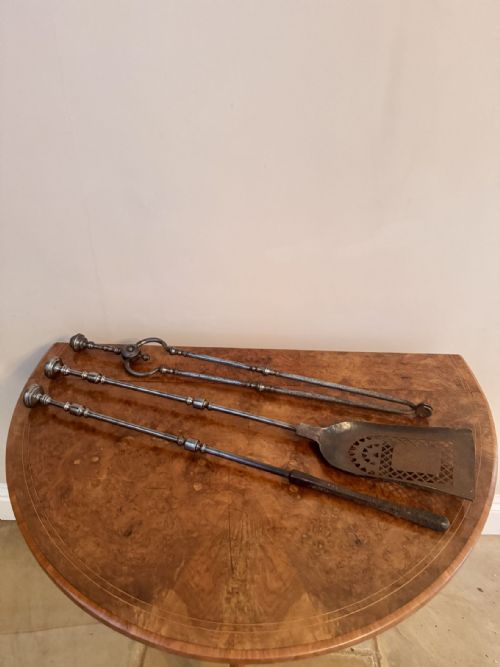
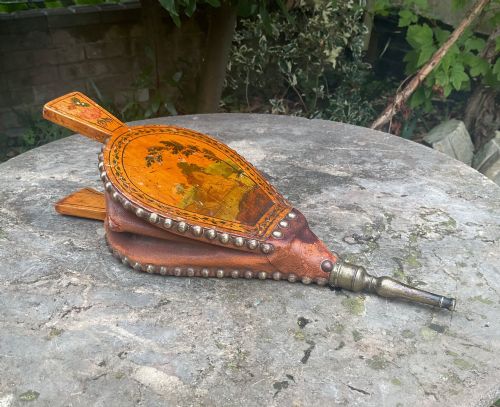
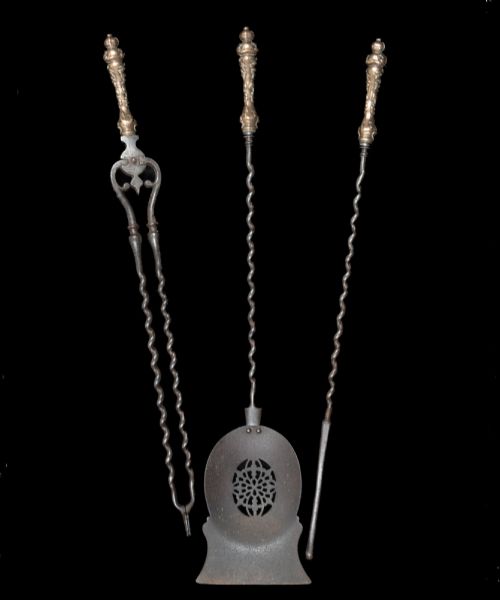
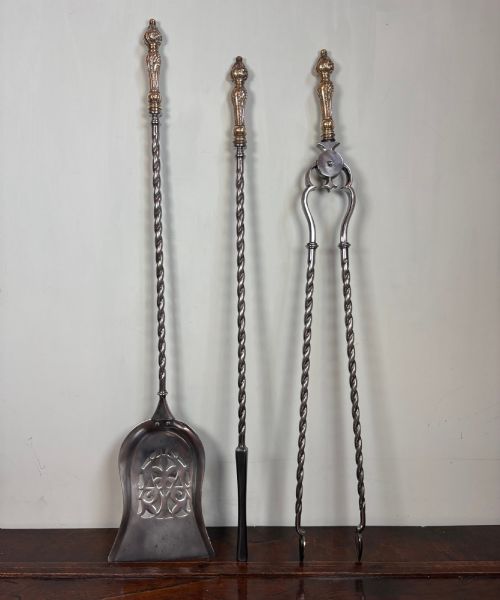
19th century fire tools comprise sets of companion pieces designed for managing an open hearth, most frequently encountered as complete sets of fire irons including a shovel, tongs, and a poker. The selection also extends to specialised items such as log grabbers, toasting forks, and matching andirons.
Comprising pieces from the Victorian and Georgian periods alongside Arts and Crafts designs, these hearth accessories range from polished steel and burnished finishes to robust wrought iron and bright brass. English and French examples appear across rustic country styles and more ornate Rococo or Gothic forms.
Buyers will find both standard sets meant for daily use beside the grate and larger companion sets complete with their own stands. Whether formed from simple hand-forged iron or finished in polished brass, each grouping reflects the domestic heating needs of the nineteenth-century household.
How they were made
Blacksmiths and metalworkers shaped these pieces primarily from iron, steel, and brass, utilising hand-forging techniques for durable wrought iron elements and structural components. Polished and burnished steel surfaces required careful grinding and smoothing to achieve a bright, reflective finish suitable for formal parlours.
Brass elements were frequently cast and turned, providing bright finials and handles that contrasted with blackened iron or steel shafts. Wrought iron and hand-forged pieces display the characteristic hammer marks and irregularities of traditional smithing, ensuring each poker, shovel, and pair of tongs was uniquely sturdy.
19th Century Fire Tools Retail Price Guide 2026
Typical asking prices for 19th century fire tools among the pieces listed under this phrase on Sellingantiques today, from the lower quarter to the upper quarter. They describe what is for sale here now, not the wider market.
Some nineteenth-century Victorians enjoyed oversized Gothic toasting forks by the hearth, proving toast was serious business long before electricity.
What varies in quality
The distinction between standard hearth furnishings and top-tier examples lies in the weight of the metal and the refinement of the finishing. High-quality sets utilise heavy-gauge brass and thick steel that resist bending during heavy use, whereas lesser items may feel light and flexible in the hand.
Design sophistication also sets the better pieces apart, evidenced by crisp casting details on brass handles, well-balanced tongs that spring evenly, and hand-forged scrollwork or Gothic twists executed with precision rather than haste.
The 19th Century Fire Tools Glossary
- Fire irons
- A matched set of tools for tending a domestic fire, typically consisting of a poker, shovel, and tongs.
- Andirons
- Horizontal metal supports placed in a hearth to hold logs above the base of the fireplace, often sold alongside matching fire tools.
- Log grabber
- A specialised tool designed for lifting and repositioning heavy logs within the hearth without burning one's hands.
- Burnished steel
- Steel that has been mechanically polished to a smooth, bright lustre, common on finer nineteenth-century fire irons.
- Rococo
- An ornate, asymmetrical decorative style characterised by scrolling curves and natural motifs, seen on several brass companion sets.
19th Century Fire Tools: Frequently Asked Questions
What is included in a set?
Standard sets typically comprise a poker for stirring embers, a shovel for clearing ash, and tongs for handling fuel.
Additional pieces such as log grabbers, stands, or matching andirons also appear depending on the specific ensemble.
How do I choose the right finish?
Polished and burnished steel bring a bright, formal look to the hearth that suits refined Victorian and Georgian interiors.
Wrought iron and rustic country styles offer a heavier, textured appearance that complements simpler brick or stone fireplaces.
Were these tools meant to be used?
Most nineteenth-century irons were constructed from durable steel, iron, and brass specifically for daily hearth maintenance.
While many survive in decorative condition today, their robust hand-forged and cast construction makes them suitable for active fires.
How do I date a set?
Dating relies on stylistic markers such as Rococo curves, Gothic twists, or Arts and Crafts simplicity alongside material choices like burnished steel versus wrought iron.
Victorian and earlier nineteenth-century examples often feature heavy brass handles and hand-forged joints characteristic of period production methods.