



19th Century Agate Jewellery
These 19th century agate jewellery pieces offer the rich colour and tactile weight characteristic of Victorian hardstone work.
19th Century Agate Jewellery
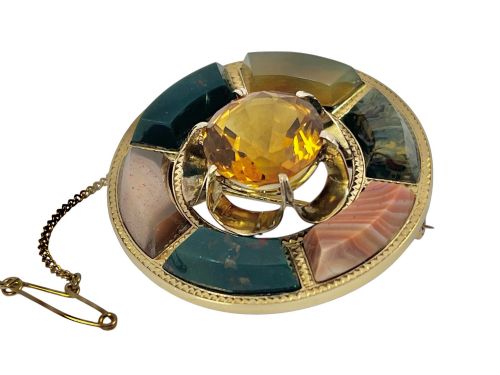
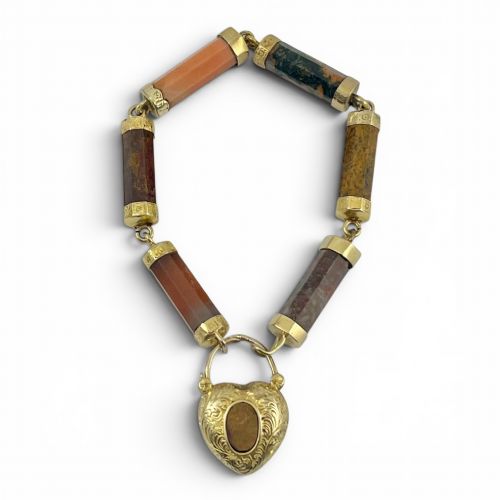
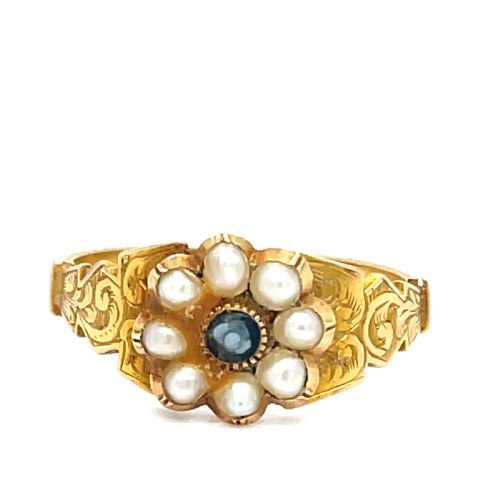
When you search for 19th century agate jewellery, you encounter distinctive pieces created during the Victorian era, heavily influenced by Scottish Revival designs. The selection centres principally on brooches, kilt pins, dirk brooches, bracelets and mourning rings. These items showcase regional lapidary traditions, particularly Scottish pebble work featuring banded stones.
Most examples originate from the Victorian period, spanning decades from the eighteen-fifties through to eighteen-ninety. You will frequently find brooches set with Montrose or specimen agates alongside bracelets combining hardstone with precious metals. French cameo brooch variants also appear, demonstrating the broader European scope of hardstone carving during the same period.
How they were made
The construction relies on natural hardstones, primarily banded agate, jasper and quartz varieties, cut and polished to reveal intricate geological strata. These stones are mounted into solid settings of silver, nine-carat gold or eighteen-carat gold. Some compositions incorporate supplementary materials such as pearls, citrines and glass to accent the central stones.
Lapidaries shaped the hardstones into smooth pebbles or flat specimens, which metalworkers then secured within claw settings or elaborate silver frameworks. Scottish Revival pieces often utilised engraved silver work to mimic traditional highland weaponry and motifs. The integration of hardstone into mourning rings further required precise bezel settings to protect the stone alongside hair compartments or inscriptions.
19th Century Agate Jewellery Retail Price Guide 2026
Typical asking prices for 19th century agate jewellery among the pieces listed under this phrase on Sellingantiques today, from the lower quarter to the upper quarter. They describe what is for sale here now, not the wider market.
Victorian kilt pins doubling as deadly-looking dirk brooches let previous generations accessorise their knitwear with miniature highland weaponry.
What varies in quality
The calibre of the stone cutting dictates much of the visual appeal, with superior pieces displaying crisp natural banding and high-polish finishes free from surface pitting. The richness and variety of the agate colours contribute significantly to a piece's standing. Stones with distinct translucency and striking contrasts command greater visual depth than uniform or muddy specimens.
The quality of the metalwork forms the second pillar of assessment, distinguishing simple mounts from substantial chased silver or high-karat gold settings. Finely detailed engraving on silver dirk brooches or robust hinge mechanisms on bracelets indicate superior craftsmanship. The harmonious integration of stones into the metal frame without excess solder or misaligned bezels separates standard production from finer output.
The 19th Century Agate Jewellery Glossary
- Agate
- A cryptocrystalline variety of silica, principally chalcedony, characterised by fineness of grain and brightness of colour. It forms in concentric bands in vugs in ancient volcanic rocks.
- Hardstone
- A term for semi-precious stones used in jewellery and decorative objects, including agate, jasper and onyx. These materials are chosen for their hardness and polishability.
- Specimen brooch
- A piece of jewellery designed to display specific local mineral samples or polished pebbles. In nineteenth-century Scottish examples, these highlighted native stones.
- Dirk brooch
- A large fastening pin modelled after the traditional Scottish dagger, the dirk. These pieces typically feature elaborate silver mounts and substantial central agates.
- Montrose agate
- A specific regional variety of Scottish agate associated with the area around Montrose. Collectors prize these stones for their distinct colouration and banding patterns.
19th Century Agate Jewellery: Frequently Asked Questions
How do I date 19th century agate jewellery?
Dating relies on stylistic markers such as the heavy Scottish Revival influence and the specific form of the mount. Hallmarks on the gold or silver components often provide precise assay years.
Construction techniques also reveal age, as bezel settings and pin mechanisms evolved across the Victorian decades from eighteen-fifty to eighteen-ninety.
Were these pieces worn as mourning jewellery?
Certain items, particularly rings and specific brooches from the Victorian era, served as mourning jewellery. The integration of dark agates with gold and pearls suited the sombre dress codes of the period.
Other pieces were purely celebratory or fashion accessories connected to the romanticising of the Scottish Highlands by the court.
What is Scottish Revival jewellery?
Scottish Revival jewellery refers to nineteenth-century pieces inspired by traditional Celtic and Highland motifs. Queen Victoria's affection for Balmoral popularised these designs across Britain.
Items typically feature dirk, claymore or thistle shapes executed in silver and set with local pebbles like agate and jasper.
How should I care for antique agate jewellery?
Agate is a durable quartz mineral, but the antique silver or gold settings require gentle handling. Clean pieces with a soft dry cloth and avoid harsh chemical dips that damage softer stones or pearls.
Store items separately to prevent the harder stones from scratching adjacent metalwork or softer gems.