
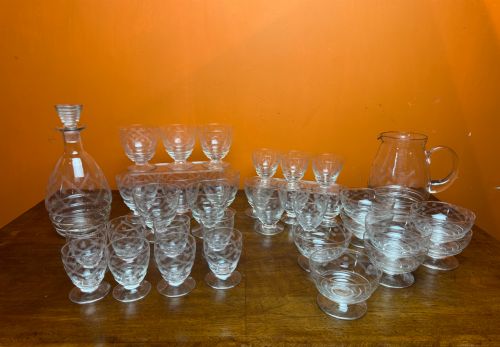


1930s Glassware Set
A 1930s glassware set brings sharp geometric lines and vibrant enamel decoration straight to the modern table.
1930s Glassware Set
A 1930s glassware set represents the height of Art Deco design, bringing together matching decanters, jugs, trays, and drinking glasses designed for formal entertaining. You will most frequently meet complete drink sets and decanter suites originating from Czech workshops and French makers, often incorporating matching sets of six glasses.
These groupings encompass everything from substantial crystal decanter sets with geometric cutting to large suites of drinking glasses adorned with etched or enamelled decoration. The overarching style adheres firmly to Art Deco principles, prioritising bold silhouettes and stylised motifs over fussy Victorian ornamentation.
How they were made
Makers utilised clear glass, lead crystal, moulded glass, and black glass as the primary foundations for these sets, shaping the material through industrial pressing and skilled blowing techniques. Frosted glass surfaces provided a tactile contrast to polished clear areas, catching the light in distinctive ways.
Decoration was applied through precise engraving, deep acid etching, and hand-painted enamel work to create striking geometric patterns and figurative scenes such as the Jazz Man motif. Matching trays and vessels frequently integrated contrasting bands of colour to accentuate the angular forms typical of the period.
Listings feature Art Deco styles from 1930, utilising clear glass, lead crystal, black glass, and enamel.
What varies in quality
Quality in a 1930s glassware set is determined by the crispness of the moulding, the depth of the glass cutting, and the precision of the hand-applied enamel or engraved details. Finer pieces demonstrate superior clarity in the lead crystal and perfectly matched components that sit securely on their original glass trays.
The distinction between standard production and top-tier items rests on the attribution to known designers and the survival of a complete, undamaged suite of matching glasses. Pieces by named makers display greater refinement in the proportions and a higher standard of finishing on every individual glass and stopper.
Rene Lalique·Karl Palda·Riihimaki
The 1930s Glassware Set Glossary
- Art Deco
- A design style dominant in the 1930s characterised by sleek geometric shapes, stylised motifs, and modern industrial materials. It replaced the organic curves of earlier movements with sharp angles and symmetry.
- Decanter Set
- A matched grouping consisting of a central serving bottle with a stopper, accompanied by a collection of drinking vessels and occasionally a matching tray. These sets were designed for serving spirits and liqueurs during social gatherings.
- Engraved Glass
- Glassware decorated by cutting lines and patterns into the surface using a small rotating wheel or diamond point. This technique produces permanent, tactile designs that catch the light.
- Lead Crystal
- A heavy type of glass containing metallic oxide that increases brilliance, weight, and clarity, allowing for deep, sharp facets when cut. It rings when struck gently.
- Moulded Glass
- Glass formed by pressing molten material into a metal or wooden mould to create repeating patterns and three-dimensional shapes efficiently. This method enabled the mass production of complex Art Deco forms.
1930s Glassware Set: Frequently Asked Questions
What is in a typical set?
A standard set usually comprises a central decanter with its stopper alongside six matching drinking glasses, sometimes presented on a dedicated glass tray. Larger suites expand this arrangement to include thirty-four pieces or specialised jugs for mixed drinks.
These groupings were intended to provide a uniform service for guests during the interwar cocktail revival. Every element shares the same decorative scheme, whether through enamel, etching, or crystal cutting.
Were they used daily?
Most of these sets were reserved for formal entertaining, dinner parties, and cocktail hours rather than everyday family dining. Their delicate enamels and fine crystal meant owners treated them with considerable care.
This occasional use explains why many surviving suites retain their matching glasses and original condition. They spent much of their existence safely stored in cabinets between social events.
How to spot Czech pieces?
Czech glassware from this era is identifiable by bold black glass, vibrant enamel work, and striking geometric crystal cuts. Bohemia was a major centre for innovative production during the 1930s.
Many of these items feature experimental colour combinations and modernist silhouettes associated with workshops like those of Karl Palda. They reflect the region's long tradition of artistic glass manufacture.