


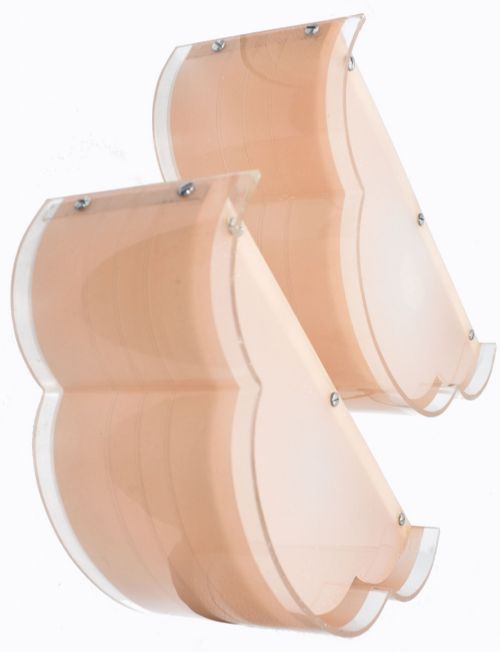
1930s Glass Sconce
A 1930s glass sconce brings architectural light to a wall, combining moulded glass with polished metal to define an interior.
1930s Glass Sconce
A 1930s glass sconce is primarily a wall-mounted lighting fixture designed to direct illumination across a room while serving as a decorative focal point. The examples encountered here lean heavily into the geometric and stylised motifs of Art Deco and French Art Deco design, often appearing in matching pairs or larger suites.
Forms span several distinct silhouettes, including clam shells, cloud shapes, trumpets, flames, and stepped skyscraper profiles. While the core of the selection sits firmly in the 1930s, occasional pieces stretch back to the 1920s or Edwardian periods, demonstrating the longevity of these robust architectural forms.
Wall lights and girandoles round out the offerings, utilising bracketed metal arms or flush wall plates to support heavy shades. Buyers select these fixtures to anchor period schemes or to introduce reflective metallic surfaces and textured glass into contemporary spaces.
Materials and construction methods
Construction relies heavily on the pairing of metal and glass, with chrome plating, solid brass, bronze, and silvered wood forming the structural frames and backplates. These metals provide both the necessary rigidity for wall mounting and the reflective sheen characteristic of the period.
Shades and panels are cast from frosted glass, pink mirror glass, lucite, or resin, often moulded into complex three-dimensional shapes like clouds and clam shells. Bakelite and catalin occasionally appear in mountings or switch housings, highlighting the era's adoption of early synthetic plastics.
Assembly typically involves mechanical fastening of glass elements to metal armatures using custom brackets and screws, ensuring the heavy shades remain secure against vertical surfaces.
Several pairs are shaped like clouds, proving that 1930s designers literally wanted to put the weather on your dining room wall.
Distinguishing quality across pieces
Quality separates along the precision of the glassmoulding and the weight of the metal chassis. Finer examples display crisp, deep relief in motifs such as flames and skyscrapers, whereas simpler iterations rely on smooth, plain tubular or curved planes.
The choice of materials dictates the upper tier of the range, where heavy cast bronze or thick chrome plating over brass meets signed or heavy-gauge pressed glass. Simpler constructions utilise lighter sheet metal stampings and standard moulded glass panels.
The integrity of the assembly and the uniformity of matching pairs or sets elevate certain pieces, distinguishing bespoke studio production from standard commercial output.
Baccarat·Lalique
The 1930s Glass Sconce Glossary
- Sconce
- A wall-mounted light fixture designed to hold one or more electric bulbs or candles. These pieces project outward from the vertical surface to wash walls in directed illumination.
- Art Deco
- A dominant design style of the 1920s and 1930s characterised by sleek geometric shapes, streamlined forms, and stylised natural motifs. It bridges traditional craftsmanship with industrial modernity.
- Girandole
- An ornamental branched wall light or sconce, frequently incorporating mirrors to multiply the effect of the illumination. The silvered wood frame version demonstrates this traditional decorative form.
- Bakelite
- An early form of thermosetting plastic utilised during the period for electrical components and decorative mounts. Its dark, durable composition is typical of mid-century industrial hardware.
- Frosted glass
- Glass treated by acid-etching or sandblasting to create a textured, opaque surface that diffuses light evenly. It softens the glare of the bulb while highlighting moulded surface patterns.
1930s Glass Sconce: Frequently Asked Questions
How do I install a vintage sconce?
Vintage wall lights require secure anchoring to wall studs or solid masonry due to the weight of their metal and glass components. Professional electrical installation ensures proper grounding and compatibility with modern wiring standards.
Positioning depends on ceiling height and room proportions, though flanking a mirror or doorway remains a traditional placement. Ensuring the backplate covers existing electrical boxes prevents structural exposure.
Are these lights wired for modern bulbs?
Most period fixtures accommodate standard modern candelabra or Edison screw bulbs, though rewiring is frequently undertaken to meet current safety codes. The internal sockets are usually adapted during restoration without altering the external metal and glass appearance.
Low-heat LED alternatives help protect fragile vintage glass and synthetic components from thermal stress over extended periods of use.
How do I clean frosted and moulded glass?
Gentle washing with warm water and mild soap removes dust from textured and frosted surfaces without damaging the glass. A soft brush helps clear debris from deep recesses in moulded cloud or flame shades.
Harsh chemical abrasives should be avoided to preserve the original surface finish of both the glass and the surrounding chrome or brass plating.
What defines the French style in these lights?
French lighting from this era often incorporates heavier cast bronze frames alongside sculptural glass elements by prominent designers. The emphasis lies on artistic expression and sophisticated material pairings.
These pieces tend to feature more complex organic forms, such as clam shells and stylised flora, contrasted against stark geometric backplates.