


1930s Glass Desk Clock
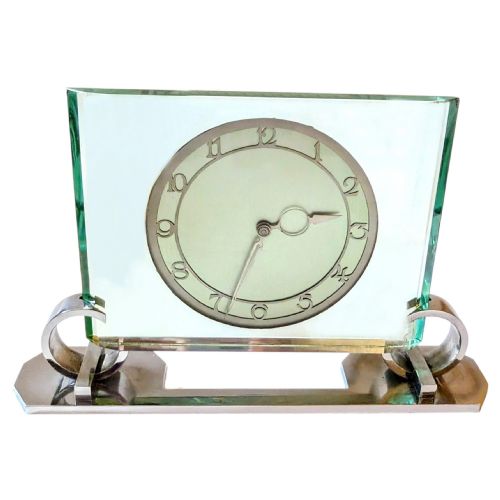
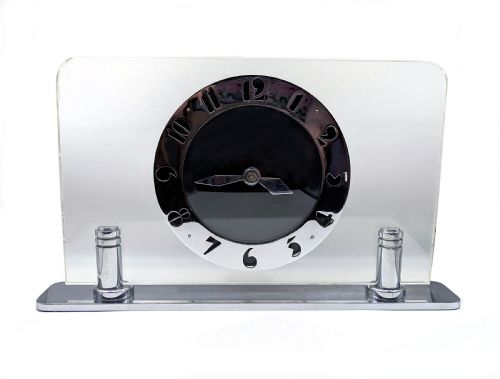
A 1930s glass desk clock brings geometric clarity and functional modernism to a desk or mantelpiece.
1930s Glass Desk Clock
When you search for a 1930s glass desk clock, you encounter timepieces dominated by the Art Deco style, featuring modernist designs and clean geometric lines. These objects function primarily as desk or mantel clocks, often combining timekeeping with decorative illumination or architectural presence.
The versions most likely to appear on this page originate from the 1920 and 1930 periods, incorporating materials such as mirror glass, peach mirror glass, green glass, and blue glass alongside metal accents. Makers and firms like Smiths Clockmakers, Mappin & Webb, Jaeger-LeCoultre, and GEC produced these distinctive forms.
How they were made
Makers constructed these clocks using sheet glass, mirror glass, and coloured glass panels mounted to metal, chrome-plated, or brass chassis. Many examples integrate marble or green marble bases to provide stability and visual contrast to the transparent or reflective upper structures.
Mechanical movements, wind-up mechanisms, eight-day movements, electric systems, and Bulle clock systems power these timepieces. Dials and bezels frequently utilise chrome plating, brass details, and contrasting numerals to match the modernist aesthetic.
Some models hide their workings so cleverly that guests spend hours searching for the gears.
What varies in quality
The distinction between tiers rests in the ambition of the design and the refinement of the materials, such as the depth of peach or blue mirror glass and the precision of the modernist metalwork. Signed pieces by established makers or designers demonstrate greater attention to detail in the integration of glass and movement.
Execution of the dial assembly and the harmony between the glass panels and the metal chassis determine the overall presence of the piece. Superior examples maintain crisp geometric angles and intact surface finishes across both the glass body and the underlying clockwork housing.
Smiths Clockmakers·Mappin & Webb·Jaeger-LeCoultre·GEC
The 1930s Glass Desk Clock Glossary
- Art Deco
- A design style of the 1920s and 1930s characterised by streamlined shapes, geometric patterns, and modern industrial materials. It influences the architecture and presentation of these desk and mantel clocks.
- Bulle clock
- An electromechanical clock driven by a pendulum interacting with an electromagnet. This system represents an innovative technical approach used during the period.
- Mystery clock
- A timepiece where the movement is concealed or seemingly disconnected from the hands, creating a floating effect. These designs showcase clever mechanical ingenuity.
- Peach mirror glass
- A tinted reflective glass panel displaying a warm pinkish-orange tone. This material provides distinct colouration popular in modernist interior objects.
- Opaline uranium glass
- A translucent pale glass containing uranium dioxide, which exhibits a characteristic glow under ultraviolet light. It adds vivid colour to decorative desk accessories.
1930s Glass Desk Clock: Frequently Asked Questions
How do I wind a mechanical 1930s glass desk clock?
Most mechanical versions utilise a key inserted into winding arbors located on the dial or the rear movement plate. Turn the key gently until resistance indicates full tension.
Avoid over-winding to protect the internal mainspring. Eight-day movements require attention roughly once a week to maintain accurate timekeeping.
Where should I place a glass desk clock?
Position the clock on a stable, level surface away from direct sunlight and areas of heavy vibration. Desks, mantelpieces, and bookshelves provide suitable display locations.
Ensure adequate clearance around the piece so the glass and chrome elements catch ambient light effectively.
How do electric models differ from wind-up versions?
Electric variants rely on mains power or specialised electric movements rather than a manual mainspring. They eliminate the need for regular winding.
Wind-up and mechanical eight-day versions depend entirely on traditional gear trains and escapements driven by stored spring power.