




1930s Gents Jewellery
These 1930s gents jewellery pieces capture the geometric rigour and vibrant colour of the Art Deco period, offering a distinct sartorial edge for the modern wardrobe.
1930s Gents Jewellery
When searching for 1930s gents jewellery, collectors encounter a focused selection of accessories designed for men during the Art Deco era. The inventory centres heavily on matching pairs of enamel gents cufflinks, alongside tie pins and wristwatches from the period.
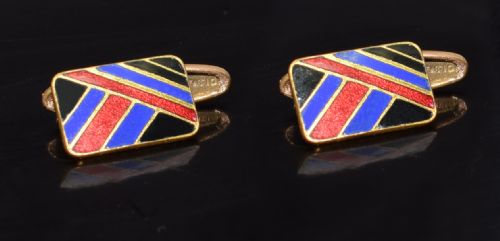
The dominant aesthetic across these objects is Art Deco Modernist design, often featuring clean geometric lines and contrasting colours. Cufflinks form the vast majority of available pieces, frequently utilising vitreous enamel set into metallic bases.
How they were made
Makers utilised metals such as silver, silver plate, brass, stainless steel, and silver-tone metal to form the structural foundations of cufflinks and tie pins. These base materials provided durability and structured frames for decorative elements.
Vitreous enamel and standard enamel were applied to metal surfaces to introduce rich colour palettes, including distinct green and black combinations. Technicians fused glass powders onto the metal base under high heat to create smooth, durable coloured sections.
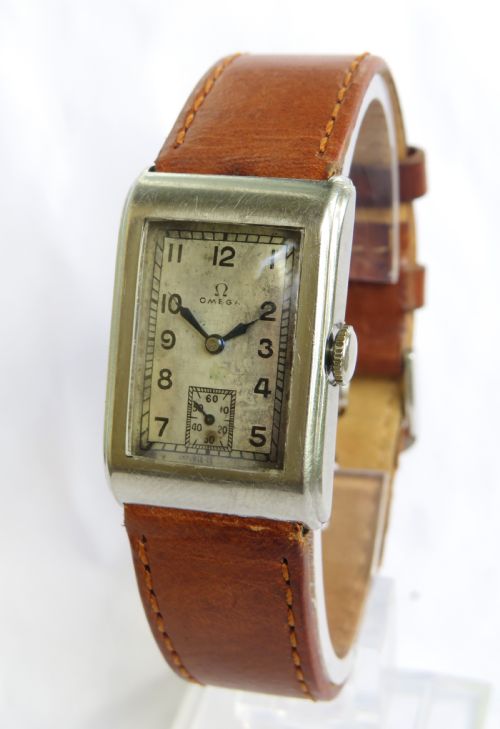
A solitary tank watch from 1939 sneaks into a sea of geometric cufflinks, proving gentlemen of the decade liked to keep time in style.
What varies in quality
The precision of the enamel work dictates the refinement of each piece, distinguishing simple utilitarian items from finer decorative accessories. Clean edges between contrasting enamel colours demonstrate superior skill in application and firing.
The choice of base metal also separates the range, with solid silver examples offering greater intrinsic material value compared to silver-tone metal, brass, or plated alternatives. Structural integrity in mechanical closures like swivel-back or chain-linked cufflinks further influences the overall standard.
The 1930s Gents Jewellery Glossary
- Art Deco
- A design style characterised by sleek geometric shapes, streamlined forms, and bold modernist motifs popular during the interwar period.
- Vitreous Enamel
- A material made by fusing powdered glass to a substrate by firing, resulting in a smooth, durable, and brightly coloured surface.
- Tie Pin
- A decorative accessory used to secure a necktie to the underlying shirt, often matching the design of accompanying cufflinks.
- Cufflinks
- Devices used to secure the cuffs of dress shirts, typically consisting of two decorative faces connected by a shank or chain.
1930s Gents Jewellery: Frequently Asked Questions
What items count as 1930s gents jewellery?
The category primarily encompasses men's accessories designed during the 1930s, consisting mainly of cufflinks, tie pins, and wristwatches.
These pieces reflect the prevailing Art Deco aesthetic of the decade through geometric shapes and enamel detailing.
How do I wear vintage cufflinks?
Vintage cufflinks require a French cuff shirt with designated buttonholes on both sides of the cuff.
Slip the shank through the fabric layers and secure the toggle or chain to hold the cuff neatly closed.
Are these pieces made of solid silver?
Materials vary across the selection, including solid silver alongside silver plate, brass, stainless steel, and silver-tone metal.
Examination of hallmarks or testing helps determine the exact metal composition of individual items.
What is Art Deco modernist design?
Art Deco modernist design focuses on streamlined geometry, clean lines, and functional elegance rather than ornate Victorian flourishes.
In men's accessories, this translates to bold enamel patterns and structured metallic forms.