

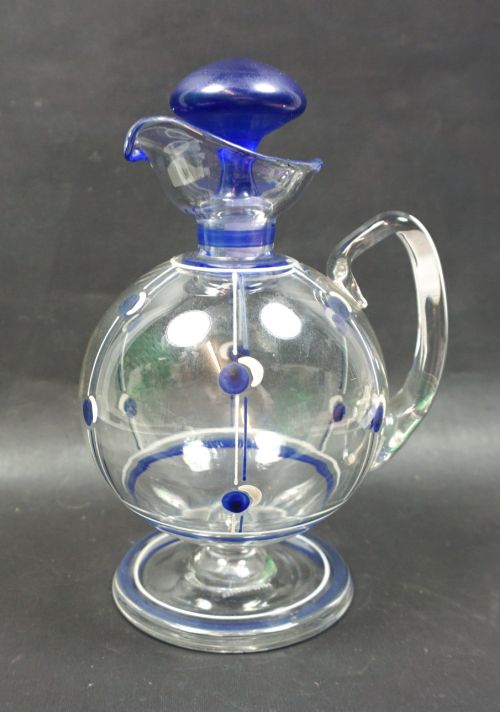



1930s Crystal Decanter
A 1930s crystal decanter brings geometric brilliance and striking modernist lines to any room, offering both functional service and unmistakable period character.
1930s Crystal Decanter
A 1930s crystal decanter is a drinking vessel designed during the Art Deco era, encompassing standalone decanters, claret jugs, and complete decanter sets with matching glasses. These pieces showcase the bold, geometric aesthetic of the period, often hailing from makers in Bohemia, Czechoslovakia, France, and England.
The objects seen here range from clear lead crystal and heavy cut glass to vibrant pieces decorated with blue enamel or vibrant green glass. Many examples feature integrated service components, whilst others incorporate silver mounts or chrome and glass tantalus frames.
How they were made
The manufacture of these pieces relies on high-quality lead crystal and clear glass, shaped through heavy cutting, engraving, or moulding. Artisans achieved the sharp geometric motifs characteristic of the style through precise wheel-cutting and facet work.
Colour and surface detail were frequently added using hand-enamelled decoration in contrasting tones like blue, or by pairing the glass with sterling silver mounts and chrome frameworks. This combination of glassblowing, cutting, and metalwork defines the physical structure of the era's barware.
1930s Crystal Decanter Retail Price Guide 2026
Typical asking prices for 1930s crystal decanter among the pieces listed under this phrase on Sellingantiques today, from the lower quarter to the upper quarter. They describe what is for sale here now, not the wider market.
The inventory spans production from France, Czechoslovakia, Bohemia, and England across the interwar period.
What varies in quality
Quality in these vessels is determined by the clarity and weight of the lead crystal, alongside the crispness of the cut or engraved decoration. Heavier, more resonant glass and deep, precise faceting distinguish finer examples from standard production.
The sophistication of the design work also sets pieces apart, particularly where hand-enamelling is intact and neatly applied, or where the piece forms part of a complete, matching set with its original glasses. The integration of quality mounts in silver or chrome further elevates the standing of an individual vessel.
Karl Palda·Val Saint Lambert·Jacques Adnet
The 1930s Crystal Decanter Glossary
- Lead crystal
- A type of glass containing lead oxide, which increases weight, brilliance, and clarity. This material allows for deep, sharp cutting.
- Tantalus
- A locking wooden or metal frame holding decanters securely while displaying them to view. The locking mechanism prevents unauthorised access to the contents.
- Claret jug
- A specialised pouring vessel traditionally used for red wine. These pieces often feature mounted handles and spouts in silver or metal.
- Enamel
- A decorative glassy substance fused to the surface of the glass through firing. It provides colourful geometric patterns typical of the period.
- Art Deco
- The dominant design style of the 1920s and 1930s characterised by symmetry, geometric shapes, and modernist lines. It influences the form of both the glassware and its metal mounts.
1930s Crystal Decanter: Frequently Asked Questions
What is a 1930s crystal decanter set?
A 1930s crystal decanter set typically includes a central pouring vessel accompanied by a matching group of small drinking glasses or liquor cups. These sets were designed for entertaining and display during the interwar period.
They often share uniform geometric decoration, colour schemes such as blue enamel or green glass, and display the signature Art Deco styling of makers working in Bohemia and Europe.
How do I identify a 1930s decanter?
Identification relies on recognising distinct Art Deco design elements, such as angular geometric patterns, faceted cutting, and modernist chrome or silver mounts. The materials frequently involve heavy lead crystal or characteristic coloured glass.
Many pieces from this era originate from known stylistic centres like Czechoslovakia or France, sometimes bearing attribution to specific designers or factories active around 1930.
Were these decanters used for wine or spirits?
These vessels served various alcoholic beverages depending on their specific form, with claret jugs dedicated to red wine and liquor services intended for spirits. Sets often catered to after-dinner cordials and liqueurs.
The inclusion of matching glasses within a service indicates they were meant for direct pouring and tasting during social gatherings.
What is a tantalus and how does it work?
A tantalus is a locking frame that secures decanters by holding their stoppers firmly in place beneath a metal bar. This prevents the removal of the decanters without a key while keeping the contents visible.
Examples from this period often combine oak woodwork or chrome and glass structures to house the bottles securely.