
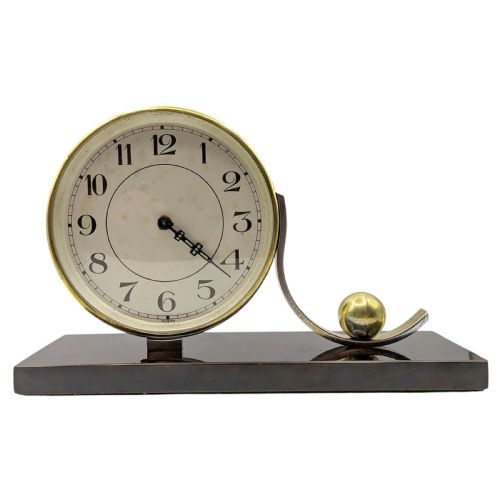
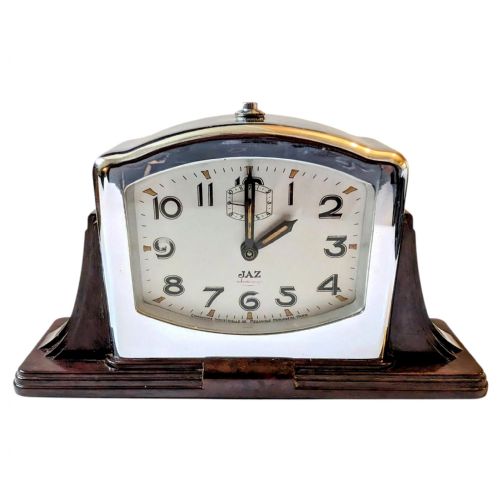
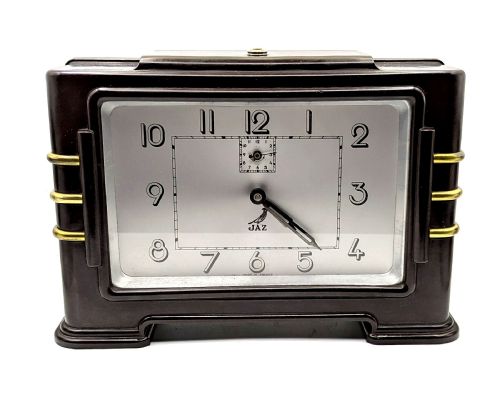


1930s Bakelite Desk Clock
These 1930s bakelite desk clock pieces bring geometric modernist design and robust early plastics to a modern interior.
1930s Bakelite Desk Clock
A 1930s bakelite desk clock represents the quintessential Art Deco aesthetic applied to timekeeping. These objects function as practical desk accessories and mantel pieces, showcasing the bold geometric forms characteristic of the period.
The pieces on this page originate from English, French, and Hungarian workshops, taking the form of desk clocks, mantel clocks, and alarm clock calendars. Most examples integrate bakelite with contrasting metallic elements to create a streamlined profile.
Buyers encountering this selection will find structural variations that range from compact desk pieces to large mantel clocks. The grouping relies firmly upon 1930s production dates and the widespread adoption of early phenolic resin.
How they were made
Bakelite served as the primary moulded body material, shaped under heat and pressure into crisp geometric and streamline silhouettes. Manufacturers frequently paired this dark or coloured synthetic resin with polished chrome and brass bezels, hinges, and feet.
Makers incorporated glass viewing panels to protect the dial faces, sometimes employing transparent see-through designs. Secondary structural elements occasionally utilised ebonised wood to add weight and tonal contrast to the bakelite housings.
Materials documented across the inventory include moulded bakelite, chrome, brass, glass, and ebonised wood.
What varies in quality
Quality in these timepieces rests upon the precision of the moulding and the retention of crisp architectural lines. Finer examples display smooth, unblemished synthetic resin surfaces paired with substantial metal mounts rather than flimsy attachments.
The sophistication of the movement and the integration of secondary functions, such as calendar displays or electric mechanisms, elevate certain items above standard domestic models. Original dial legibility and harmonious proportions between the bakelite base and the clock face separate ordinary production from distinguished pieces.
Jaz·Blangy Clockmakers·Smiths
The 1930s Bakelite Desk Clock Glossary
- Bakelite
- An early thermosetting phenol formaldehyde resin prized for its durability and rich colour range. It formed the durable housing for many modernist desktop objects.
- Art Deco
- A design style spanning the interwar years characterised by stylised motifs, streamlined shapes, and modern industrial materials. This movement heavily influenced interwar clock design.
- Streamline
- An aerodynamic styling derivative of Art Deco that emphasised sweeping horizontal lines and rounded corners. French and Hungarian makers frequently applied this aesthetic to clock casings.
- Ebonised wood
- Timber treated to resemble heavy, black ebony. Makers utilised this material alongside synthetic resin to add contrast and structural heft.
1930s Bakelite Desk Clock: Frequently Asked Questions
Where were these clocks made?
The evidence points to workshops operating across England, France, and Hungary during the 1930s. These regional centres produced distinct interpretations of the prevailing modernist style.
French and Hungarian makers often leaned into streamlined silhouettes, while English production frequently yielded robust domestic mantel and desk timepieces.
What materials make up the casing?
Bakelite forms the main body of these pieces, providing a stable and colourful moulded housing. Chrome, brass, and glass frequently accompany the synthetic resin to frame the dial and accent the base.
Ebonised wood also appears as a secondary structural material in certain interwar designs.
How do electric movements differ from mechanical ones?
Electric movements, such as those by Smith Electric, utilise mains power to drive the gears without manual winding. Mechanical 30-hour variants rely on a mainspring that requires regular physical intervention.
Both systems sit within identical architectural bakelite and chrome housings characteristic of the period.
How do I style a bakelite desk clock today?
These clocks anchor a workspace or mantelpiece by introducing strong horizontal lines and rich synthetic materials. Pair them with mid-century modern furniture or minimalist surfaces to highlight their geometric forms.
Their compact scale allows them to sit comfortably on bookshelves, side tables, or office desks.