


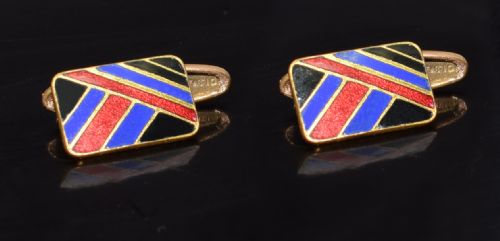


1930s Art Deco Cufflinks
These 1930s art deco cufflinks deliver sharp modernist geometry and crisp colour to a shirt cuff.
1930s Art Deco Cufflinks
When you search for 1930s art deco cufflinks, you find gentleman's matching pairs designed for double cuffs during the height of the modernist movement. The style embraces geometric patterns, clean lines, and architectural silhouettes such as skyscraper motifs.
The version you meet most often on this page pairs vitreous or standard enamel with silver, silver plate, or various gold purities. These pieces date principally from around 1930 up to the late 1930s and into 1940.
Most entries represent English manufacture of gents' accessories, intended for formal or business attire. They arrive as matching pairs, maintaining uniform geometric designs across both faces.
How they were made
Metals form the structural foundation, ranging from base brass and silver-tone metal through to sterling silver, 9ct gold, and 18ct yellow gold. Silversmiths and jewellers shaped these metals into geometric plates and hinged backing mechanisms.
Enamel application defines the visual surface, utilising coloured vitreous enamel or standard enamel to create contrasting bands and blocks of green, black, red, and other shades. Artisans fused glass powders to metal bases under high heat for durable, glossy finishes.
Listings span periods from 1930 to 1940, incorporating materials such as enamel, silver, brass, and both 9ct and 18ct gold.
What varies in quality
The choice of base metal sets the baseline for quality, distinguishing solid 18ct or 9ct gold and sterling silver from silver-tone metal, brass, and silver plate. Higher metal purities elevate the substance and longevity of the accessory.
Precision in the enamel work separates standard production from finer examples. Crisp lines within geometric patterns and intact, smoothly polished enamel surfaces indicate superior craftsmanship during the 1930s.
Payton Pepper & Co
The 1930s Art Deco Cufflinks Glossary
- Vitreous Enamel
- A material made by fusing powdered glass to a metallic substrate through firing. This technique creates a glossy, durable coloured surface resistant to fading.
- Modernist
- An early twentieth-century design movement favouring minimalist geometric forms and industrial inspiration over traditional ornamentation. It heavily influences the visual language of these accessories.
- Skyscraper Motif
- An architectural design element referencing tall modern buildings, translated into stepped geometric shapes on the face of the cufflink.
- Silver Plate
- A base metal core covered with a thin layer of silver. It offers the visual appeal of silver at a different material tier.
1930s Art Deco Cufflinks: Frequently Asked Questions
How do I wear these?
Slide the toggle or chain through the buttonholes of a double-cuffed shirt so the decorative geometric face displays outward.
Ensure the matching pair faces the same direction on each wrist for a balanced look.
Are these for daily use?
Solid gold and silver pairs with robust enamel handle regular wear when treated with care.
Store them in a dedicated box to protect the enamel surfaces from scratching against other items.
How do I date them?
Look for the characteristic geometric lines and skyscraper motifs associated with the 1930s.
Assay marks on gold and silver components help pinpoint the exact year of manufacture.
What is the difference between gold and silver pairs?
Gold pairs utilise 9ct or 18ct yellow gold for a warmer metallic tone and higher intrinsic value.
Silver and silver-toned options provide a cooler, industrial aesthetic typical of modernist design.