


1920s Ruby Target Ring
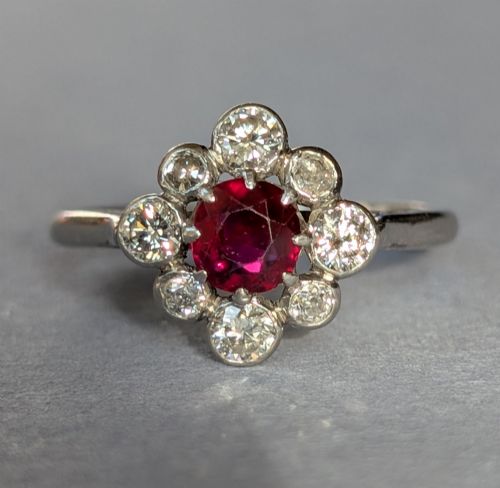
A 1920s ruby target ring is a concentrated geometric jewel designed to catch the eye with concentric circles of colour.
1920s Ruby Target Ring
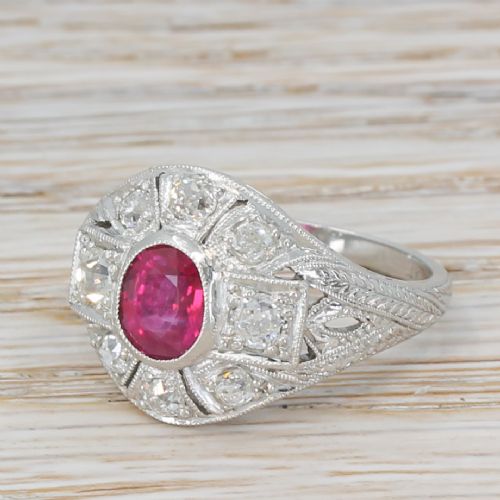
A 1920s ruby target ring centres on a bright red gemstone surrounded by geometric rows of diamonds, creating a distinct circular motif. Most examples here follow the Art Deco style, favouring precise symmetry and architectural lines over organic curves.
The pieces on this page span the 1920s, 1930s, 1940s, and Edwardian periods, appearing primarily as dress rings. Formats range from traditional round clusters to elongated marquis and checkerboard arrangements.
How they were made
Maker's workshops built these rings using durable metals like platinum and 18ct white gold to support intricate stone settings without dominating the design. These bright white metals provide a crisp backdrop that contrasts sharply against the deep red of the ruby.
Listings feature platinum, 18ct white gold, and yellow gold alongside natural Burmese rubies.
What varies in quality
Quality rests in the origin and visual impact of the central ruby, particularly stones originating from Mogok in Burma. The finest specimens display a balanced, saturated red hue that holds its intensity across different lighting conditions.
The precision of the concentric stone arrangement and the crispness of the platinum or gold work define the upper tier of these pieces. Master jewellers achieved a seamless flow between the central ruby and the surrounding diamond tiers.
The 1920s Ruby Target Ring Glossary
- Target ring
- A ring style featuring a central gemstone encircled by one or more concentric rings of contrasting stones. This layout creates a focused, bullseye effect on the finger.
- Art Deco
- A design movement spanning the 1920s and 1930s characterised by symmetry, geometric patterns, and stylised motifs. It replaced the flowing curves of earlier periods with sharp architectural lines.
- Old cut diamond
- A precursor to the modern brilliant cut, featuring a smaller table, higher crown, and a noticeable culet facet at the base. These stones were hand-faceted to catch candlelight.
- Millegrain
- A decorative technique involving a row of tiny raised metal beads along the edges of a setting. This adds a refined texture and frames the stones.
- Marquis cluster
- A boat-shaped gemstone arrangement that lengthens the appearance of the finger. It combines central pointed stones with surrounding diamond work.
1920s Ruby Target Ring: Frequently Asked Questions
How do I wear a target ring?
These pieces function primarily as dress rings due to their wide circular faces. They sit best on the middle or ring finger.
Because of the intricate concentric stone settings, pair them with simple bands to let the geometric design stand out.
Are these rings comfortable?
The low profile of many platinum and gold mountings helps the ring sit flat against the hand. This design reduces snagging during daily wear.
Heavier cluster arrangements benefit from a secure fit to prevent the head from turning on the finger.
What defines Art Deco jewellery?
Art Deco pieces rely on strict geometric order, straight lines, and contrasting white metals against coloured stones. This aesthetic rejected past ornate styles in favour of modern industrial forms.
Platinum became the metal of choice for its strength and ability to hold delicate stone settings.
How do I care for my ring?
Clean platinum and white gold settings gently using warm water and a soft brush to remove dirt trapped beneath the stones. Avoid harsh chemical dips that can damage natural rubies.
Store the jewel separately in a lined box to prevent the diamonds from scratching softer metalwork.