


1920s Diamond Target Ring
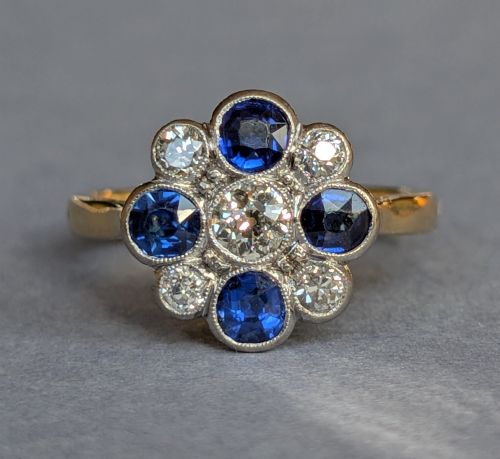
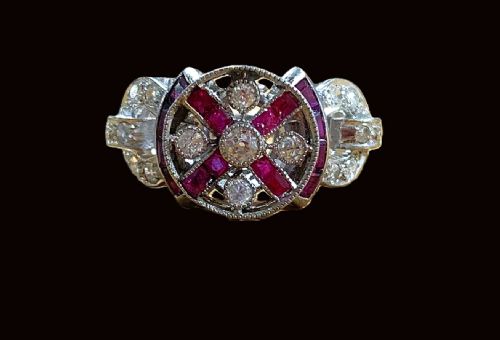
A 1920s diamond target ring centres a bright central stone within concentric geometric borders of calibré gems, offering the distinct architecture of the Art Deco period.
1920s Diamond Target Ring
A 1920s diamond target ring is a dress ring shaped around a central circular motif, designed to draw the eye outward in geometric tiers. These pieces belong predominantly to the Art Deco movement, carrying the crisp lines and symmetry characteristic of the era.
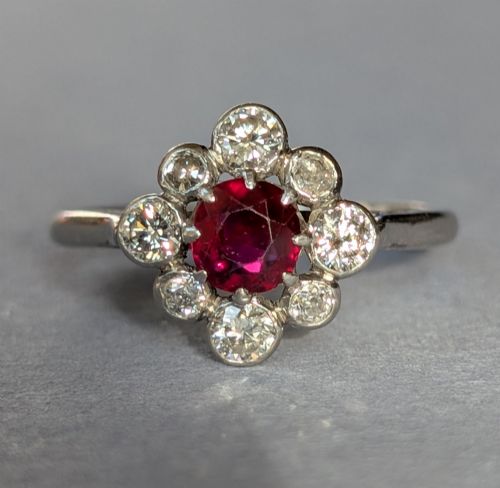
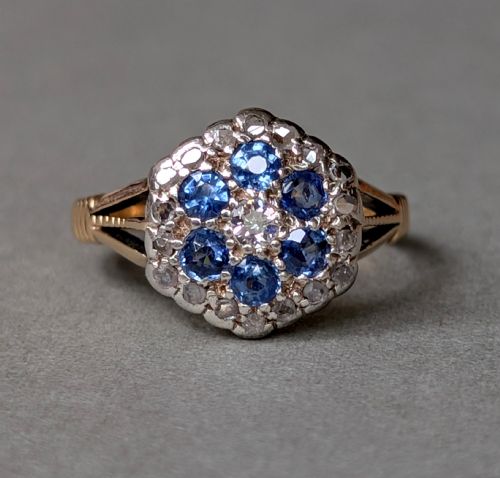
The most common examples on this page pair a central diamond with contrasting borders of blue sapphire, ruby, or emerald. Platinum and 18ct white gold settings dominate, though yellow gold combinations also appear alongside Edwardian overlaps and later 1930s examples.
How they were made
Jewellers utilised platinum and 18ct white gold to construct delicate, rigid mountings that could hold multiple tiny stones securely without heavy metal bulk. Calibré-cut coloured gems were precisely shaped to form continuous, tight borders around the central diamond.
Old-cut diamonds dominate these rings, possessing open culets and smaller tables that catch candlelight differently than modern brilliant cuts. Master metalsmiths combined platinum tops with 18ct yellow gold shanks on occasion, balancing bright white framing with traditional warmth.
Several rings tuck secret piercing beneath their concentric faces, ensuring light reaches the diamonds from underneath.
What varies in quality
The precision of the stone-cutting and the exactness of the concentric geometry separate fine examples from standard ones. Calibré-cut sapphires or rubies that fit flush without gaps demonstrate superior workshop skill.
The weight and purity of the platinum work dictate the refinement of the silhouette, where finer millegrain edges and pierced under-bezels elevate the overall architectural execution.
The 1920s Diamond Target Ring Glossary
- Target ring
- A circular cluster ring featuring a central stone encircled by one or more concentric rings of contrasting gemstones. This layout creates a bulls-eye visual effect.
- Calibré cut
- Small gemstones shaped specifically to fit tightly into a designated channel or geometric border without gaps. This technique defines intricate Art Deco mounting.
- Old cut
- A diamond facet arrangement hand-polished before the standardisation of the modern brilliant cut in the mid-twentieth century. These stones typically exhibit smaller tables and higher crowns.
- Millegrain
- A decorative border of tiny raised metal beads edging a setting. This technique softens harsh metallic lines with delicate texture.
- Cluster ring
- A ring design centred on a prominent stone surrounded by a group of smaller stones. The formation maximises surface sparkle.
1920s Diamond Target Ring: Frequently Asked Questions
What is a target ring?
A target ring is a specific style of cluster ring where a central gemstone is framed by one or more concentric rings of contrasting coloured stones or diamonds.
This circular, concentric arrangement creates a graphic motif reminiscent of a target, which became hugely popular during the Art Deco period.
Are these rings suitable for daily wear?
Many people wear these antique rings daily, provided they receive appropriate care and regular security checks by a jeweller.
Because the settings rely on delicate platinum claws and channel work, avoiding heavy impact protects the calibré stones and fine metalwork.
How do I identify a 1920s ring?
Authentic pieces from this decade generally display geometric symmetry, platinum or white gold fabrication, and characteristic old-cut diamonds.
The presence of calibré-cut sapphires, rubies, or emeralds arranged in strict concentric tiers points directly to the Art Deco aesthetic of the 1920s.
What is calibré cutting?
Calibré cut refers to small gemstones cut to precise, custom dimensions so they fit tightly together in a continuous geometric line.
In target rings, these stones form the sharp, uninterrupted coloured borders that encircle the central diamond.