
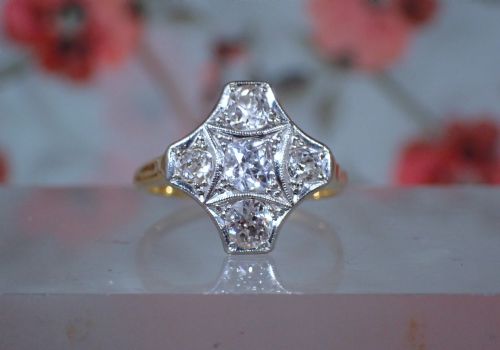


1920s Diamond Plaque Ring
A 1920s diamond plaque ring brings geometric elegance to the hand, offering intricate openwork settings that collectors prize for their distinct period style.
1920s Diamond Plaque Ring
A 1920s diamond plaque ring presents a flat, ornamental face across the finger, typical of the Art Deco movement. These jewels span the 1920s, 1930s, and 1940s, alongside Edwardian examples.
The most common formats on this page are elongated or panel rings, featuring symmetrical geometric layouts set with diamonds alongside sapphires, rubies, and emeralds.
Makers utilised rings and dress rings as canvases for intricate metalwork, combining yellow gold, white gold, and platinum to frame the central stones.
Materials and Construction
Platinum and 18ct white gold provide the bright, durable framework essential for holding delicate openwork plaque designs and pavé settings. Yellow gold also appears in combination with platinum.
Old cut, old transitional, and rose cut diamonds supply the characteristic subtle sparkle, complemented by calibre-cut sapphires, rubies, and emeralds that add vibrant colour contrasts.
Diamond, sapphire, ruby, emerald, and onyx appear frequently as primary materials in these dress rings.
Assessing Quality and Execution
The distinction between tiers rests on the precision of the piercing and milling work within the platinum or gold framework. Finer pieces maintain crisp geometric lines and secure stone settings without heavy metal borders.
The integration of calibré-cut coloured stones, such as rubies and sapphires, alongside well-matched old cut diamonds elevates the overall harmony of the design.
The 1920s Diamond Plaque Ring Glossary
- Plaque ring
- A ring featuring a flat, ornamental top surface that spreads across the finger. This layout allows for elaborate geometric patterning.
- Art Deco
- A design style dominant in the 1920s and 1930s characterised by symmetry, geometric motifs, and stylised lines. It heavily influenced jewellery manufacturing of the period.
- Old cut diamond
- A diamond cut with a small table, high crown, and large culet, typical of stones faceted before modern brilliant-cut standards. These stones exhibit a soft, distinctive glow under candlelight.
- Pavé
- A setting technique where small gemstones are closely set together with minimal visible metal. This creates a continuous surface of sparkle.
1920s Diamond Plaque Ring: Frequently Asked Questions
How do I wear a plaque ring daily?
A plaque ring sits flat against the finger, making it suitable for regular wear when handled with reasonable care.
Because these pieces contain delicate openwork and older stone cuts, remove the ring during heavy manual tasks to protect the metal and settings.
What periods do these rings come from?
The pieces span the 1920s and 1930s, with additional examples from the 1940s and the Edwardian era.
Art Deco aesthetics dominate the selection, linking the manufacturing techniques across these adjacent decades.
Are coloured stones common in these rings?
Many designs incorporate sapphires, rubies, or emeralds alongside the central diamonds. These coloured stones often form contrasting borders or geometric accents.
French work and standard British pieces frequently utilised calibré-cut rubies and sapphires to heighten the visual impact.
What metal combinations should I expect?
Platinum and 18ct white gold dominate the settings to provide a bright surface for the diamonds. Yellow gold also appears, sometimes combined with white gold or platinum in tricolour arrangements.