


1920s Crystal Lighting
These 1920s crystal lighting fixtures bring glittering period presence and brilliant illumination to a room, combining Art Deco design with traditional revival forms.
1920s Crystal Lighting
When you search for 1920s crystal lighting, you encounter a distinct group of decorative objects spanning large ballroom chandeliers, wall sconces, candlesticks, and necklaces. These pieces date from the 1920 period and reflect both contemporary modernism and retrospective taste.
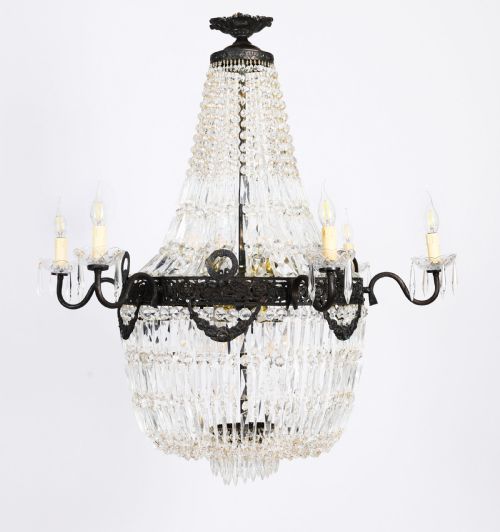
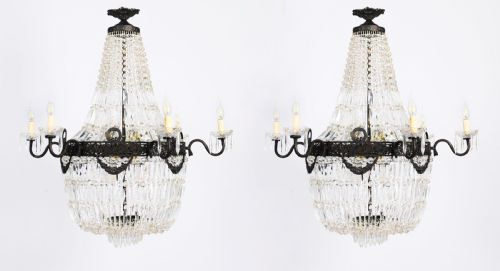
The most common form on this page is the large multi-light chandelier, often built in Louis Revival, French Chateau, or Art Deco styles. You also find smaller fixtures featuring beaded arms, cut-glass drops, and gilt or patinated bronze mounts.
Origin details in the evidence point towards English and French workshops producing grand multi-light fixtures alongside domestic items like candlesticks. The selection ranges from intimate twin-branch girandoles to massive ballrooms fixtures carrying dozens of lights.
How they were made
Makers utilised cast bronze, gilt bronze, and brass to form the structural frames and arms that support the electrical or candle-holding components. These metal foundations are combined with cut crystal, cut glass, and rock crystal elements suspended across the bodies.
Assembly methods involved wiring or pinning glass beads and cut-glass drops to beaded arms and tent structures. The glass components were shaped through cutting and polishing to maximise light refraction from the internal light sources.
Listings for this phrase exclusively feature items dated to the year 1920, encompassing both Art Deco and traditional revival styles.
What varies in quality
Quality differences emerge in the density and clarity of the crystal components, along with the precision of the glass cutting. Superior pieces exhibit sharper facets on the drops and higher transparency in the glass and rock crystal elements.
The heft and detail of the metalwork also define the tier of the piece, with heavier gilt bronze or patinated bronze frames showing crisper casting than simpler brass structures. The scale of the fixture, from a single twin-branch girandole to a massive ballroom chandelier, generally reflects the ambition of the original commission.
The 1920s Crystal Lighting Glossary
- Tent chandelier
- A lighting fixture featuring an upper canopy connected by strings of crystal beads to a lower metal ring, forming a tent-like silhouette. This design originated in earlier centuries but remained popular in revival pieces.
- Girandole
- A decorative branched candlestick or wall sconce designed to hold multiple candles or bulbs. Mirrored backs were often used historically to reflect the light.
- Rock crystal
- Naturally occurring colourless quartz that is cut and polished for jewellery and decorative lighting components. It differs from manufactured lead crystal by being a natural mineral.
- Gilt bronze
- Metalwork finished with a fine layer of gold applied to a bronze base. This technique protects the underlying bronze and provides a rich decorative surface.
1920s Crystal Lighting: Frequently Asked Questions
What styles define 1920s lighting?
The lighting from this decade incorporates Art Deco geometry alongside heavy revivals of earlier French and English aesthetics. You see Louis Revival, French Chateau, and Grand Regency forms sitting alongside clean Interwar Classic designs.
This mix occurred because makers drew on traditional palace aesthetics while simultaneously developing modern, stylised geometric patterns for contemporary interiors.
How many lights do these chandeliers have?
The fixtures vary widely in scale, ranging from twin-branch wall sconces and single girandoles up to massive ballroom chandeliers with fourteen or forty-one lights.
The larger multi-light examples were built for high ceilings in substantial rooms, while smaller configurations suited domestic spaces.
Are all these pieces French or English?
The evidence points to distinct origins across the Channel, specifically highlighting French and English pieces. French examples often include bronze girandoles and chateaux-style chandeliers, while English workshops produced grand ballroom fixtures.
Stylistic markers such as Louis Revival or Art Deco appear across different regional outputs.
What materials make up the drops?
The hanging elements are fashioned from cut crystal, cut glass, and occasionally rock crystal. These materials are shaped to refract light effectively from the internal bulbs or candles.
Metal frames of brass, gilt bronze, and patinated bronze support these glass drops and beaded arms.