


A 2026 Guide by Sellingantiques
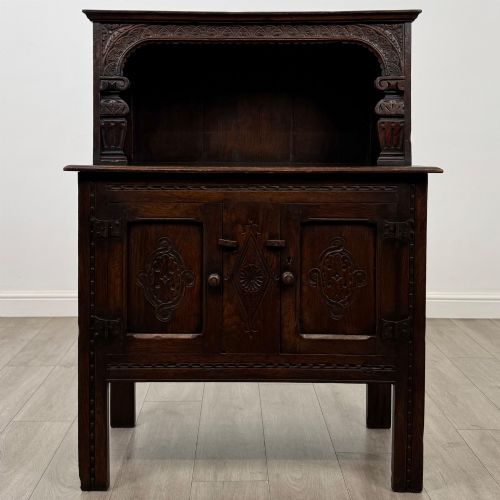
Arts and Crafts Movement Continental Secessionist Sideboard and Dresser, 1910
Priced at £2,300 from The Design Gallery
Early Georgian homes used plain side tables before full antique sideboards took over. They needed something with actual storage for dining equipment.
Robert Adam introduced the pedestal and urn arrangement. A central table stood flanked by separate pedestal cupboards.
Later designs combined these three pieces into one solid unit. Thomas Shearer published some early designs for the unified sideboard in 1788.
Look at Victorian examples for much heavier proportions. Dining rooms grew larger and the furniture scaled up to match the changing domestic architecture.
Gillows of Lancaster produced hundreds of standard models. They often stamped their name on the top edge of a drawer front.
Thomas Sheraton popularised the bow-fronted shape. He did not make them himself but his pattern books drove the trade.
Scottish makers like William Trotter supplied heavy mahogany variations. Their pieces feature thick reeded legs and robust carved details.
The 2026 retail price guide for Antique Sideboards is drawn from a proprietary archive of over 1.1 million retail prices indexed by Sellingantiques since 2003. This guide relies exclusively on their own internal data; no external sources or auction records are used.
Analysing nearly 25 years of UK antique market history alongside current retail values, the data indicates that typical UK retail prices for Antique Sideboards range between £800 and £4,000. Entry-level prices generally fall under £800 and premium examples upwards of £4,000.
A deep cellaret drawer usually sits on one side. Lead linings inside these kept the wine bottles cool.
Check the back edge for a brass gallery rail. Servants draped a cloth over this to protect the wall from splashing food.
Shallow central drawers held flatware and serving spoons. Some retain their original green baize linings.
Early unified forms relied on heavy mortise and tenon joints in the frame. The weight of the top required thick supporting timbers underneath.
Serpentine fronts demanded complex brick-built cores. The cabinetmaker glued up overlapping pine blocks before shaping the curve and applying the veneer.
Drawer bottoms run front to back on earlier pieces. Later nineteenth-century examples often have bottoms running side to side.
"Some concealed a discreet chamber pot in a lower cupboard. Long formal dinners meant guests needed nearby facilities."
"The central arch underneath was functional. It allowed the butler to stand closer to the serving surface while reaching across the top."
"They often held hot water in lead-lined urns. Diners could quickly rinse their cutlery between courses without leaving the room."
Based on almost 25 years of Sellingantiques UK antique market data, Antique Sideboards appeared 23857 times (out of 1,100,000 antiques) which gives it a rarity score of 1/100.
This score measures scarcity within the Sellingantiques archive only and is not a survey of the entire antiques market, so these statistics may not be indicative of the general availability of Antique Sideboards elsewhere.
Unbolt the rail from the backboard if you can. It stops polish getting into the mahogany and saves the wood finish.
Use a standard liquid metal polish and a soft cloth. Work in small sections and buff it off before it dries out.
They held wine bottles upright.
The depth stopped tall glass tipping over when you opened the drawer.
Wealthy clients often commissioned cabinetmakers to fit specific architectural niches. Robert Adam designed townhouses with curved alcoves meant to house matching serving tables.
Most standard antique sideboards were freestanding pieces sold from showroom floors. They needed finished backs or simple washboards because they stood against flat walls.
If a piece has unfinished sides or an odd asymmetrical profile, it was likely built in.
The later nineteenth-century models often dismantle. Look for large wooden screws under the top slab holding it to the pedestal bases.
Once you remove those screws, the flat top lifts off. The two side pedestals then move as separate boxes. Take the drawers out first to shed some extra weight.
Please note: This Antique Sideboards guide and its associated pricing data are provided for general informational purposes only. It does not constitute formal financial, investment, or appraisal advice and should not be relied upon as the sole basis for any commercial activity, purchasing, or sales decisions. Sellingantiques.co.uk accepts no liability for any actions taken in reliance on this information. Always consult with a qualified professional or independent appraiser.
