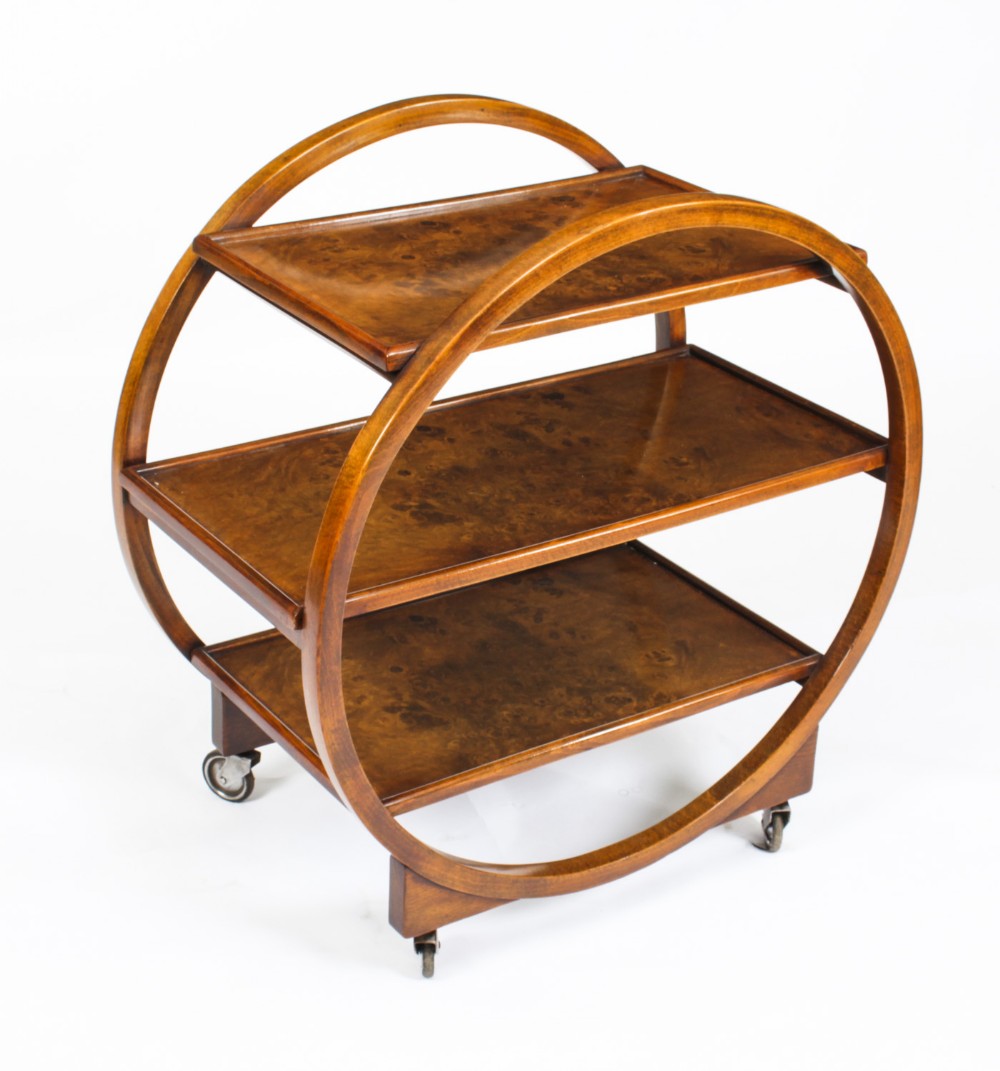
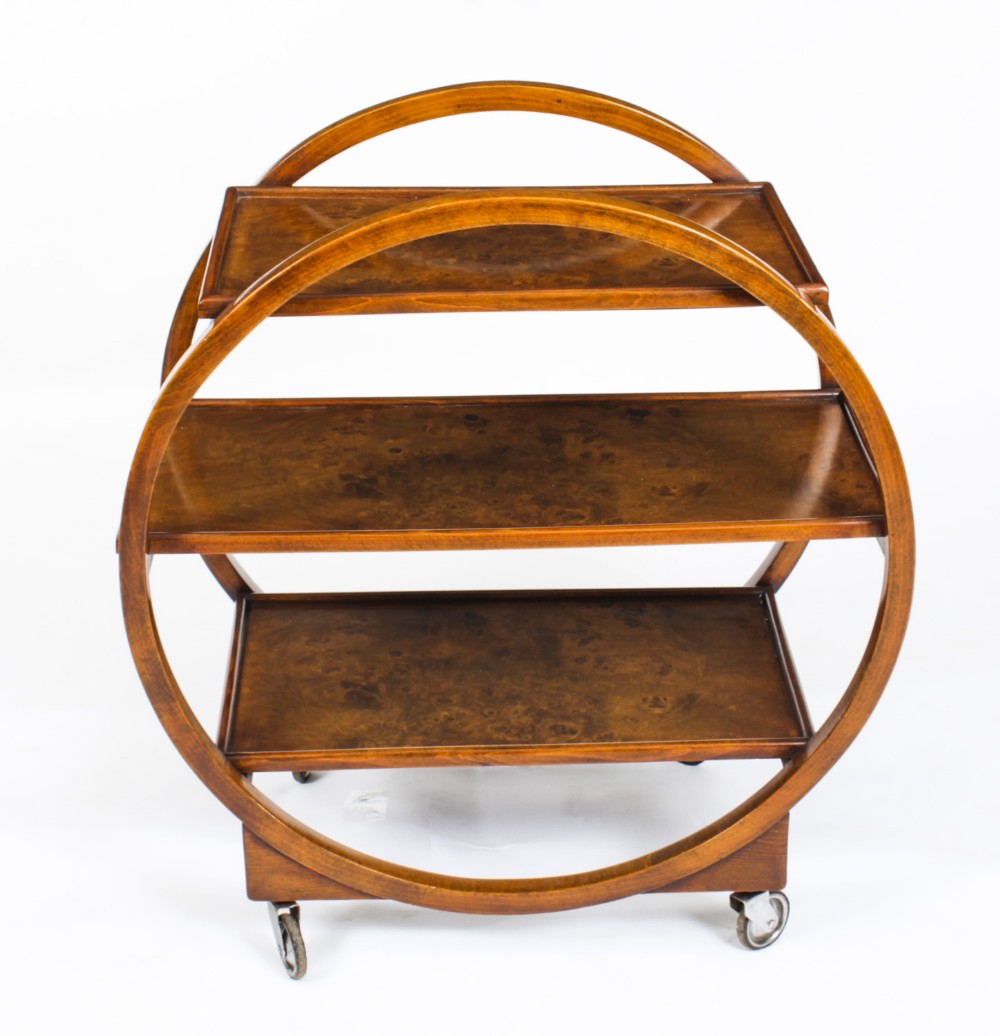
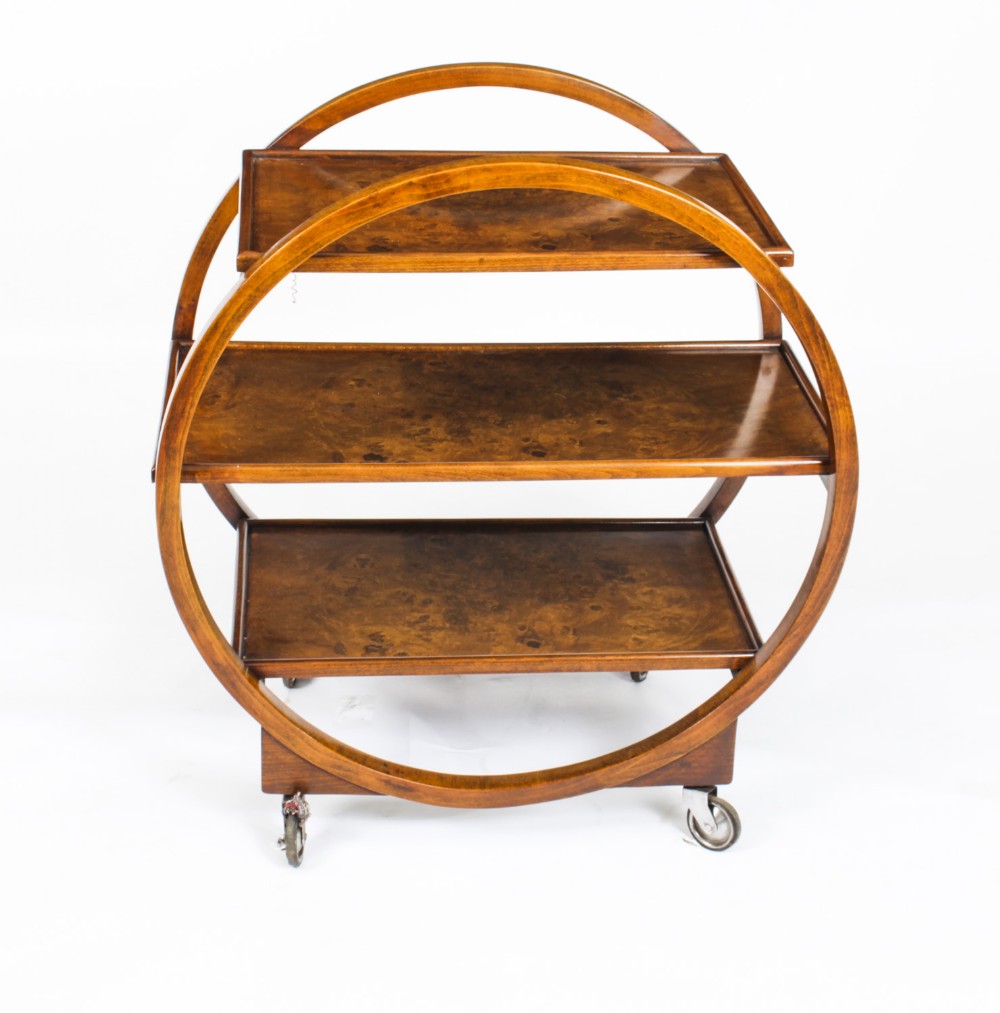
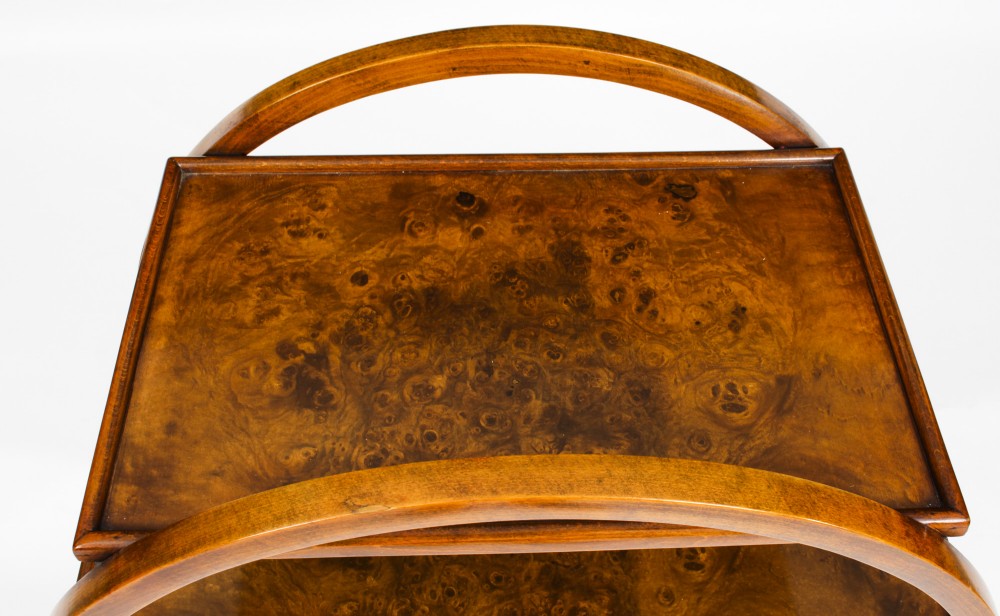
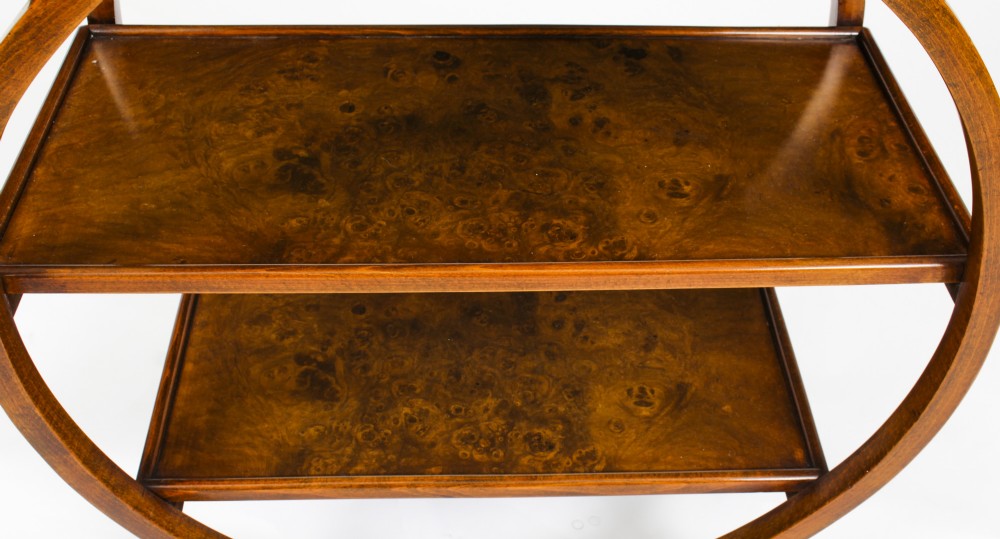
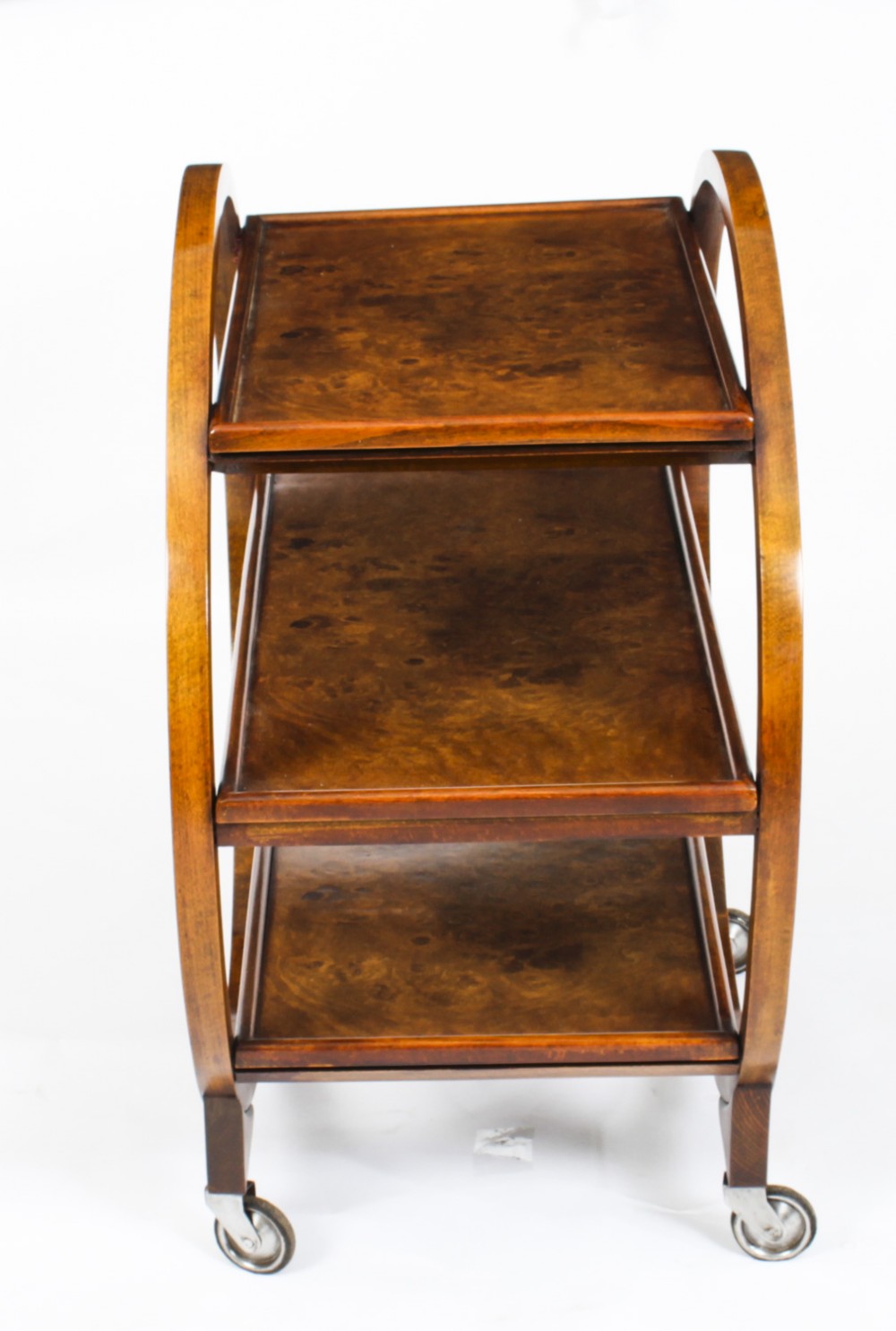
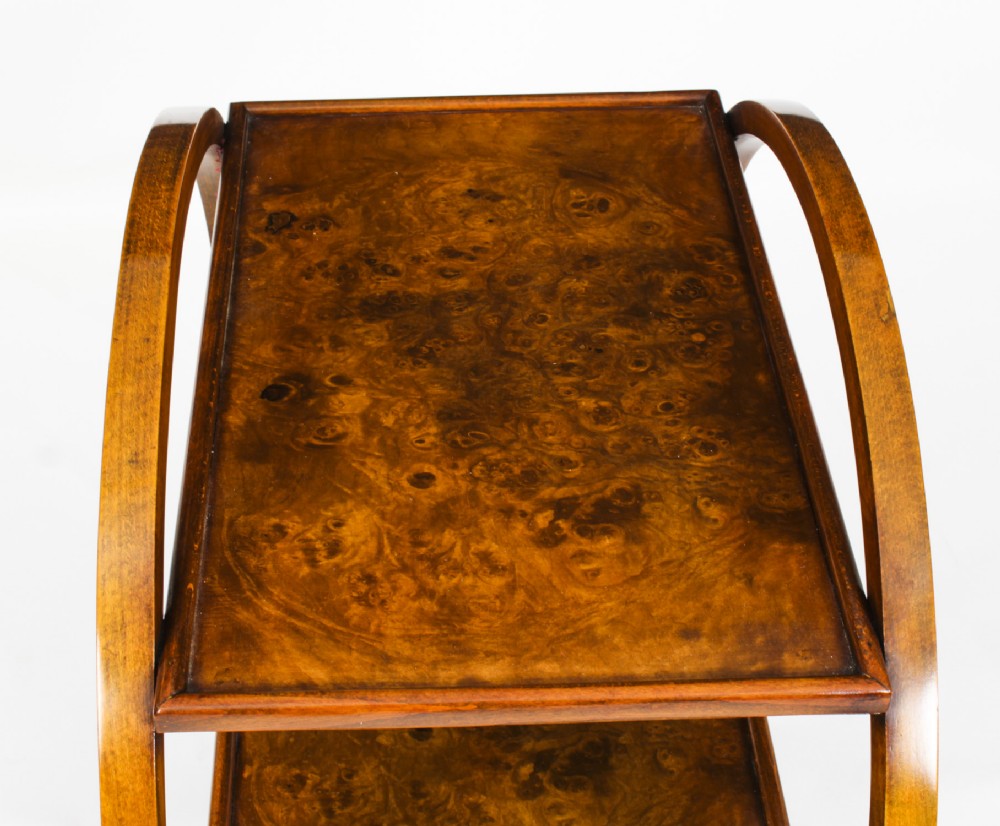
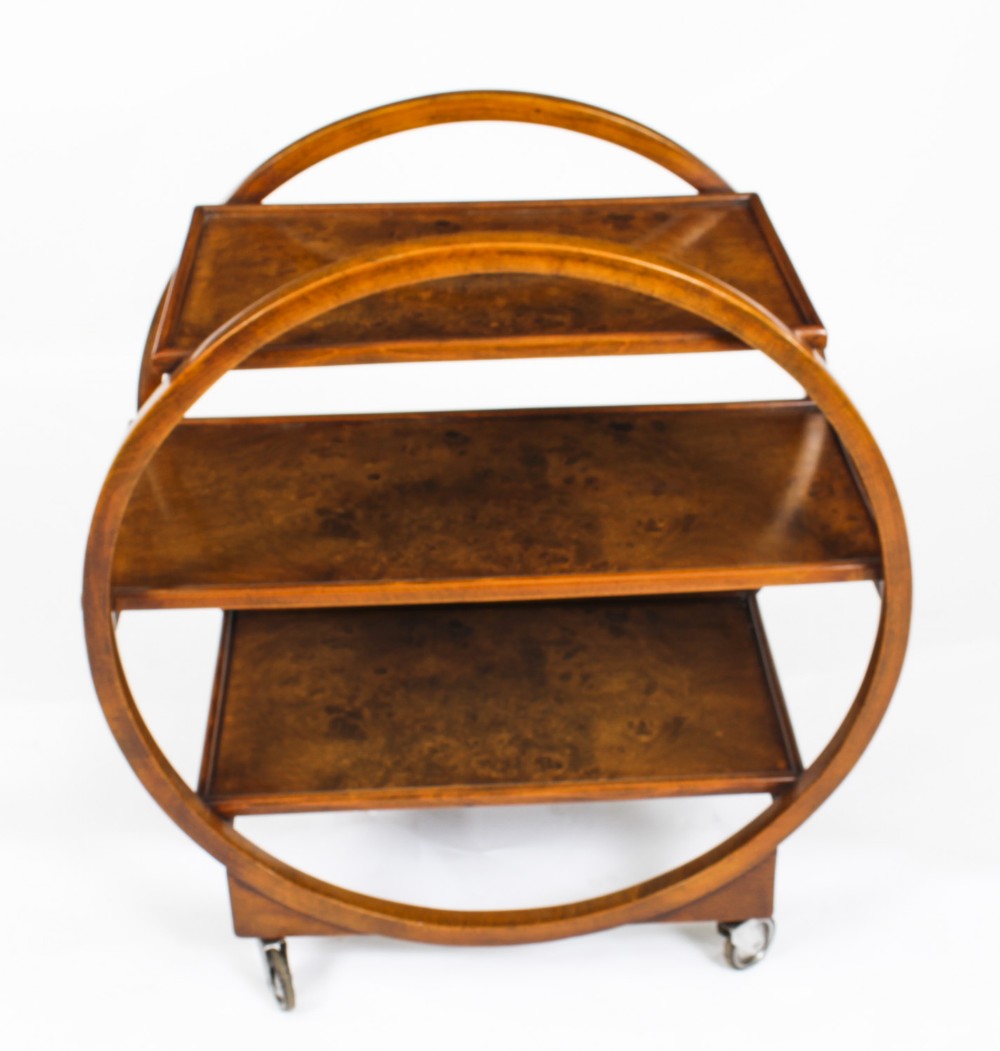
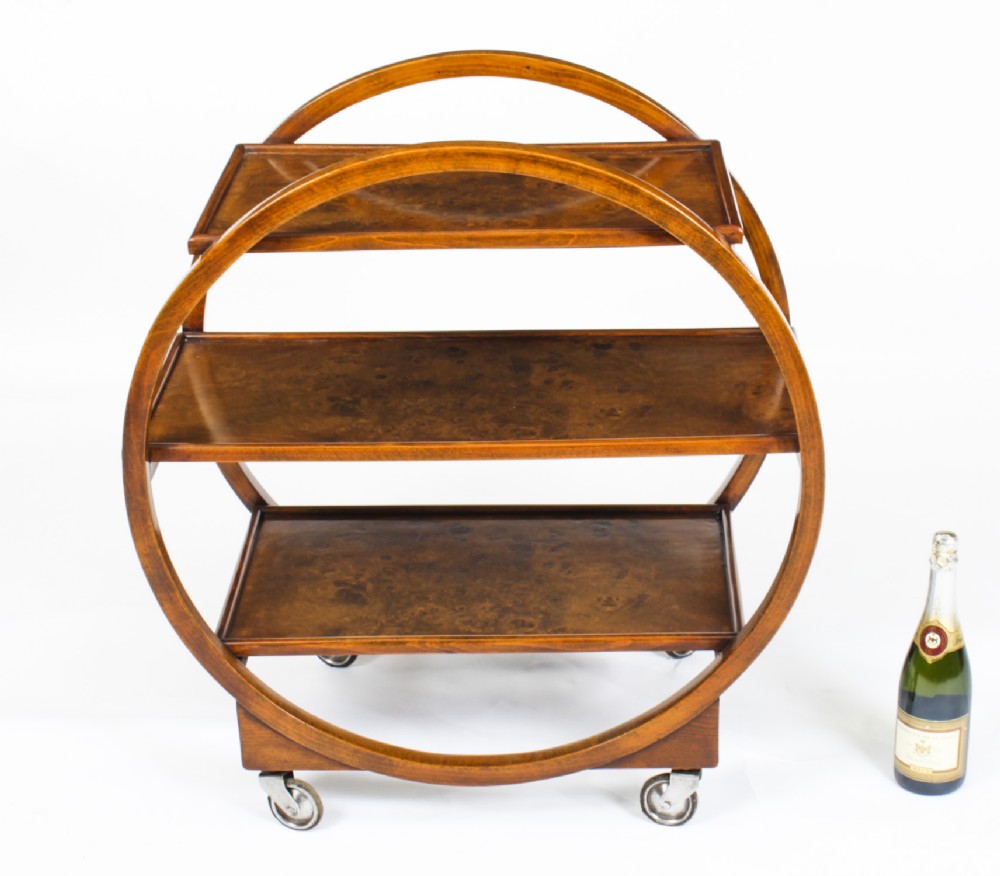
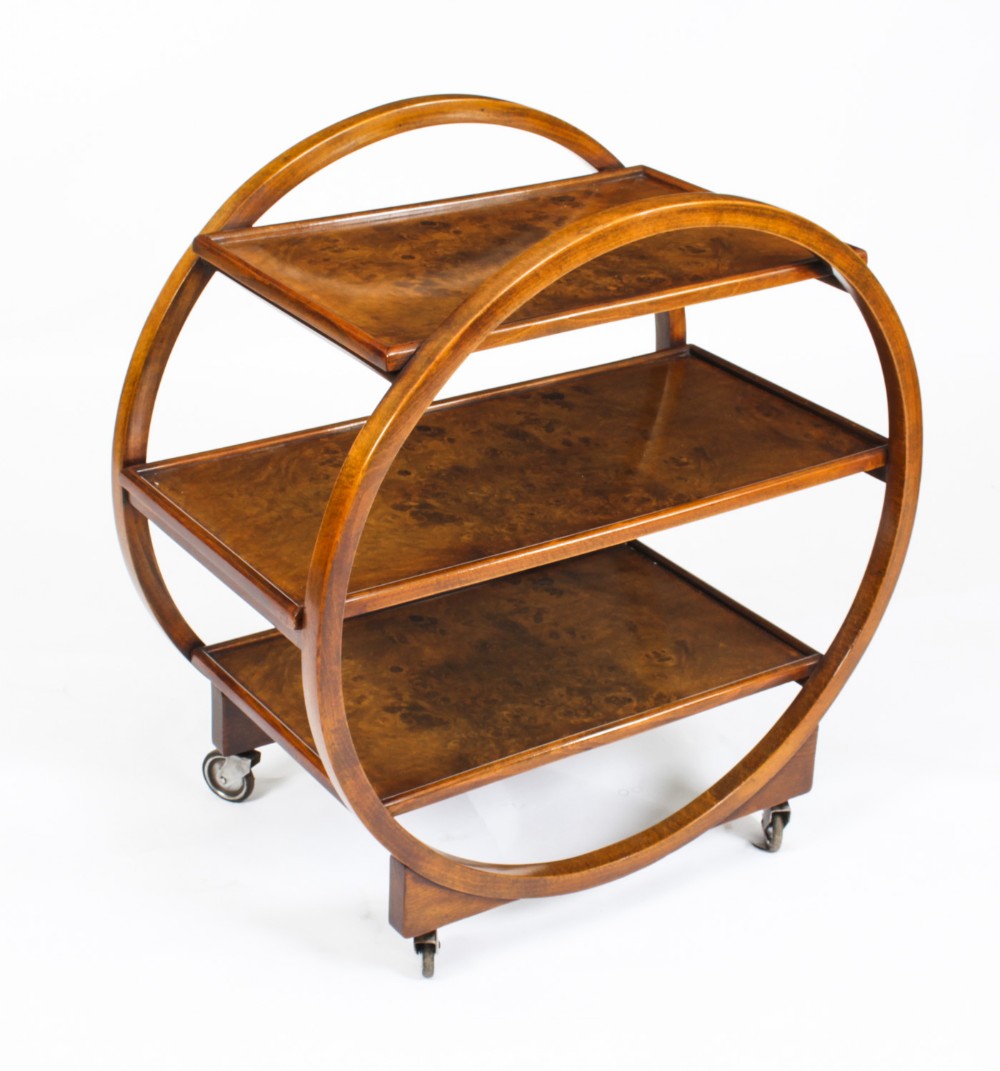
This is a striking antique Art Deco three-tier pollard oak hostess trolley dating from the 1920s.
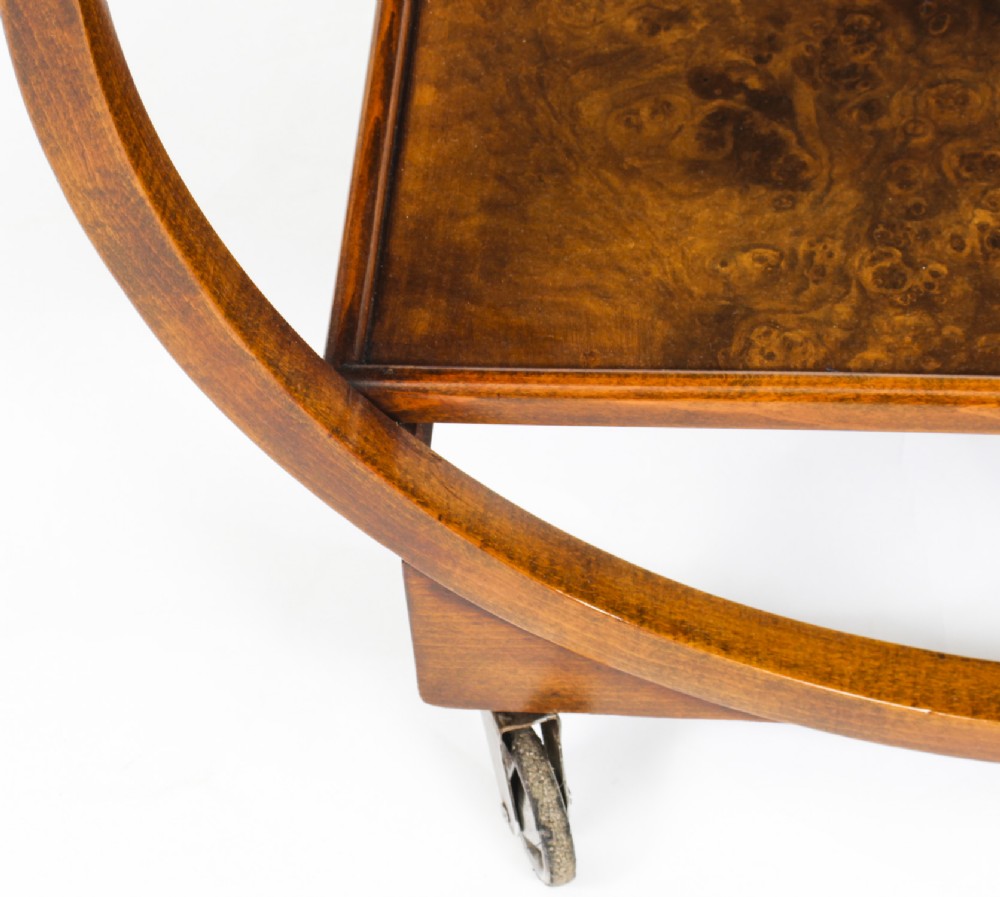
The trolley has sides shaped as a circle holding three shelf sections, and it is raised on castors.
This is a very entertaining serving tea trolley which can also be used as a display unit.
Condition:
In excellent condition having been beautifully cleaned, polished and waxed in our workshops, please see photos for confirmation.
Dimensions in cm:
Height 78 x Width 74 x Depth 43
Dimensions in inches:
Height 2 foot, 7 inches x Width 2 foot, 5 inches x Depth 1 foot, 5 inches
Pollard Oak
Pollarding is a pruning system in which the upper branches of a tree are removed, promoting a dense head of foliage and branches. It has been common in Europe since medieval times and is practised today in urban areas worldwide, primarily to maintain trees at a predetermined height. The bole of the tree, constantly cut back over a period of years, will eventually form a lump, or ‘burr’, which when sawn for veneer, gives a lovely grained, swirling figure.
The effect is similar to that of burr walnut with its distinctive speckled grain. Burrs, or ‘burls’, are growths which appear on the side of tree trunks, resulting from a tree undergoing some form of stress. They may be caused by an injury, virus or fungus.
During the 19th century great strides were made in the mechanisation of cabinet making. Marc Isambard Brunel [ Isambard Kingdom’s father] built the first steam driven saw mill, and invented a circular saw that could be used to cut veneers thinly and evenly for the first time. He also developed the first hydraulic veneer press. The figured wood cut from burrs and pollards is notoriously difficult to cut and lay: the wild grain which makes it so attractive results in a very delicate, brittle veneer. The new machines enabled the Victorian craftsmen to make the most of these beautiful timbers.
Art Deco or Deco,
is an influential visual arts design style which first appeared in France during the 1920s, flourished internationally during the 30s and 40s.
It is an eclectic style that combines traditional craft motifs with Machine Ageimagery and materials. The style is often characterized by rich colours, bold geometric shapes, and lavish ornamentation.
Deco emerged from the Interwar period when rapid industrialization was transforming culture. One of its major attributes is an embrace of technology. This distinguishes Deco from the organic motifs favored by its predecessor Art Nouveau.
Historian Bevis Hillier defined Art Deco as "an assertively modern style...[that] ran to symmetry rather than asymmetry, and to the rectilinear rather than the curvilinear; it responded to the demands of the machine and of new material...[and] the requirements of mass production".
During its heyday Art Deco represented luxury, glamour, exuberance, and faith in social and technological progress.
Our reference: A2028