60,653  PAGES BROWSED TODAY PAGES TODAY 103  ANTIQUES UPLOADED TODAY NEW ARRIVALS
ID #SA758893
FOR SALE
£9,500
Email
Save
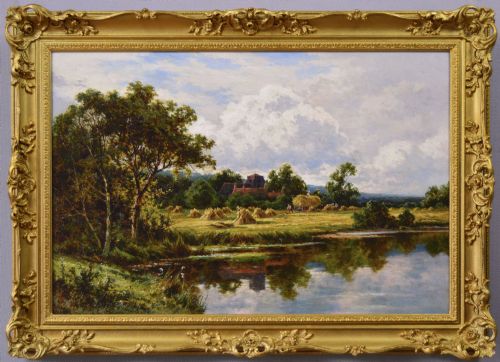
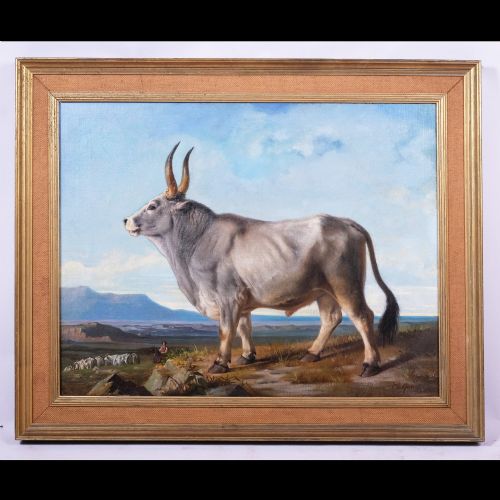
Landscape Animal Oil Painting of Cattle & Sheep at a River by Thomas Sidney Cooper
Benton Fine Art
for sale €11,115     $12,065
£9,500
Benton Fine Art

Benton Fine Art

Sellingantiques Verified Since Sep 2012
View Dealers Stock Page
  • About Us
    Specialists in 19th & early 20th century original oil paintings by listed artists
  • Trade Associations
    Benton Fine Art is a registered member of LAPADA  BADA  CINOA
Id #SA758893
PDF SHARE
SAVE

Landscape Animal Oil Painting of Cattle & Sheep at a River by Thomas Sidney Cooper

19th century
For Sale by Benton Fine Art
Description

Thomas Sidney Cooper

British, (1803-1902)

Canterbury Meadows

Oil on canvas, signed & dated ‘T. Sidney Cooper RA/1894

Image size: 14.75 inches x 24.75 inches

Size including frame: 21.5 inches x 31.5 inches

Thomas Sidney Cooper was born in St Peter’s Street Canterbury on 26 September 1803 to William and Sarah Cooper. He was christened Thomas Cooper and at some point adopted Sydney or Sidney as his middle name. At the age of 12 he started working as a coach painter and later a scene painter, continuing to draw and paint in his spare time.

When he was 21 he was helped by his uncle to move to London and study at the Royal Academy. However, he didn’t complete the course and returned to Canterbury. Shortly afterwards in 1824, he travelled to Brussels where he met Eugène Joseph Verboeckhoven who had a great influence on his work. He also met and married Charlotte Pearson the daughter of a mathematician. After the revolution broke out they returned to London in 1831 where Cooper started selling paintings of the cattle that he sketched at Smithfield Market. The couple lived at Portland Terrace, St John’s Wood and together had four children. His son Thomas George Cooper (1836-1901) became an artist and also his great nephew William Sidney Cooper (1854-1927) both of whom he taught.

In 1824, he travelled to Brussels where he met Eugène Joseph Verboeckhoven who had a great influence on his work. He also met and married Charlotte Pearson the daughter of a mathematician. After the revolution broke out they returned to London in 1831 where Cooper started selling paintings of the cattle that he sketched at Smithfield Market. The couple lived at Portland Terrace, St John’s Wood and together had four children. His son Thomas George Cooper also became an artist.

In 1833 he made his debut at the Royal Academy, where he continued to exhibit regularly until his death. He also exhibited at the Royal Society of British Artists and the British Institution between 1833 and 1863. He was elected ARA in 1845 and RA in 1867. From the early 1840’s he lived at 16 Wellington Terrace, until the 1850’s when he moved to 2 Dorset Square, Regent’s Park. He continued to live there for over 10 years until he moved to 42 Chepstow Villas, Bayswater. Around 1849, he had a second house built in Harbledown, Canterbury and named it Vernon Holme after his patron and from where he would also paint and exhibit.

Cooper specialised in paintings of cattle or sheep, which earned him the nickname of 'Cow Cooper'. He became one of the most accomplished and successful animal landscape painters of the 19th century. He built Alms Houses in Canterbury and in 1882 set up the Canterbury Sidney Cooper School of Art. In July 1901, he was awarded the Commander of the Royal Victorian Order (CVO). Cooper died at Harbledown, Canterbury on 7 February 1902 and was buried at St Martin Churchyard.

Examples of his work can be found at the Royal Museum in Canterbury, Tate Gallery, Victoria and Albert Museum, Atkinson Art Gallery, Birmingham Museum, Brighton and Hove Museum, Northampton Museum Sheffield Museum and other public collections.

Canterbury Meadows was a subject he painted on many occasions and would have known very well. With the River Stour running through it, the location provided local farmers with the ideal grazing ground and watering for their cattle and sheep. The church in the distance with its distinctive spire is most likely to be the church of St Mary the Virgin at Fordwich which still stands today.

Presentation: The painting is housed in a new, English made gilt frame which is in excellent condition.

Condition: As with all of our original antique oil paintings, this work is offered in ready to hang gallery condition, having just been professionally cleaned, restored and revarnished.

© Benton Fine Art

Physical Dimensions
Height
54.5cm (21.46")
Width
80cm (31.50")
Depth
7.5cm (2.95")
Declaration

Benton Fine Art has dated this Victorian Pastoral Oil Painting to the 1890s.

Reference Numbers
Sellingantiques Reference
SA758893
Dealers Notes

Members of the British Antique Dealers Association (BADA) the London and Provincial Antique Dealers Association (LAPADA).

We use a professional, fully insured and tracked door to door service for our UK and international deliveries. Please contact us for further information and shipping quotes.

Viewing is by APPOINTMENT ONLY. However, we can also arrange for you to view the item in your home, depending on the location.

For a wider range of stock please visit www.bentonfineart.com.

If you would like to purchase this item or have any questions, please email us at pictures@bentonfineart.com or call 07710 540549.

© Benton Fine Art

Description
Thomas Sidney Cooper

British, (1803-1902)

Canterbury Meadows

Oil on canvas, signed & dated ‘T. Sidney Cooper RA/1894

Image size: 14.75 inches x 24.75 inches

Size including frame: 21.5 inches x 31.5 inches

Thomas Sidney Cooper was born in St Peter’s Street Canterbury on 26 September 1803 to William and Sarah Cooper.
Benton Fine Art

He was christened Thomas Cooper and at some point adopted Sydney or Sidney as his middle name. At the age of 12 he started working as a coach painter and later a scene painter, continuing to draw and paint in his spare time.

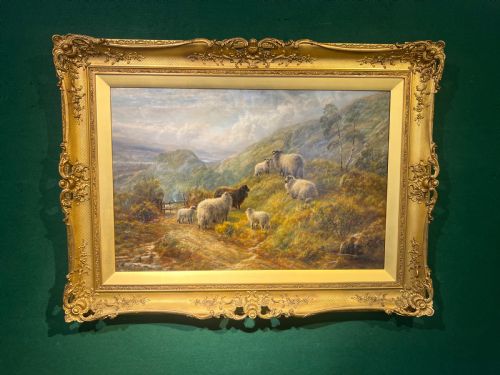
fig 1. A horizontal Victorian oil painting portraying cattle drinking from a river beside a flock of sheep, framed in an ornate gilded scroll frame.
fig 1. Landscape Animal Oil Painting of Cattle & Sheep at a River by Thomas Sidney Cooper

When he was 21 he was helped by his uncle to move to London and study at the Royal Academy. However, he didn’t complete the course and returned to Canterbury. Shortly afterwards in 1824, he travelled to Brussels where he met Eugène Joseph Verboeckhoven who had a great influence on his work. He also met and married Charlotte Pearson the daughter of a mathematician. After the revolution broke out they returned to London in 1831 where Cooper started selling paintings of the cattle that he sketched at Smithfield Market. The couple lived at Portland Terrace, St John’s Wood and together had four children. His son Thomas George Cooper (1836-1901) became an artist and also his great nephew William Sidney Cooper (1854-1927) both of whom he taught.

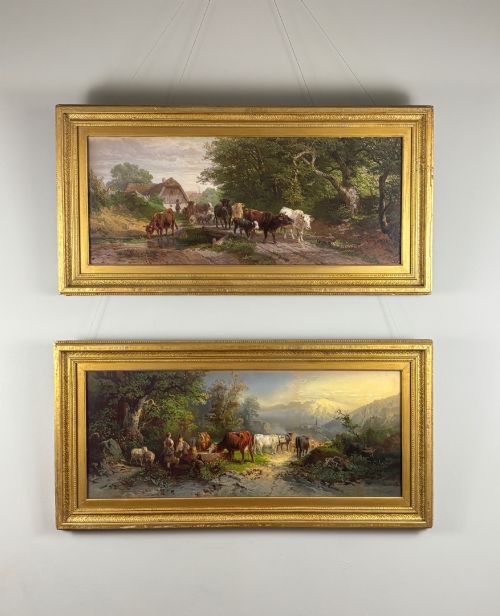
fig 2. A horizontal Victorian oil painting portraying cattle drinking from a river beside a flock of sheep, framed in an ornate gilded scroll frame.
fig 2. Landscape Animal Oil Painting of Cattle & Sheep at a River by Thomas Sidney Cooper

In 1824, he travelled to Brussels where he met Eugène Joseph Verboeckhoven who had a great influence on his work. He also met and married Charlotte Pearson the daughter of a mathematician. After the revolution broke out they returned to London in 1831 where Cooper started selling paintings of the cattle that he sketched at Smithfield Market. The couple lived at Portland Terrace, St John’s Wood and together had four children. His son Thomas George Cooper also became an artist.

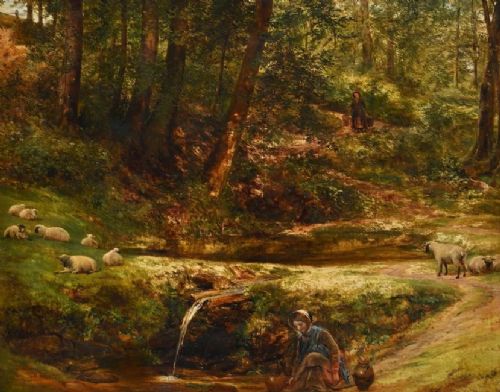
fig 3. A horizontal Victorian oil painting portraying cattle drinking from a river beside a flock of sheep, framed in an ornate gilded scroll frame.
fig 3. Landscape Animal Oil Painting of Cattle & Sheep at a River by Thomas Sidney Cooper

In 1833 he made his debut at the Royal Academy, where he continued to exhibit regularly until his death. He also exhibited at the Royal Society of British Artists and the British Institution between 1833 and 1863. He was elected ARA in 1845 and RA in 1867. From the early 1840’s he lived at 16 Wellington Terrace, until the 1850’s when he moved to 2 Dorset Square, Regent’s Park. He continued to live there for over 10 years until he moved to 42 Chepstow Villas, Bayswater. Around 1849, he had a second house built in Harbledown, Canterbury and named it Vernon Holme after his patron and from where he would also paint and exhibit.

fig 4. A horizontal Victorian oil painting portraying cattle drinking from a river beside a flock of sheep, framed in an ornate gilded scroll frame.
fig 4. Landscape Animal Oil Painting of Cattle & Sheep at a River by Thomas Sidney Cooper

Cooper specialised in paintings of cattle or sheep, which earned him the nickname of 'Cow Cooper'. He became one of the most accomplished and successful animal landscape painters of the 19th century. He built Alms Houses in Canterbury and in 1882 set up the Canterbury Sidney Cooper School of Art. In July 1901, he was awarded the Commander of the Royal Victorian Order (CVO). Cooper died at Harbledown, Canterbury on 7 February 1902 and was buried at St Martin Churchyard.

fig 5. A horizontal Victorian oil painting portraying cattle drinking from a river beside a flock of sheep, framed in an ornate gilded scroll frame.
fig 5. Landscape Animal Oil Painting of Cattle & Sheep at a River by Thomas Sidney Cooper

Examples of his work can be found at the Royal Museum in Canterbury, Tate Gallery, Victoria and Albert Museum, Atkinson Art Gallery, Birmingham Museum, Brighton and Hove Museum, Northampton Museum Sheffield Museum and other public collections.

fig 6. A horizontal Victorian oil painting portraying cattle drinking from a river beside a flock of sheep, framed in an ornate gilded scroll frame.
fig 6. Landscape Animal Oil Painting of Cattle & Sheep at a River by Thomas Sidney Cooper

Canterbury Meadows was a subject he painted on many occasions and would have known very well. With the River Stour running through it, the location provided local farmers with the ideal grazing ground and watering for their cattle and sheep. The church in the distance with its distinctive spire is most likely to be the church of St Mary the Virgin at Fordwich which still stands today.

fig 7. A horizontal Victorian oil painting portraying cattle drinking from a river beside a flock of sheep, framed in an ornate gilded scroll frame.
fig 7. Landscape Animal Oil Painting of Cattle & Sheep at a River by Thomas Sidney Cooper

Presentation: The painting is housed in a new, English made gilt frame which is in excellent condition.

Condition: As with all of our original antique oil paintings, this work is offered in ready to hang gallery condition, having just been professionally cleaned, restored and revarnished.

© Benton Fine Art

Height
54.5cm (21.46")
Width
80cm (31.50")
Depth
7.5cm (2.95")
Date of Manufacture

Benton Fine Art has dated this Victorian Pastoral Oil Painting to the 1890s.

Reference Numbers
Sellingantiques Ref
SA758893
Benton Fine Art
Benton Fine Art
Sellingantiques verified Since Sep 2012

Specialists in 19th & early 20th century original oil paintings by listed artists

Dealer Profile

You can view the stock and full dealer information on the Benton Fine Art Profile Page

Trade Associations

Benton Fine Art is a registered member of LAPADA  BADA  CINOA

PDF SHARE
SAVE
A horizontal Victorian oil painting portraying cattle drinking from a river beside a flock of sheep, framed in an ornate gilded scroll frame.
1 / 9
Archive I A horizontal Victorian oil painting portraying cattle drinking from a river beside a flock of sheep, framed in an ornate gilded scroll frame.

Landscape Animal Oil Painting of Cattle & Sheep at a River by Thomas Sidney Cooper

Archive II A horizontal Victorian oil painting portraying cattle drinking from a river beside a flock of sheep, framed in an ornate gilded scroll frame. View II
Archive III A horizontal Victorian oil painting portraying cattle drinking from a river beside a flock of sheep, framed in an ornate gilded scroll frame. View III
Archive IV A horizontal Victorian oil painting portraying cattle drinking from a river beside a flock of sheep, framed in an ornate gilded scroll frame. View IV
Archive V A horizontal Victorian oil painting portraying cattle drinking from a river beside a flock of sheep, framed in an ornate gilded scroll frame. View V
Archive VI A horizontal Victorian oil painting portraying cattle drinking from a river beside a flock of sheep, framed in an ornate gilded scroll frame. View VI
Archive VII A horizontal Victorian oil painting portraying cattle drinking from a river beside a flock of sheep, framed in an ornate gilded scroll frame. View VII
Archive VIII A horizontal Victorian oil painting portraying cattle drinking from a river beside a flock of sheep, framed in an ornate gilded scroll frame. View VIII
Archive IX A horizontal Victorian oil painting portraying cattle drinking from a river beside a flock of sheep, framed in an ornate gilded scroll frame. View IX
FURTHER BROWSING

Visitors also looked at these ⇣

Enlarged Archival View
Telephone 07710 540 549
Location
Near Broadway
Worcestershire
United Kingdom

By appointment only.
Verified Since Sep 2012
Items For Sale 210
Benton Fine Art
Benton Fine Art
Verified Since Sep 2012
View Dealer Info
Location: Near Broadway, Worcestershire, United Kingdom, , By appointment only.
Verified
Sep 2012
For Sale
210
A horizontal Victorian oil painting portraying cattle drinking from a river beside a flock of sheep, framed in an ornate gilded scroll frame.
Landscape animal oil painting of cattle & sheep at a river by Thomas Sidney Cooper
Ref: SA758893
A horizontal Victorian oil painting portraying cattle drinking from a river beside a flock of sheep, framed in an ornate gilded scroll frame.
Detail View 1
Detail View 2
Detail View 3
Detail View 4
Detail View 5
Detail View 6
Detail View 7
Detail View 8
Archival Detail
Every single antique dealer on our platform is individually approved by our internal team. We verify their professional trade history, ethical standards, and photographic quality to ensure a secure, high-standard buying environment. Upon joining, every dealer agrees to a strict 9-point code of conduct. While issues can occasionally arise, our dealers typically resolve them swiftly and directly with the buyer. In fact, since our founding in 2002, Sellingantiques has only had to step in to help resolve an issue on roughly five occasions—a true testament to the quality of our dealers and their dedication to your happiness.
Our dealers are highly experienced in packing and shipping fragile, high-value antiques. Because you are in direct contact with the dealer, you will be able to easily go through all available shipping and insurance options together to ensure your item arrives safely.
Antiques are the ultimate green purchase. By choosing historical pieces over newly manufactured goods, you completely eliminate the carbon footprint of modern mass production while preserving exceptional, timeless craftsmanship.

Victorian pastoral oil paintings typically depict serene rural landscapes, agricultural scenes, and livestock in meticulous detail. Popularised by artists who focused on naturalism, these works celebrated agrarian life during an era of rapid industrialisation.

These artworks were predominantly executed using oil paints on stretched linen or cotton canvas. Frames were typically crafted from timber with moulded plaster or gesso ornament, finished with gold leaf gilded surfaces.

Authentic pieces exhibit signs of age such as natural craquelure across the paint layer, darkening or yellowing of the varnish, and oxidation on the canvas backing. The frames often show age-related wear to the gilding and hand-finished joinery on the reverse.

Positioning a classic pastoral scene above a contemporary sideboard or fireplace creates a balanced contrast between historic artwork and modern lines. Pairing the rich gilded frame with neutral wall tones allows the artwork to serve as an architectural focal point.

Keep the artwork away from direct sunlight, high humidity, and heat sources to prevent cracking or warping. Lightly dust the surface and carved frame with a soft, dry microfibre brush, avoiding liquid cleaners or chemical polishes.
items
Add keywords to the filter
Price
£100
£250000
Era
Movements
Material
Origin
Stock Location
Freshness
Online Payments
Categories