18,356  PAGES BROWSED TODAY PAGES TODAY 36  ANTIQUES UPLOADED TODAY NEW ARRIVALS
ID #SA712866
FOR SALE
£7,500
Email
Save
Studio of Philip Mercier, 1689-1760 The Fair Oyster Girl
Artware Fineart
for sale €8,775     $9,525
£7,500

Artware Fineart

Sellingantiques Verified Since Sep 2008
View Dealers Stock Page
Id #SA712866
PDF SHARE
SAVE

Studio of Philip Mercier, 1689-1760 The Fair Oyster Girl

18th century
For Sale by Artware Fineart
Description

Studio of Philip Mercier, 1689-1760

The Fair Oyster Girl

oil on canvas

83 x 67 cm (33 x 27 in.)

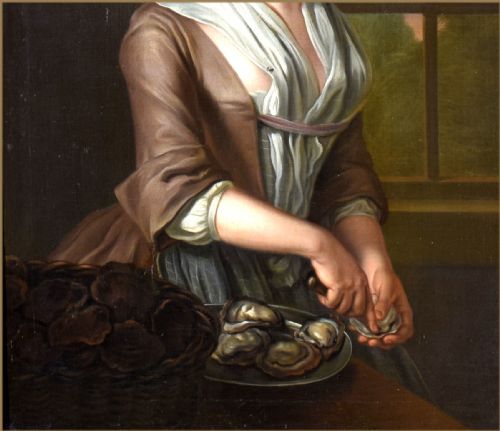
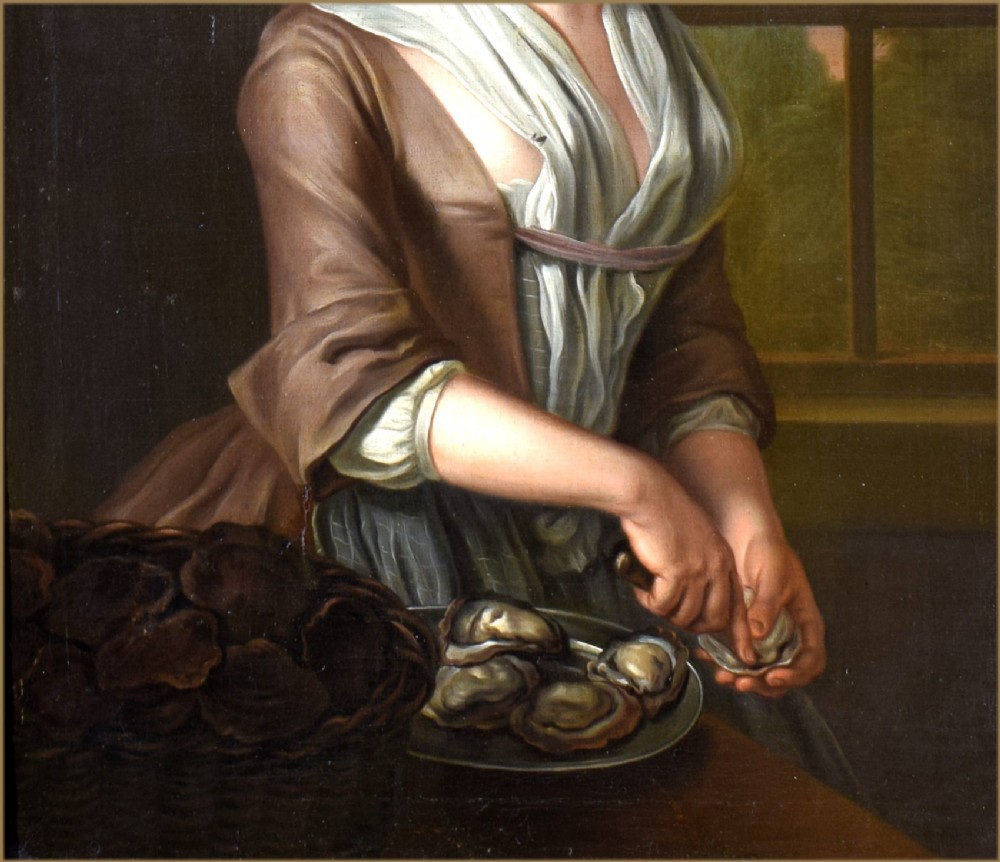
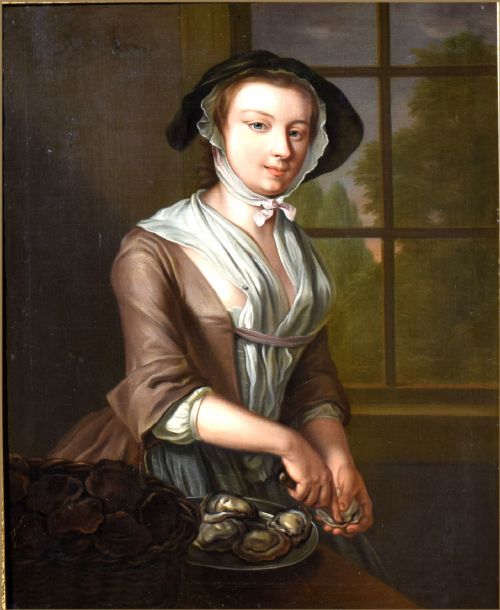
A young woman standing beside a window at a table, a basket by her right elbow, opening oysters and putting them on a plate in front of her, looking up towards the viewer, wearing a wide-brimmed hat over a frilled cap
Literature

Published by: Carington Bowles biography After: Philippe Mercier 1766-1799 (circa) inscribed in the margin with the title and ''The Oysters good! the Nymph so fair, Who would not wish to taste her Ware " // 124 // Printed for Carington Bowles, at No. 69 in St. Pauls Church Yard, London.'
'Avenue House, Ampthill, Bedfordshire: The Residence of Professor A.E. Richardson, P.R.A., and Mrs. Richardson', Antique Collector, XXVI, February 1955, p. 6.

M. Webster, Francis Wheatley, London, 1970, p. 70, fig. 85.

J. Ingamells and R. Raines, 'A catalogue of the paintings, drawings and etchings of Philip Mercier', The Walpole Society, XLVI, 1978, pp. 43-44, no. 164, pl. 11a.

E.D.G. Johnson, Paintings of the British Street Scene, 1986, pl. 109.

Notes

Mercier settled in England in circa 1716, becoming Principal Painter to Frederick Prince of Wales in 1729. In 1736, however, Mercier was dismissed and escaped London's competitive portraiture market for a more receptive audience in the country. The artist's patrons during this period included the Duke of Leeds, who acquired four pictures; Sir Robert Hildyard of Winestead, who bought a portrait and two 'fancy pictures', and Thomas Worsley, who acquired five portraits (Ingamells and Raines, op. cit., p. 4).

The decade from 1740-50, while he was based in York, was the greatest period of activity for Mercier - over 160 pictures survive from this time. It was during these years that he seemed to turn purposefully towards the 'fancy picture' genre he first started to favour in the late 1730s. The term 'fancy picture' was coined in 1737 by the art critic and historian George Vertue with specific reference to Mercier's work and the influence of French rococo pastoral pictures, such as those of Greuze and Boucher. Employed loosely throughout the 18th century, the phrase 'fancy picture' was used to describe charmingly contrived genre scenes of sentimental realism, incorporating the artist's own whimsy and imagination or references to contemporary literature, with figures shown in various roles and guises.

The rise of the print market at this time furthered the popularity of such pictures, as Hogarth had so successfully demonstrated in the 1730s with The Harlot's Progress and The Rake's Progress. From 1739, Mercier's compositions were widely disseminated through an alliance with John Faber Junior, a well-known printmaker who continued to work with him through the 1750s. Following Faber's death in 1756, Mercier expanded his published work through several other printmakers: McArdell, Purcell, and most notably Richard Houston (1722-1725), who produced single plates of Mercier's work in 1756, 1758 and 1760. Houston engraved The Oyster Girl twice - a testament to its popularity - firstly under the title The Fair Oysterinda and then as Native Meltons. Both were accompanied by the following verse, rather heavy-handedly insinuating that it is perhaps not only the oysters that are for sale: 'The oysters good - The Nymph so fair! Who would not wish to taste her Ware? No need has she aloud to Cry'em Since all who see her Fare must buy'em.'

The iconography derives in part from the European tradition of portraying street vendors, including the characters popularized by Marcellus Laroon's Cryes of the City of London and more contemporaneously Hogarth's The Shrimp Girl (National Gallery, London), but it also relies on themes explored in Dutch 17th century genre painting, where the preparation of food was often associated with the

Physical Dimensions
Height
83cm (32.68")
Width
67cm (26.38")
Depth
2cm (0.79")
Declaration

Artware Fineart has dated this Georgian Portrait Oil Painting to the 18th Century.

Reference Numbers
Sellingantiques Reference
SA712866
Dealers Internal Reference
4339
Description
Studio of Philip Mercier, 1689-1760

The Fair Oyster Girl

oil on canvas

83 x 67 cm (33 x 27 in.)

A young woman standing beside a window at a table, a basket by her right elbow, opening oysters and putting them on a plate in front of her, looking up towards the viewer, wearing a wide-brimmed hat over a frilled cap

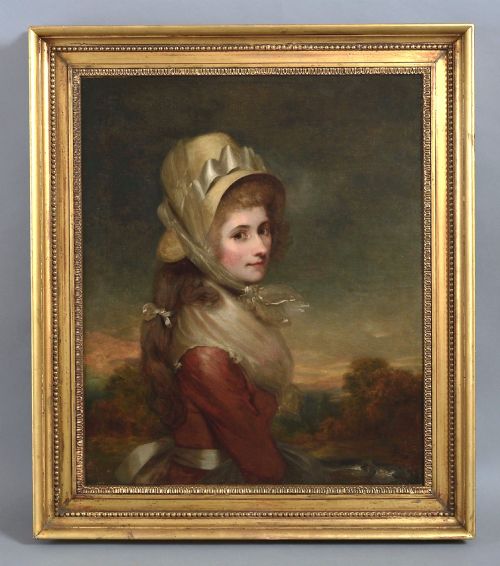
fig 1. An eighteenth-century oil painting depicting a young woman in period attire shucking oysters, housed within an ornate gilded frame.
fig 1. Studio of Philip Mercier, 1689-1760 The Fair Oyster Girl

Literature

Published by: Carington Bowles biography After: Philippe Mercier 1766-1799 (circa) inscribed in the margin with the title and ''The Oysters good! the Nymph so fair, Who would not wish to taste her Ware " // 124 // Printed for Carington Bowles, at No. 69 in St. Pauls Church Yard, London.'

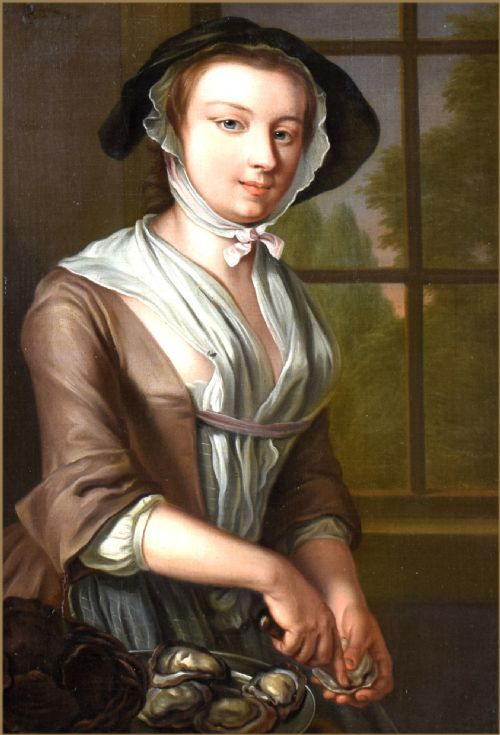
fig 2. An eighteenth-century oil painting depicting a young woman in period attire shucking oysters, housed within an ornate gilded frame.
fig 2. Studio of Philip Mercier, 1689-1760 The Fair Oyster Girl

'Avenue House, Ampthill, Bedfordshire: The Residence of Professor A.E. Richardson, P.R.A., and Mrs. Richardson', Antique Collector, XXVI, February 1955, p. 6.

M. Webster, Francis Wheatley, London, 1970, p. 70, fig. 85.

J. Ingamells and R.

Raines, 'A catalogue of the paintings, drawings and etchings of Philip Mercier', The Walpole Society, XLVI, 1978, pp.
Artware Fineart

43-44, no. 164, pl. 11a.

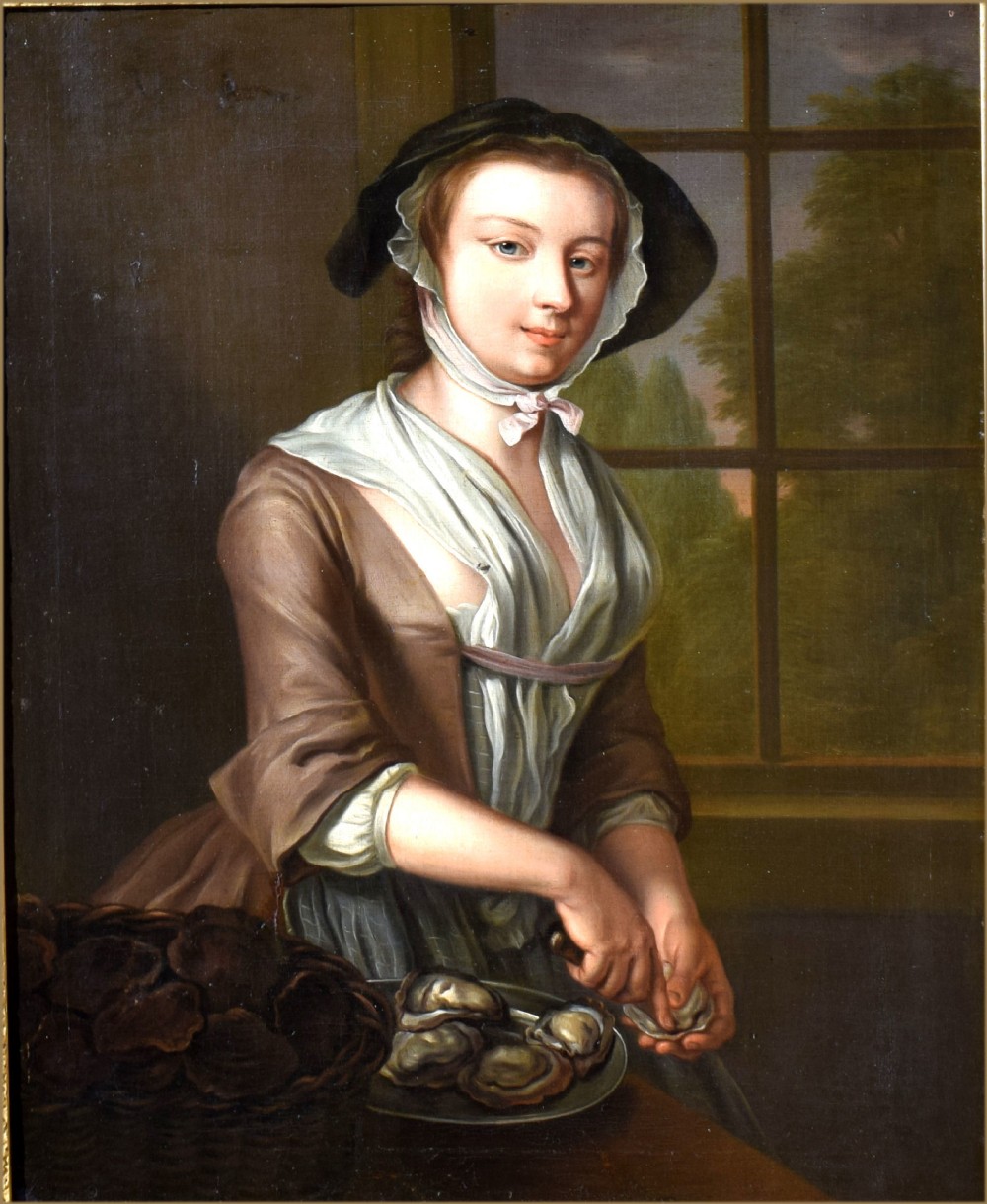
fig 3. An eighteenth-century oil painting depicting a young woman in period attire shucking oysters, housed within an ornate gilded frame.
fig 3. Studio of Philip Mercier, 1689-1760 The Fair Oyster Girl

E.D.G. Johnson, Paintings of the British Street Scene, 1986, pl. 109.

Notes

Mercier settled in England in circa 1716, becoming Principal Painter to Frederick Prince of Wales in 1729. In 1736, however, Mercier was dismissed and escaped London's competitive portraiture market for a more receptive audience in the country. The artist's patrons during this period included the Duke of Leeds, who acquired four pictures; Sir Robert Hildyard of Winestead, who bought a portrait and two 'fancy pictures', and Thomas Worsley, who acquired five portraits (Ingamells and Raines, op. cit., p. 4).

The decade from 1740-50, while he was based in York, was the greatest period of activity for Mercier - over 160 pictures survive from this time. It was during these years that he seemed to turn purposefully towards the 'fancy picture' genre he first started to favour in the late 1730s. The term 'fancy picture' was coined in 1737 by the art critic and historian George Vertue with specific reference to Mercier's work and the influence of French rococo pastoral pictures, such as those of Greuze and Boucher. Employed loosely throughout the 18th century, the phrase 'fancy picture' was used to describe charmingly contrived genre scenes of sentimental realism, incorporating the artist's own whimsy and imagination or references to contemporary literature, with figures shown in various roles and guises.

The rise of the print market at this time furthered the popularity of such pictures, as Hogarth had so successfully demonstrated in the 1730s with The Harlot's Progress and The Rake's Progress. From 1739, Mercier's compositions were widely disseminated through an alliance with John Faber Junior, a well-known printmaker who continued to work with him through the 1750s. Following Faber's death in 1756, Mercier expanded his published work through several other printmakers: McArdell, Purcell, and most notably Richard Houston (1722-1725), who produced single plates of Mercier's work in 1756, 1758 and 1760. Houston engraved The Oyster Girl twice - a testament to its popularity - firstly under the title The Fair Oysterinda and then as Native Meltons. Both were accompanied by the following verse, rather heavy-handedly insinuating that it is perhaps not only the oysters that are for sale: 'The oysters good - The Nymph so fair! Who would not wish to taste her Ware? No need has she aloud to Cry'em Since all who see her Fare must buy'em.'

The iconography derives in part from the European tradition of portraying street vendors, including the characters popularized by Marcellus Laroon's Cryes of the City of London and more contemporaneously Hogarth's The Shrimp Girl (National Gallery, London), but it also relies on themes explored in Dutch 17th century genre painting, where the preparation of food was often associated with the

Height
83cm (32.68")
Width
67cm (26.38")
Depth
2cm (0.79")
Date of Manufacture

Artware Fineart has dated this Georgian Portrait Oil Painting to the 18th Century.

Reference Numbers
Sellingantiques Ref
SA712866
Dealers Internal Ref
4339
Artware Fineart
Sellingantiques verified Since Sep 2008
Dealer Profile

You can view the stock and full dealer information on the Artware Fineart Profile Page

PDF SHARE
SAVE
An eighteenth-century oil painting depicting a young woman in period attire shucking oysters, housed within an ornate gilded frame.
1 / 4
Archive I An eighteenth-century oil painting depicting a young woman in period attire shucking oysters, housed within an ornate gilded frame.

Studio of Philip Mercier, 1689-1760 The Fair Oyster Girl
Archive II An eighteenth-century oil painting depicting a young woman in period attire shucking oysters, housed within an ornate gilded frame. View II
Archive III An eighteenth-century oil painting depicting a young woman in period attire shucking oysters, housed within an ornate gilded frame. View III
Archive IV An eighteenth-century oil painting depicting a young woman in period attire shucking oysters, housed within an ornate gilded frame. View IV
FURTHER BROWSING

Visitors also looked at these ⇣

Enlarged Archival View
Telephone 07958 699 645
Location
18 La Gare
51 Surrey Row
London
SE1 0BZ
United Kingdom
Verified Since Sep 2008
Items For Sale 243
Items Sold 223
Artware Fineart
Verified Since Sep 2008
View Dealer Info
Location: 18 La Gare , 51 Surrey Row , London , SE1 0BZ , United Kingdom
Verified
Sep 2008
For Sale
243
Sold
223
An eighteenth-century oil painting depicting a young woman in period attire shucking oysters, housed within an ornate gilded frame.
Studio of Philip Mercier, 1689-1760 The Fair Oyster Girl
Ref: SA712866
An eighteenth-century oil painting depicting a young woman in period attire shucking oysters, housed within an ornate gilded frame.
Detail View 1
Detail View 2
Detail View 3
Archival Detail
Every single antique dealer on our platform is individually approved by our internal team. We verify their professional trade history, ethical standards, and photographic quality to ensure a secure, high-standard buying environment. Upon joining, every dealer agrees to a strict 9-point code of conduct. While issues can occasionally arise, our dealers typically resolve them swiftly and directly with the buyer. In fact, since our founding in 2002, Sellingantiques has only had to step in to help resolve an issue on roughly five occasions—a true testament to the quality of our dealers and their dedication to your happiness.
Our dealers are highly experienced in packing and shipping fragile, high-value antiques. Because you are in direct contact with the dealer, you will be able to easily go through all available shipping and insurance options together to ensure your item arrives safely.
Antiques are the ultimate green purchase. By choosing historical pieces over newly manufactured goods, you completely eliminate the carbon footprint of modern mass production while preserving exceptional, timeless craftsmanship.

Popularised during the eighteenth century, Georgian genre portraiture captures scenes of daily life, working trades, and domestic activities, distinct from formal aristocratic portraiture.

Artists utilized hand-ground oil pigments on hand-woven linen canvas, often housed within carved wooden frames finished with gold leaf gilded surfaces.

Authentic period paintings feature natural age-related craquelure across the paint layer, original wooden stretchers with hand-tacked canvas edges, and historical gilding on timber frames.

Position the portrait as a focal point above a mantelpiece or console table, allowing the gilded frame to contrast against neutral modern backgrounds or dark heritage walls.

Display the painting away from direct sunlight, radiators, and high humidity, dusting the gilt frame gently with a soft dry brush to prevent material degradation.
items
Add keywords to the filter
Price
£100
£250000
Era
Movements
Material
Origin
Stock Location
Freshness
Online Payments
Categories