15,294  PAGES BROWSED TODAY PAGES TODAY 36  ANTIQUES UPLOADED TODAY NEW ARRIVALS
ID #SA299641
FOR SALE
£4,500
Email
Save
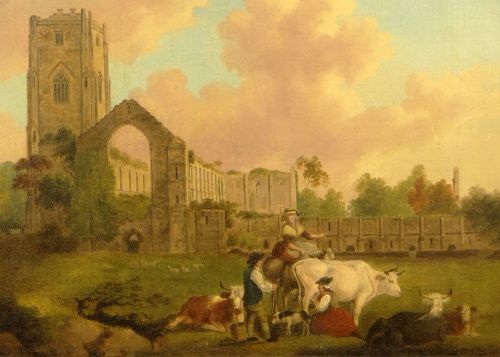
Julius Ceaser Ibbetson 1759 - 1817 a View of Fountains Abbey with a Milkmaid Milking a Cow in the Foreground
Artware Fineart
for sale €5,265     $5,715
£4,500

Artware Fineart

Sellingantiques Verified Since Sep 2008
View Dealers Stock Page
Id #SA299641
PDF SHARE
SAVE

Julius Ceaser Ibbetson 1759 - 1817 a View of Fountains Abbey with a Milkmaid Milking a Cow in the Foreground

19th century
For Sale by Artware Fineart
Description

Julius Ceaser Ibbetson 1759 - 1817

A View of Fountains Abbey with a Milkmaid milking a Cow in the foreground

oil on canvas

18.31 x 26.46 in. (46.50 x 67.20 cm.)

Provenance : Christies, 14th April 1950, Lot 1032, bt Manuadpour 3 Gns

After a dispute and riot in 1132 at the Benedictine house, St Mary's Abbey, in York, 13 monks were expelled and, after unsuccessfully attempting to return to the early 6th-century Rule of St Benedict, were taken into the protection of Thurstan, Archbishop of York.He provided them with land in the valley of the River Skell, a tributary of the Ure. The enclosed valley had all the natural features needed for the creation of a monastery, providing shelter from the weather, stone and timber for building, and a supply of running water. After enduring a harsh winter in 1133, the monks applied to join the Cistercian order and in 1135 became the second house of that order in northern England, after Rievaulx. The monks subjected themselves to Clairvaux Abbey, in Burgundy which was under the rule of St Bernard. Under the guidance of Geoffrey of Ainai, a monk sent from Clairvaux, the group learned how to celebrate the seven Canonical Hours and were shown how to construct wooden buildings in accordance with Cistercian practice. After Henry Murdac was elected to the abbacy in 1143, the small stone church and timber claustral buildings were replaced. Within three years, an aisled nave had been added to the stone church, and the first permanent claustral buildings built in stone and roofed in tile had been completed.
In 1146 an angry mob, displeased with Murdac's role in opposing the election of William FitzHerbert to the archbishopric of York, attacked the abbey and burnt down all but the church and some surrounding buildings.The community recovered swiftly from the attack and founded four daughter houses. Henry Murdac resigned the abbacy in 1147 to become the Archbishop of York and was replaced first by Maurice, Abbot of Rievaulx then, on the resignation of Maurice, by Thorald. Thorald was forced by Henry Murdac to resign after two years in office. The next abbot, Richard, held the post until his death in 1170 and restored the abbey's stability and prosperity. In 20 years as abbot, he supervised a huge building programme which involved completing repairs to the damaged church and building more accommodation for the increasing number of recruits. Only the chapter house was completed before he died and the work was ably continued by his successor, Robert of Pipewell, under whose rule the abbey gained a reputation for caring for the needy.The next abbot was William who presided over the abbey from 1180 to 1190 and he was succeeded by Ralph Haget, who had entered Fountains at the age of 30 as a novice, after pursuing a military career. During the European famine of 1194 Haget ordered the construction of shelters in the vicinity of the abbey and provided daily food rations to the poor enhancing the abbey's reputation for caring for the poor and attracting more grants from wealthy benefactors.
In the first half of the 13th century Fountains increased in reputation and prosperity under the next three abbots, John of York (1203–1211), John of Hessle (1211–1220) and John of Kent (1220–1247). They were burdened with an inordinate amount of administrative duties and increasing demands for money in taxation and levies but managed to complete another massive expansion of the abbey's buildings. This included enlarging the church and building an infirmary. In the second half of the 13th century the abbey was in more straitened circumstances. It was presided over by eleven abbots, and became financially unstable largely due to forward selling its wool crop, and the abbey was criticised for its dire material and physical state when it was visited by Archbishop John Romeyn in 1294. The run of disasters that befell the community continued into the early 14th century when northern England was invaded by

Physical Dimensions
Height
54cm (21.26")
Width
75cm (29.53")
Depth
3cm (1.18")
Declaration

Artware Fineart has dated this Georgian Landscape Oil Painting to the 1800s.

Reference Numbers
Sellingantiques Reference
SA299641
Dealers Internal Reference
3673
Description
Julius Ceaser Ibbetson 1759 - 1817

A View of Fountains Abbey with a Milkmaid milking a Cow in the foreground

oil on canvas

18.31 x 26.46 in. (46.50 x 67.20 cm.)

Provenance : Christies, 14th April 1950, Lot 1032, bt Manuadpour 3 Gns

After a dispute and riot in 1132 at the Benedictine house, St Mary's Abbey, in York, 13 monks were expelled and, after unsuccessfully attempting to return to the early 6th-century Rule of St Benedict, were taken into the protection of Thurstan, Archbishop of York.He provided them with land in the valley of the River Skell, a tributary of the Ure.

The enclosed valley had all the natural features needed for the creation of a monastery, providing shelter from the weather, stone and timber for building, and a supply of running water.
Artware Fineart

After enduring a harsh winter in 1133, the monks applied to join the Cistercian order and in 1135 became the second house of that order in northern England, after Rievaulx. The monks subjected themselves to Clairvaux Abbey, in Burgundy which was under the rule of St Bernard. Under the guidance of Geoffrey of Ainai, a monk sent from Clairvaux, the group learned how to celebrate the seven Canonical Hours and were shown how to construct wooden buildings in accordance with Cistercian practice. After Henry Murdac was elected to the abbacy in 1143, the small stone church and timber claustral buildings were replaced. Within three years, an aisled nave had been added to the stone church, and the first permanent claustral buildings built in stone and roofed in tile had been completed.

fig 1. An 18th-century oil painting depicting the ruined gothic arch and tower of Fountains Abbey with cattle and figures in a green pastoral field.
fig 1. Julius Ceaser Ibbetson 1759 - 1817 a View of Fountains Abbey with a Milkmaid Milking a Cow in the Foreground

In 1146 an angry mob, displeased with Murdac's role in opposing the election of William FitzHerbert to the archbishopric of York, attacked the abbey and burnt down all but the church and some surrounding buildings.The community recovered swiftly from the attack and founded four daughter houses. Henry Murdac resigned the abbacy in 1147 to become the Archbishop of York and was replaced first by Maurice, Abbot of Rievaulx then, on the resignation of Maurice, by Thorald. Thorald was forced by Henry Murdac to resign after two years in office. The next abbot, Richard, held the post until his death in 1170 and restored the abbey's stability and prosperity. In 20 years as abbot, he supervised a huge building programme which involved completing repairs to the damaged church and building more accommodation for the increasing number of recruits. Only the chapter house was completed before he died and the work was ably continued by his successor, Robert of Pipewell, under whose rule the abbey gained a reputation for caring for the needy.The next abbot was William who presided over the abbey from 1180 to 1190 and he was succeeded by Ralph Haget, who had entered Fountains at the age of 30 as a novice, after pursuing a military career. During the European famine of 1194 Haget ordered the construction of shelters in the vicinity of the abbey and provided daily food rations to the poor enhancing the abbey's reputation for caring for the poor and attracting more grants from wealthy benefactors.

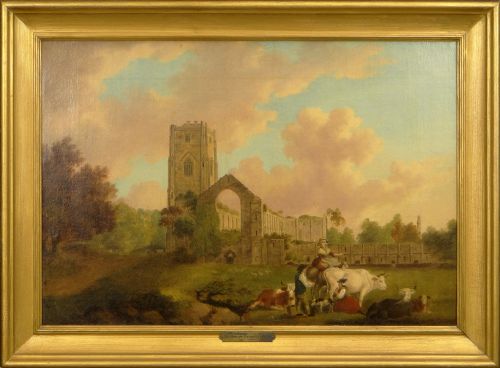
fig 2. An 18th-century oil painting depicting the ruined gothic arch and tower of Fountains Abbey with cattle and figures in a green pastoral field.
fig 2. Julius Ceaser Ibbetson 1759 - 1817 a View of Fountains Abbey with a Milkmaid Milking a Cow in the Foreground

In the first half of the 13th century Fountains increased in reputation and prosperity under the next three abbots, John of York (1203–1211), John of Hessle (1211–1220) and John of Kent (1220–1247). They were burdened with an inordinate amount of administrative duties and increasing demands for money in taxation and levies but managed to complete another massive expansion of the abbey's buildings. This included enlarging the church and building an infirmary. In the second half of the 13th century the abbey was in more straitened circumstances. It was presided over by eleven abbots, and became financially unstable largely due to forward selling its wool crop, and the abbey was criticised for its dire material and physical state when it was visited by Archbishop John Romeyn in 1294. The run of disasters that befell the community continued into the early 14th century when northern England was invaded by

Height
54cm (21.26")
Width
75cm (29.53")
Depth
3cm (1.18")
Date of Manufacture

Artware Fineart has dated this Georgian Landscape Oil Painting to the 1800s.

Reference Numbers
Sellingantiques Ref
SA299641
Dealers Internal Ref
3673
Artware Fineart
Sellingantiques verified Since Sep 2008
Dealer Profile

You can view the stock and full dealer information on the Artware Fineart Profile Page
PDF SHARE
SAVE
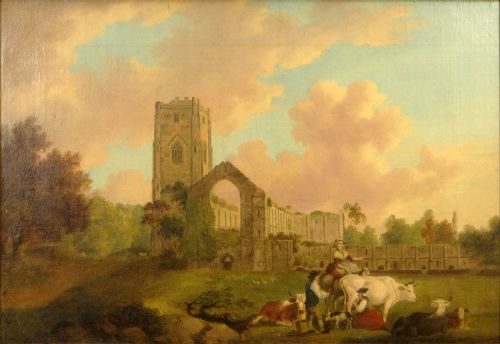
An 18th-century oil painting depicting the ruined gothic arch and tower of Fountains Abbey with cattle and figures in a green pastoral field.
1 / 4
Archive I An 18th-century oil painting depicting the ruined gothic arch and tower of Fountains Abbey with cattle and figures in a green pastoral field.

Julius Ceaser Ibbetson 1759 - 1817 a View of Fountains Abbey with a Milkmaid Milking a Cow in the Foreground
Archive II An 18th-century oil painting depicting the ruined gothic arch and tower of Fountains Abbey with cattle and figures in a green pastoral field. View II
Archive III An 18th-century oil painting depicting the ruined gothic arch and tower of Fountains Abbey with cattle and figures in a green pastoral field. View III
Archive IV An 18th-century oil painting depicting the ruined gothic arch and tower of Fountains Abbey with cattle and figures in a green pastoral field. View IV
FURTHER BROWSING

Visitors also looked at these ⇣

Enlarged Archival View
Telephone 07958 699 645
Location
18 La Gare
51 Surrey Row
London
SE1 0BZ
United Kingdom
Verified Since Sep 2008
Items For Sale 243
Items Sold 223
Artware Fineart
Verified Since Sep 2008
View Dealer Info
Location: 18 La Gare , 51 Surrey Row , London , SE1 0BZ , United Kingdom
Verified
Sep 2008
For Sale
243
Sold
223
An 18th-century oil painting depicting the ruined gothic arch and tower of Fountains Abbey with cattle and figures in a green pastoral field.
Julius Ceaser Ibbetson 1759 - 1817 A View of Fountains Abbey with a Milkmaid milking a Cow in the foreground
Ref: SA299641
An 18th-century oil painting depicting the ruined gothic arch and tower of Fountains Abbey with cattle and figures in a green pastoral field.
Detail View 1
Detail View 2
Detail View 3
Archival Detail
Every single antique dealer on our platform is individually approved by our internal team. We verify their professional trade history, ethical standards, and photographic quality to ensure a secure, high-standard buying environment. Upon joining, every dealer agrees to a strict 9-point code of conduct. While issues can occasionally arise, our dealers typically resolve them swiftly and directly with the buyer. In fact, since our founding in 2002, Sellingantiques has only had to step in to help resolve an issue on roughly five occasions—a true testament to the quality of our dealers and their dedication to your happiness.
Our dealers are highly experienced in packing and shipping fragile, high-value antiques. Because you are in direct contact with the dealer, you will be able to easily go through all available shipping and insurance options together to ensure your item arrives safely.
Antiques are the ultimate green purchase. By choosing historical pieces over newly manufactured goods, you completely eliminate the carbon footprint of modern mass production while preserving exceptional, timeless craftsmanship.

British landscape paintings of the 18th century frequently combined idealized natural scenery with elements of national heritage, such as gothic abbey ruins and rural pastoral life. Artists focused on atmospheric light, classical composition, and detailed depictions of livestock and agricultural workers.

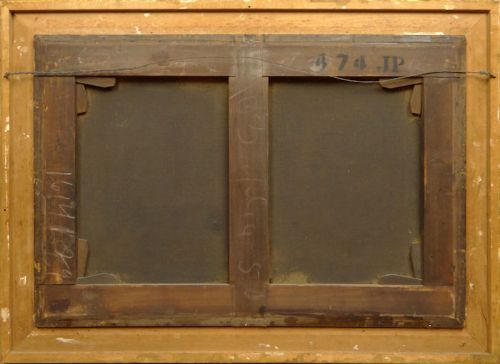
Paintings from this era were created using hand-ground mineral and organic pigments mixed with linseed or walnut oil, applied directly onto hand-stretched linen or cotton canvas frames secured with wooden keys.

Authentic pieces generally exhibit age-appropriate craquelure patterns across the paint layer, natural oxidisation on the reverse of the canvas, hand-carved or turned wooden stretcher frames, and subtle brushwork characteristic of traditional glazing methods.

Integrate classical landscape art by mounting it above a focal fireplace or sideboard, pairing it with dark timber panelling or neutral walls, and illuminating it with a low-voltage brass picture light.

Display the painting away from direct sunlight, dampness, and heat sources. Clean gently using a dry, soft camel-hair brush to remove surface dust, and consult a professional conservator for varnish restoration.
items
Add keywords to the filter
Price
£100
£250000
Era
Movements
Material
Origin
Stock Location
Freshness
Online Payments
Categories