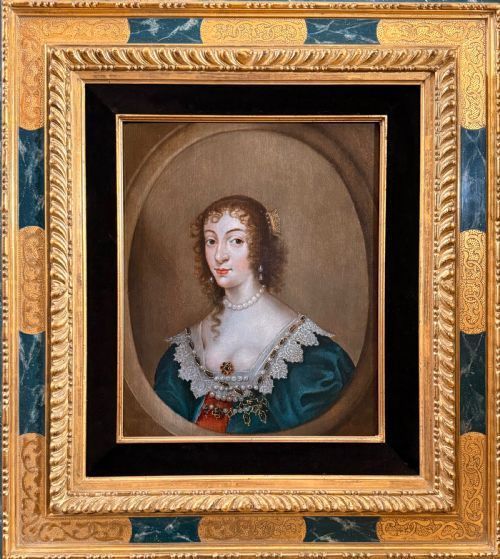
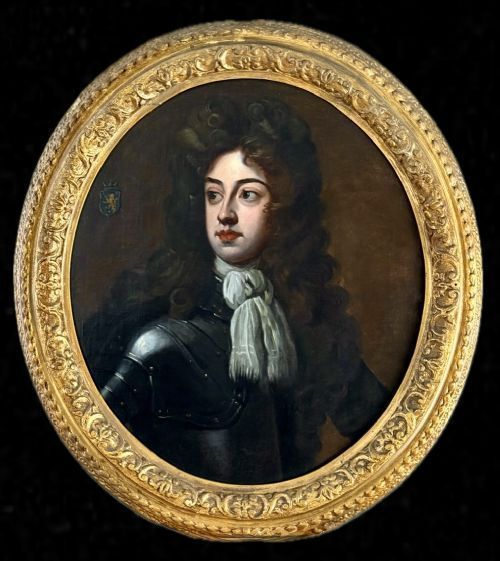
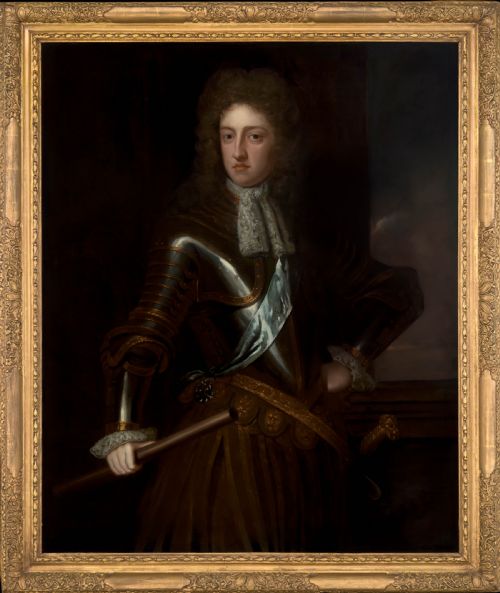
Cheshire Antiques Consultant Ltd has dated this 17th Century Oil Portrait to the 17th Century.
Subject & Medium
Oil on canvas, late 17th century.
Although no surviving documentary evidence confirms the sitter.

Attributed to the Circle of Sir Godfrey Kneller (1646–1723), Principal Painter to the Crown, this work exemplifies the grandeur, cultivated elegance, and aristocratic authority characteristic of Restoration-era English portrait painting.

Composition & Technique
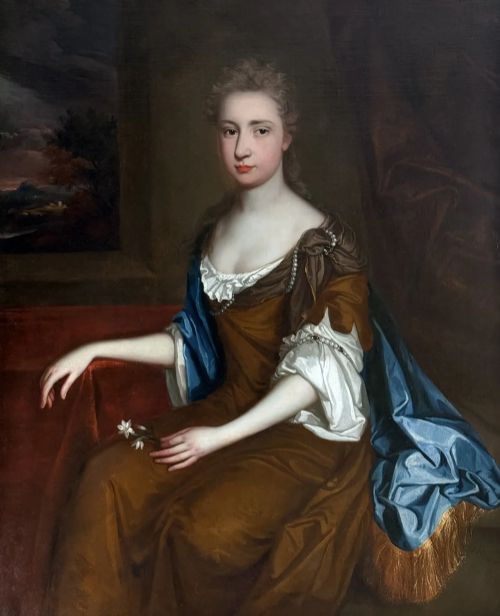
The sitter is portrayed three-quarter length in a commanding vertical format typical of late 17th century English aristocratic portraiture. Her torso is angled outward while her head turns gently toward the viewer, conveying composure, dignity, and elevated rank.

Her richly painted golden silk gown dominates the composition, articulated in sweeping folds of amber and burnished ochre. Subtle glazing and careful tonal modelling convincingly convey the sheen and texture of fine silk. Crisp white lace cuffs and chemise sleeves provide refined contrast against the warmth of the drapery.

The flesh tones are delicately blended, producing the smooth, idealised refinement associated with portraiture from Kneller’s artistic circle.
The background reveals a romanticised river landscape beneath a warm sunset sky — a classic device in English Baroque portrait painting symbolising landed status, cultivation, and continuity.

The overall execution demonstrates clarity of composition, decorative richness, and controlled theatricality consistent with works produced within Kneller’s stylistic sphere.
About the Sitter
If the traditional identification is correct, Elizabeth, Countess of Westmorland belonged to one of England’s established noble families during a period of significant political and cultural transformation.

Her life coincided with the Restoration of the monarchy in 1660, when aristocratic portraiture became central to reaffirming dynastic legitimacy following years of upheaval.
She is recorded as having died at approximately nineteen years of age. During the Restoration period, early death among members of the nobility often resulted in the commissioning of idealised commemorative portraits designed to preserve youth, beauty, and family lineage.

The serene expression and luminous presentation seen in this portrait are consistent with that tradition.
Historical Context
Sir Godfrey Kneller’s influence shaped the visual identity of Britain’s ruling elite during the late 17th and early 18th centuries. Portraits from his studio and circle established the standard for aristocratic representation in England for decades.

Large formal portraits such as this were originally intended for display in the principal reception rooms of country houses and London town residences, serving as architectural statements of lineage and inherited authority.

Today, monumental English Baroque oil paintings remain highly desirable among collectors of Old Master paintings and period English antiques.
About the Artist – Circle of Sir Godfrey Kneller
This painting is attributed to the Circle of Sir Godfrey Kneller, indicating execution by a contemporary artist closely associated with and strongly influenced by Kneller’s style.

Born in Lübeck, Kneller trained in the Dutch Baroque tradition before settling in England in 1676. He was appointed Principal Painter to the Crown after the accession of William and Mary in 1688, later knighted and created a Baronet.
His studio became the dominant portrait workshop of Restoration England. Works attributed to his circle maintain the compositional elegance, refined modelling, and decora
Cheshire Antiques Consultant Ltd has dated this 17th Century Oil Portrait to the 17th Century.
Source the historic in 17th, 18th, 19th & 20th century fine arts, painting, sculptures & collectibles
You can view the stock and full dealer information on the Cheshire Antiques Consultant Ltd Profile Page

17th Century Baroque Oil Portrait Countess of Westmorland Circle of Sir Godfrey Kneller