41,419  PAGES BROWSED TODAY PAGES TODAY 98  ANTIQUES UPLOADED TODAY NEW ARRIVALS
ID #SA1150331
FOR SALE
£1,450
Email
Save
Yew Wood 19th Century Childs Windsor Armchair
S and S Timms Antiques Ltd
for sale €1,697     $1,842
£1,450
S and S Timms Antiques Ltd

S and S Timms Antiques Ltd

Sellingantiques Verified Since Sep 2007
View Dealers Stock Page
  • Trade Associations
    S and S Timms Antiques Ltd is a registered member of LAPADA  BADA  CINOA
Id #SA1150331
PDF SHARE
SAVE

Yew Wood 19th Century Childs Windsor Armchair

18th century
Description

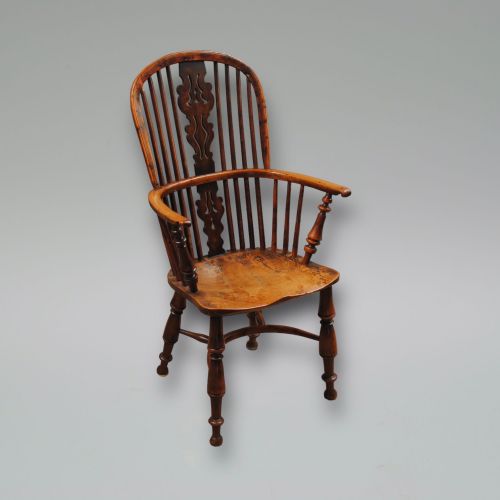
A Very Good Quality And Extremely Charming Early 19th Century Yew Wood, Ash & Elm Childs Windsor Armchair, Having Elegant Hooped Back With Pierced & Shaped Central Splat Flanked By Turned Upright Supports, Over Well Figured Shaped Seat, Raised On Elegant Turned Legs United By Rare Crinoline Stretcher. 

This beautiful childs windsor chair is constructed from yew wood which is a really good feature and it also boasts a crinoline stretcher. Not all windsor chairs had crinoline stretchers, especially childs examples, and most have standard H stretchers to support the legs, but there is something incredibly elegant about the swept crinoline stretchers. It is believed the term crinoline is borrowed from the crinoline petticoats which 19th century ladies would utilise below their dresses to enhance their silhouette.

Generally Windsor chairs are one of the most widely produced, widely used and widely loved items of antique furniture. They come in just about every design, size, quality, timber and period that its possible to imagine, with windsor chairs still being constructed to this very day and often costing more to purchase than the antique versions.

There is evidence of the first windsor chairs in the late 16th century, but they were very much popularised at the very end of the 18th century and early 19th century onwards. Always constructed from woods which were freely available in the UK, allowing for constant, plentiful supply they are most often found in ash and elm, sometimes fruitwood and least often in yew wood. Therefore the yew wood examples are nearly always the most sought after and best quality.

It is also rarer to find childs examples in yew wood, as naturaly being the highest regarded wood for construction, yew wood was also the most expensive and most families would not wish to splash out on that for a childs chair.

ASs with all items which we offer for sale this georgian childs chair has been inspected by our highly skilled, trained antique furniture restorers and received a natural wax polish before being placed on sale, ensuring that it is in its best possible condition and ready for immediate placement within the home following purchase. 

Circa 1820. 

Height 25in. 

Width 18in. 

Depth 13in. 

Seat Height 11in. 

Declaration

S and S Timms Antiques Ltd has dated this Antique Child Windsor Chair to the Georgian era.

Reference Numbers
Sellingantiques Reference
SA1150331
Dealers Internal Reference
9509
Dealers Notes

A Careful Selection Of High Quality Town And Country Furniture For The Home From The 17th, 18th, 19th And Early 20th Centuries.

Members Of BADA, LAPADA & CINOA.

UK Delivery Available At Reasonable Rates.

Worldwide Shipping Arranged.

Description
A Very Good Quality And Extremely Charming Early 19th Century Yew Wood, Ash & Elm Childs Windsor Armchair, Having Elegant Hooped Back With Pierced & Shaped Central Splat Flanked By Turned Upright Supports, Over Well Figured Shaped Seat, Raised On Elegant Turned Legs United By Rare Crinoline Stretcher. 
This beautiful childs windsor chair is constructed from yew wood which is a really good feature and it also boasts a crinoline stretcher.
S and S Timms Antiques Ltd

Not all windsor chairs had crinoline stretchers, especially childs examples, and most have standard H stretchers to support the legs, but there is something incredibly elegant about the swept crinoline stretchers. It is believed the term crinoline is borrowed from the crinoline petticoats which 19th century ladies would utilise below their dresses to enhance their silhouette.

fig 1. A 19th-century childs Windsor armchair crafted from yew wood, featuring a hoop back with a pierced fretwork splat, turned legs, and a curved stretcher.
fig 1. Yew Wood 19th Century Childs Windsor Armchair

Generally Windsor chairs are one of the most widely produced, widely used and widely loved items of antique furniture. They come in just about every design, size, quality, timber and period that its possible to imagine, with windsor chairs still being constructed to this very day and often costing more to purchase than the antique versions.

fig 2. A 19th-century childs Windsor armchair crafted from yew wood, featuring a hoop back with a pierced fretwork splat, turned legs, and a curved stretcher.
fig 2. Yew Wood 19th Century Childs Windsor Armchair

There is evidence of the first windsor chairs in the late 16th century, but they were very much popularised at the very end of the 18th century and early 19th century onwards. Always constructed from woods which were freely available in the UK, allowing for constant, plentiful supply they are most often found in ash and elm, sometimes fruitwood and least often in yew wood. Therefore the yew wood examples are nearly always the most sought after and best quality.

fig 3. A 19th-century childs Windsor armchair crafted from yew wood, featuring a hoop back with a pierced fretwork splat, turned legs, and a curved stretcher.
fig 3. Yew Wood 19th Century Childs Windsor Armchair

It is also rarer to find childs examples in yew wood, as naturaly being the highest regarded wood for construction, yew wood was also the most expensive and most families would not wish to splash out on that for a childs chair.

fig 4. A 19th-century childs Windsor armchair crafted from yew wood, featuring a hoop back with a pierced fretwork splat, turned legs, and a curved stretcher.
fig 4. Yew Wood 19th Century Childs Windsor Armchair

ASs with all items which we offer for sale this georgian childs chair has been inspected by our highly skilled, trained antique furniture restorers and received a natural wax polish before being placed on sale, ensuring that it is in its best possible condition and ready for immediate placement within the home following purchase. 

Circa 1820. 

Height 25in. 

Width 18in. 

Depth 13in. 

Seat Height 11in. 

Date of Manufacture

S and S Timms Antiques Ltd has dated this Antique Child Windsor Chair to the Georgian era.

Reference Numbers
Sellingantiques Ref
SA1150331
Dealers Internal Ref
9509
S and S Timms Antiques Ltd
Sellingantiques verified Since Sep 2007
Dealer Profile

You can view the stock and full dealer information on the S and S Timms Antiques Ltd Profile Page

Trade Associations

S and S Timms Antiques Ltd is a registered member of LAPADA  BADA  CINOA

PDF SHARE
SAVE
A 19th-century childs Windsor armchair crafted from yew wood, featuring a hoop back with a pierced fretwork splat, turned legs, and a curved stretcher.
1 / 12
Archive I A 19th-century childs Windsor armchair crafted from yew wood, featuring a hoop back with a pierced fretwork splat, turned legs, and a curved stretcher.

Yew Wood 19th Century Childs Windsor Armchair

Archive II A 19th-century childs Windsor armchair crafted from yew wood, featuring a hoop back with a pierced fretwork splat, turned legs, and a curved stretcher. View II
Archive III A 19th-century childs Windsor armchair crafted from yew wood, featuring a hoop back with a pierced fretwork splat, turned legs, and a curved stretcher. View III
Archive IV A 19th-century childs Windsor armchair crafted from yew wood, featuring a hoop back with a pierced fretwork splat, turned legs, and a curved stretcher. View IV
Archive V A 19th-century childs Windsor armchair crafted from yew wood, featuring a hoop back with a pierced fretwork splat, turned legs, and a curved stretcher. View V
Archive VI A 19th-century childs Windsor armchair crafted from yew wood, featuring a hoop back with a pierced fretwork splat, turned legs, and a curved stretcher. View VI
Archive VII A 19th-century childs Windsor armchair crafted from yew wood, featuring a hoop back with a pierced fretwork splat, turned legs, and a curved stretcher. View VII
Archive VIII A 19th-century childs Windsor armchair crafted from yew wood, featuring a hoop back with a pierced fretwork splat, turned legs, and a curved stretcher. View VIII
Archive IX A 19th-century childs Windsor armchair crafted from yew wood, featuring a hoop back with a pierced fretwork splat, turned legs, and a curved stretcher. View IX
Archive X A 19th-century childs Windsor armchair crafted from yew wood, featuring a hoop back with a pierced fretwork splat, turned legs, and a curved stretcher. View X
Archive XI A 19th-century childs Windsor armchair crafted from yew wood, featuring a hoop back with a pierced fretwork splat, turned legs, and a curved stretcher. View XI
Archive XII A 19th-century childs Windsor armchair crafted from yew wood, featuring a hoop back with a pierced fretwork splat, turned legs, and a curved stretcher. View XII
FURTHER BROWSING

Visitors also looked at these ⇣

Enlarged Archival View
Location
PO BOX 813
Ampthill
Bedfordshire
MK45 9AW
United Kingdom
Dealer Profile Page sellingantiques.co.uk/ss
Verified Since Sep 2007
Items For Sale 292
Items Sold 6
S and S Timms Antiques Ltd
Verified Since Sep 2007
View Dealer Info
Location: PO BOX 813, Ampthill, Bedfordshire, MK45 9AW, United Kingdom
Verified
Sep 2007
For Sale
292
Sold
6
A 19th-century childs Windsor armchair crafted from yew wood, featuring a hoop back with a pierced fretwork splat, turned legs, and a curved stretcher.
Yew Wood 19th Century Childs Windsor Armchair
Ref: SA1150331
A 19th-century childs Windsor armchair crafted from yew wood, featuring a hoop back with a pierced fretwork splat, turned legs, and a curved stretcher.
Detail View 1
Detail View 2
Detail View 3
Detail View 4
Detail View 5
Detail View 6
Detail View 7
Detail View 8
Detail View 9
Detail View 10
Detail View 11
Archival Detail
Every single antique dealer on our platform is individually approved by our internal team. We verify their professional trade history, ethical standards, and photographic quality to ensure a secure, high-standard buying environment. Upon joining, every dealer agrees to a strict 9-point code of conduct. While issues can occasionally arise, our dealers typically resolve them swiftly and directly with the buyer. In fact, since our founding in 2002, Sellingantiques has only had to step in to help resolve an issue on roughly five occasions—a true testament to the quality of our dealers and their dedication to your happiness.
Our dealers are highly experienced in packing and shipping fragile, high-value antiques. Because you are in direct contact with the dealer, you will be able to easily go through all available shipping and insurance options together to ensure your item arrives safely.
Antiques are the ultimate green purchase. By choosing historical pieces over newly manufactured goods, you completely eliminate the carbon footprint of modern mass production while preserving exceptional, timeless craftsmanship.

Originating in England during the early 18th century, Windsor chairs were developed as regional vernacular furniture. Characterised by steam-bent wood spindles and legs socketed directly into a carved wooden seat, these pieces were produced by country craftspeople using locally sourced timbers.

Traditional English Windsor chairs were built using a combination of woods, frequently incorporating yew for bent components like the hoop back and arms, alongside elm for the seat. Construction relied on steam bending, wood turning, and wedged mortise-and-tenon joints without relying on complex timber frames.

Authentic 19th-century examples display irregular hand-turned legs, hand-carved splats, wedged tenon joints visible on top of the seat, and natural wear patterns on the stretchers and armrests. The timber will show historical shrinkage around joinery and developed surface patination.

A child-sized Windsor chair serves as an accent piece beside a fireplace, positioned within an entryway, or displayed in a bedroom. Its compact scale and warm timber tone complement both traditional country schemes and minimalist contemporary settings.

Preservation involves regular dusting with a soft cloth and periodic application of natural beeswax polish to protect the finish. The chair should be kept away from direct heat sources and high humidity to prevent timber splitting or joint movement.
items
Add keywords to the filter
Price
£100
£250000
Era
Movements
Material
Origin
Stock Location
Freshness
Online Payments
Categories