



Yorkshire Coastal Landscape Art
Yorkshire coastal landscape art captures the rugged cliffs, bustling harbours, and maritime heritage of the northern shores through the eyes of regional painters.
Yorkshire Coastal Landscape Art
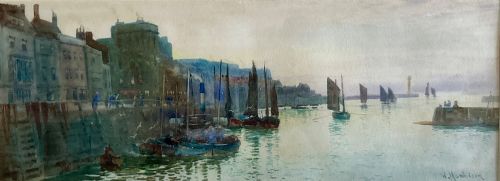
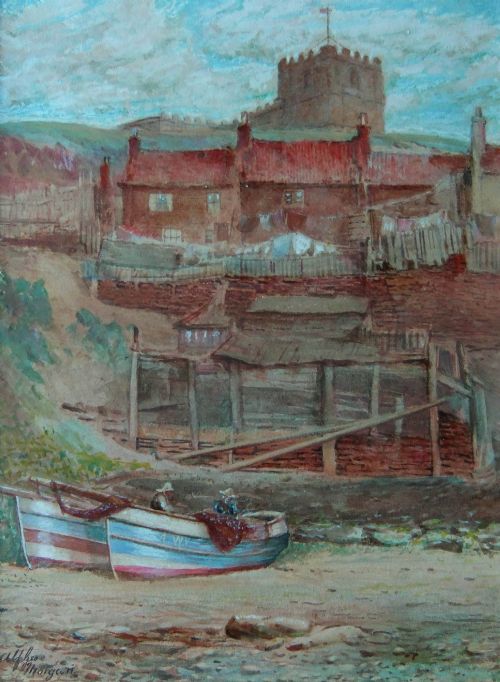
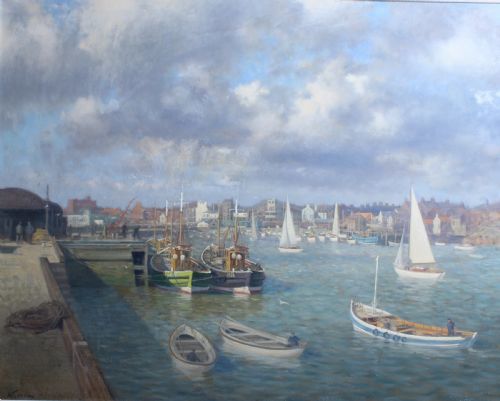
Yorkshire coastal landscape art encompasses paintings depicting iconic locations such as Whitby, Scarborough, Staithes, and Robin Hood's Bay. These works document local scenes ranging from fishing docks and sandy bays to cliffside villages and historic abbeys.
The selections available here lean heavily towards works executed on paper and canvas, spanning the Victorian era through the mid-20th century. Watercolour paintings and oil works dominate the selection, reflecting the preferred mediums of British landscape artists working along the North Sea coast.
Materials and technique
Artists utilised watercolour pigment on paper to capture the transient light and atmospheric weather of the North Yorkshire coast, often building translucent washes for skies and textured applications for breaking waves. Alternatively, oil paint applied to canvas, board, or panel offered a heavier body of pigment suited to capturing the robust textures of stone harbour walls and turbulent seas.
Framed within periods spanning turn-of-the-century academic traditions to mid-century British modernism, these paintings rely on direct observation of local topography. The application ranges from the precise detail favoured in Victorian realism to the looser brushwork characteristic of British Impressionism and regional art colonies.
Yorkshire Coastal Landscape Art Retail Price Guide 2026
Typical asking prices for yorkshire coastal landscape art among the pieces listed under this phrase on Sellingantiques today, from the lower quarter to the upper quarter. They describe what is for sale here now, not the wider market.
Surviving works employ watercolour pigment and oil paint across paper, canvas, board, and wooden panels.
Distinctions in quality
Quality in these coastal paintings rests upon the artist's ability to render atmospheric conditions and spatial depth convincingly, distinguishing hurried topographical records from accomplished plein-air studies. The handling of natural light on water and the structural integrity of cliff formations reveal the technical assurance of the hand behind the brush.
Provenance and documentation also separate standard regional watercolours from significant pieces by recognised names associated with local art groups, such as the Staithes Art Club. Stronger examples display deliberate compositional framing and a confident command over pigment, whether working in fluid watercolour or substantial oil.
Alfred G. Morgan·William Matthison·Walter Goodin·F A Roylance·Arthur Tucker·Robert Leslie Howey·Tom Clough·James Watson·Florence Hess·George Hamilton Constantine·James Thomas Watts·Frederick William Booty·Kate E Booth·Frederick Williamson·Percy Brooke·Alfred Robert Quinton·William Kay Blacklock·Rowland Henry Hill·Harry Wanless·Thomas Clavering Alder·Joseph Newington Carter·William Moore Junior·Robert Farren·Walter Emsley·Frank Rousse
The Yorkshire Coastal Landscape Art Glossary
- Watercolour
- A paint consisting of colour suspended in a water-soluble vehicle, traditionally applied to paper to achieve luminous washes.
- Plein-air
- The practice of painting outdoors to directly capture the actual light and transient qualities of a specific landscape.
- Coble
- A traditional type of open fishing boat native to the north-east coast of England, frequently featured in regional marine art.
- Impressionism
- A style of painting emphasising light and its changing qualities rather than minute detail, often utilising visible brush strokes.
Yorkshire Coastal Landscape Art: Frequently Asked Questions
What subjects appear most often in Yorkshire coastal art?
Harbours, fishing fleets, and cliffside villages dominate the imagery, particularly around Whitby and Staithes. Artists frequently recorded local vessels, bustling markets, and coastal landmarks like abbey ruins.
These scenes reflect the maritime economy and rugged geography that drew generations of painters to the North Yorkshire coast.
How do watercolours and oils differ in these coastal works?
Watercolours on paper offer a lighter, more translucent quality well suited to capturing sea mists and changing skies. Oil paintings on canvas or board provide heavier texture and richer colour saturation for rocky cliffs and turbulent water.
Both mediums were actively utilised by regional painters depending on their preferred working method.
Which periods are best represented in this art?
The selection is anchored primarily in the late 19th century and the early decades of the 20th century. Victorian realism gives way progressively to turn-of-the-century British fine art and mid-century interpretations.
This timeframe covers the active years of notable regional art groups and plein-air painters.
How should I care for vintage watercolours?
Works on paper require protection from direct sunlight to prevent the watercolour pigments from fading over time. Glazing with conservation-grade framing materials helps shield the paper from environmental moisture and pollutants.
Keeping them away from damp exterior walls ensures the paper support remains stable.